Is Thermostat and AC the Same? A Practical Guide
Explore whether a thermostat and AC are the same, with an objective, practical comparison. Learn roles, setups, and how to choose compatible cooling controls for 2026.


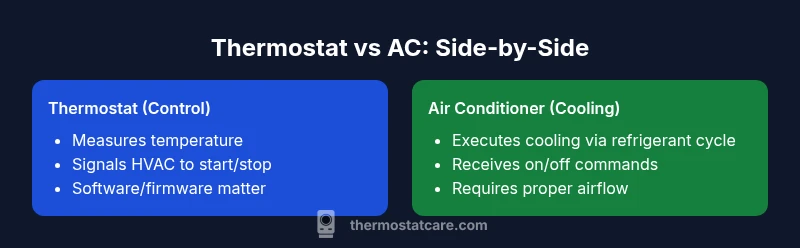
If you’re asking is thermostat and ac same, the answer is no. A thermostat is a control device that signals the HVAC system to turn heating or cooling on or off, while an air conditioner is the actual cooling unit that lowers air temperature. In most homes the thermostat manages the central AC, but they are distinct components with different functions. This quick comparison highlights the key differences and what you should consider when upgrading or troubleshooting in 2026. According to Thermostat Care, many homeowners confuse these terms, leading to mismatched expectations and unnecessary replacements. Understanding these roles sets the foundation for smarter decisions about comfort, efficiency, and maintenance.
Understanding the Role of a Thermostat vs an Air Conditioner
In plain language, many homeowners ask if is thermostat and ac same. The simple answer is no. A thermostat is a control device that senses room temperature and signals the HVAC system to start heating or cooling based on the setpoint. An air conditioner, by contrast, is a cooling component (compressor, condenser, evaporator) that actually lowers air temperature. In most homes the thermostat orchestrates the central AC, but the two are not interchangeable parts. According to Thermostat Care, many homeowners confuse these terms, which can lead to mismatched expectations and even unnecessary upgrades. Understanding the distinction is the foundation for selecting the right hardware, planning upgrades, and troubleshooting problems. This framing also helps you avoid common myths about whether swapping one component alone will solve comfort issues. The Thermostat Care team emphasizes that compatibility and proper configuration drive results, not just purchasing a newer device.
From a homeowner’s perspective, the central question is not only whether the devices exist, but how they interact. The thermostat automates decisions based on temperature readings, occupancy, and schedules. The AC unit performs the cooling work, responding to commands from the thermostat. If your home uses a heat pump, boiler, or multiple zones, the same principle applies, but the control logic becomes more complex. This section lays the groundwork for a deeper dive into configurations, energy efficiency, and practical choices for 2026.
Thermostats are evolving quickly with features like smart scheduling, adaptive comfort, and remote access. Whether you’re maintaining an older system or planning an upgrade, the critical takeaway is that the thermostat and AC serve different roles while working together to create a comfortable environment.
How a Thermostat Works in a Central HVAC System
A thermostat measures ambient room temperature using built‑in sensors and compares it to the user’s setpoint. When the room is warmer or cooler than the desired temperature, the thermostat sends a signal to the HVAC system to initiate cooling or heating. In a central HVAC setup, this involves the air handler or furnace, ductwork, and the AC coil or heat pump. Modern thermostats add features such as fan control, schedule awareness, and adaptive learning that adjust to your daily routine. The thermostat does not generate cooling or heating energy; it only decides when the system should operate. This distinction matters when diagnosing issues: if you have temperature swings, your thermostat settings or sensor placement could be the root cause, not the AC unit itself. Thermostat Care notes that placement near windows, doors, or heat sources can skew readings and lead to over- or under-cooling. Regular calibration and sensor checks are inexpensive steps with big payoffs for comfort and energy use.
How an Air Conditioner Fits Into the System
The air conditioner is the physical cooling element of a central HVAC system. It includes components such as the compressor, condenser coil, and evaporator coil, which work together to remove heat from indoor air. The thermostat’s job is to tell the HVAC system when to start or stop cooling, based on the desired temperature. If the thermostat signals cooling, the AC unit engages and circulates cooled air through the ducts. If the house uses a heat pump, the same thermostat signals can trigger heating or cooling depending on the season. The critical point: the AC can function without the thermostat only in a non-controlled setup, but comfort and efficiency will suffer. When upgrading, homeowners should verify that the thermostat is compatible with the HVAC’s control board and that wiring, power, and C-wire connections are correctly installed.
Key Differences at a Glance
- Role and scope: A thermostat is a control device; an AC unit is a cooling system. The thermostat dictates when cooling or heating runs, but it does not perform the cooling itself.
- Hardware separation: The thermostat is mounted on the wall and connected to the HVAC system; the AC is a powered mechanical unit with electrical and refrigerant components.
- Energy management: Modern thermostats can save energy through scheduling, occupancy sensing, and temperature offset strategies; the AC unit’s efficiency depends on its SEER rating and maintenance.
- Maintenance and upgrades: Thermostats require firmware updates and sensor checks; AC units require coil cleaning, refrigerant checks, and compressor health assessments.
- Troubleshooting focus: If temperatures are inconsistent, inspect thermostat placement and calibration first; if cooling is insufficient, inspect the AC’s compressor, indoor coil, and refrigerant levels.
Understanding these differences helps homeowners decide when to upgrade either device and how to optimize whole‑home comfort.
Common Setups You Might Encounter
- Traditional single thermostat with central AC: One thermostat controls cooling for the entire house; this is common in older homes with simple zoning.
- Multi‑zone or multi‑thermostat setups: Each zone has its own thermostat, enabling finer control. This improves comfort and can save energy but adds wiring and configuration complexity.
- Ductless mini‑split systems: Remote controllers for each indoor unit are common; the thermostat or wall panel controls a small zone, which may still be integrable with a home automation system.
- Heat pump configurations: In a heat pump system, the thermostat often handles both heating and cooling, but the exact control logic depends on the equipment and the wiring.
- Legacy systems with gas furnaces: The thermostat typically controls heating via the furnace in winter and cooling via the AC in summer; proper wiring and stage control are critical for efficiency.
In all cases, compatibility between the thermostat and HVAC equipment matters more than the brand of thermostat. Thermostat Care stresses verifying wiring, power, and sensor locations before upgrading.
Upgrading or Replacing: When to Consider Each Component
Consider replacing the thermostat if it’s older than 10–15 years, has dead batteries, or lacks connectivity features that enable energy savings. A smart thermostat can deliver better scheduling, remote control, and sometimes integration with other smart devices. However, compatibility with your HVAC system matters; some older furnaces or heat pumps may require adapters or not support advanced features. Upgrading the AC unit is warranted if the compressor or coils are failing, refrigerant levels are low, or the system can no longer meet your cooling demands efficiently. In many homes, upgrading one side without aligning wiring, power supply, and controls can reduce the overall benefit. A careful assessment by a licensed technician is recommended to determine the best path for your home’s layout, climate, and insulation levels. Thermostat Care advises homeowners to prioritize the combination that maximizes comfort and minimizes energy waste rather than chasing the latest gadget.
Smart Thermostats, Zoning, and Modern Comfort
Smart thermostats add learning algorithms, occupancy sensing, and remote control. They are particularly valuable in homes with variable schedules, multiple zones, or energy‑saving goals. For homes with centralized air and traditional zoning, a smart thermostat can manage temperature more efficiently, but proper zoning dampers and sensor placement are essential for real gains. If you’re evaluating whether the thermostat is enough, consider your home’s insulation, air leakage, and existing ductwork. Thermostat Care recommends starting with correct sensor placement and verifying that the thermostat’s power supply (C‑wire) is stable. If you pursue multi‑zone cooling, you’ll need compatible equipment and possibly a dedicated zoning panel. The result should be a more comfortable home with measurable energy savings and simplified control.
Troubleshooting Quick Fixes Without Replacing
Before replacing parts, try simple fixes: verify power to the thermostat and C‑wire connection, check for setpoint drift, and ensure there are no temperature swings caused by drafts or sunlight. Inspect filter cleanliness, confirm proper wiring at the control board, and verify that the outdoor unit is accessible and free of obstruction. If the thermostat reports errors, consult the manufacturer’s troubleshooting guide and consider firmware updates. In many cases, miscalibrated sensors or incorrect scheduling parameters cause more problems than any hardware issue. If cooling or heating still fails after these steps, contact a licensed HVAC technician for a system diagnostic. Thermostat Care emphasizes that understanding your system’s configuration is the first step toward a targeted fix.
Practical Checklist for Homeowners
- Confirm whether your thermostat and HVAC are compatible and properly wired.
- Check sensor placement and recalibrate the thermostat if needed.
- Inspect air filters, outdoor unit, and ductwork for obstructions and leaks.
- Review occupancy settings and schedules to optimize comfort.
- If upgrading, choose a thermostat with compatible features for your HVAC type and zone layout.
- Consider professional assessment for complex zoning or heat pump systems.
- Keep a maintenance log documenting thermostat calibration, filter changes, and compressor service.
- Align expectations with climate needs and home insulation quality for long‑term savings.
This practical checklist helps homeowners ensure effective control and avoid common pitfalls when managing thermostat and AC configurations.
Comparison
| Feature | Traditional Central HVAC with Thermostat | Smart Thermostat-Driven System |
|---|---|---|
| Control Scope | Single-zone control (one thermostat) | Multi-zone control with smart zoning |
| Energy Features | Basic on/off with setpoint | AI-driven scheduling + adaptive comfort |
| Setup Compatibility | Works with legacy HVAC | Requires compatible HVAC/zone system |
| Cost Range | Moderate upfront (hardware included with HVAC) | Higher upfront (smart thermostat + installation) |
| Best For | Simple setups, older homes | Energy-conscious homes with smart home integration |
Upsides
- Centralized control simplifies operation
- Potential energy savings with proper settings
- Works with a wide range of HVAC configurations
- Remote access and monitoring with smart options
The Bad
- Higher upfront cost for smart setups
- Requires compatible HVAC and professional installation
- Complex zoning can complicate maintenance
- Privacy considerations with data sharing in smart devices
Smart thermostat-driven systems offer clearer energy benefits for modern homes; traditional setups remain reliable for simple layouts.
Choose a smart thermostat if you want adaptive scheduling and remote control; opt for traditional setups if your system is simple and installation options are limited. The Thermostat Care team suggests prioritizing compatibility and future upgradability.
Questions & Answers
Do thermostats control heating and cooling, or just one?
Most modern thermostats control both heating and cooling, especially in central HVAC and heat pump setups. The exact behavior depends on the system and wiring. If you’re unsure, review the installation manual or consult a professional.
Most thermostats control both heating and cooling, depending on your system. Check your wiring and manual if you’re unsure.
Can I install a thermostat myself or should I hire a pro?
Many homeowners can install a basic thermostat with careful attention to wiring and power. However, complex setups, heat pumps, and multi‑zone systems often require professional installation to avoid damage and ensure safety.
A basic thermostat can be DIY for simple homes, but complex systems are best left to a pro.
Are smart thermostats worth the cost?
Smart thermostats are generally worth it for homes with irregular schedules or energy‑use goals, offering remote control and scheduling. The benefits depend on proper installation and the HVAC system’s compatibility.
Smart thermostats pay off if you want remote control and energy savings, provided they fit your system.
What maintenance does a thermostat require?
Keep firmware up to date, check sensor accuracy, and ensure there’s a clean, unobstructed sensor. Inspect wiring occasionally and verify that the power supply (C‑wire) is stable to prevent reset issues.
Update firmware, check sensors, and ensure the wiring and power are solid.
What are common signs my thermostat is failing?
Symptoms include unresponsive controls, inaccurate temperature readings, unexpected heating or cooling, or frequent power loss. If you observe these, test wiring, sensors, and consider professional evaluation.
Unresponsive controls or wrong temps are common thermostat failure clues.
Can the AC run without a thermostat?
In a basic, uncontrolled setup an AC could run without a thermostat, but you’d lose temperature regulation. For comfort, a thermostat is essential to manage cycles and efficiency.
Yes, but you’d lose control and comfort without a thermostat.
What to Remember
- Clarify roles: thermostat vs AC before buying
- Check compatibility with your HVAC before upgrading
- Consider smart thermostats for energy savings
- Use zoning for comfort in multi‑area homes
- Regularly maintain sensors, filters, and wiring