Battery-Free Thermostat Troubleshooting: Power-Wired Guide
Learn how to troubleshoot a thermostat that runs without batteries. Power checks, C-wire tests, and safe fixes to keep your system reliable when the thermostat is battery-free.


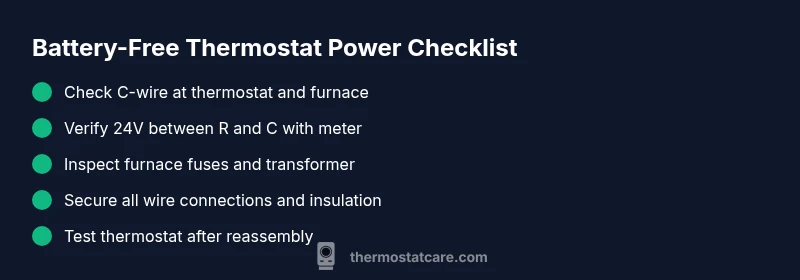
When a thermostat labeled as battery-free stops working, the most likely issue is power delivery from the HVAC system via the C-wire. Start by confirming 24V between R and C with a multimeter, ensure the C-wire is securely connected at both the thermostat and furnace, and check for a tripped breaker or blown fuse in the HVAC circuit. If power is present but the display stays dark, call an HVAC tech.
Understanding battery-free thermostats and why they work
A thermostat advertised as battery-free relies on the building’s electrical system to power its electronics. Instead of drawing power from disposable batteries, these models pull power from the HVAC wiring through the C-wire and the 24-volt transformer that feeds the furnace or air handler. This setup keeps the thermostat running continuously, reduces maintenance, and can improve performance when the system is wired correctly. The phrase thermostat without batteries describes this power model, and it underscores the importance of a solid C-wire connection and a healthy transformer. When everything is working, you won’t hear a relay click or see a blinking display, but you’ll rely on steady power from the wiring, not from replaceable cells. According to Thermostat Care, proper C-wire integrity is the single most common factor behind battery-free thermostat reliability, so start there and you’ll often fix the problem fast.
How power works in non-battery thermostats
Non-battery thermostats draw power from the 24V transformer inside the furnace or air handler. The R terminal carries the hot 24V supply, while the C terminal provides the common return path. When the thermostat calls for heat or cool, it completes circuits between R and W (heat) or R and Y (cool) using the same shared power line. In a correctly wired setup, the thermostat periodically draws a small current to power its display and memory without draining the furnace’s transformer. Any disruption in this power path—loose wires, a bad transformer, or a blown fuse—will produce symptoms in a thermostat that operates without batteries. If you’re experiencing issues, this section helps you visualize where power should flow and what needs testing first.
Common power-related symptoms
If you have a thermostat without batteries and you notice signs like a blank screen, dim display, or the HVAC not turning on when it should, power delivery is the most likely culprit. Other symptoms include a thermostat that loses time and settings, incorrect temperature readings, or frequent false cycling of the furnace. In many homes, the culprit is a loose or corroded C-wire at either end of the connection, or a tripped breaker in the furnace room. Less common but possible are blown fuses on the control board or a failed transformer. If you see any of these symptoms, don’t assume it’s a faulty thermostat—the power path may be the actual issue and is generally easier to fix.
Initial safe checks you can perform
Before you touch any wiring, ensure safety by turning off the HVAC power at the breaker. Remove the thermostat cover and inspect the wiring at the wall terminal. Look for loose, burnt, or discolored wires, and confirm that the C-wire is firmly inserted. At the furnace end, check that the C and R wires are connected to the control board and that nothing is visibly damaged. If you have a multimeter, test for 24V AC between R and C with the system powered. If there is no voltage, the fault lies in power delivery rather than the thermostat itself. Throughout this process, avoid moving high-voltage components or touching exposed terminals.
Diagnostic flow overview
To diagnose a thermostat without batteries, start with the simplest test: is there power at the thermostat (R to C)? If yes, go deeper into the thermostat wiring at both ends. If not, check the furnace circuit breaker, the HVAC disconnect, and any fuses on the control board. When you verify voltage exists, inspect the C-wire continuity and insulation for damage. The diagnostic flow should be symptom-driven: blank display points to power delivery; erratic temps point to sensor wiring or calibration; consistent but incorrect performance may indicate control board issues. At every step, document what you test and the results to avoid repeating steps and to guide a pro if needed.
Step-by-step repair approach
This section outlines a practical, repair-oriented method to restore power without batteries. First, reset the HVAC breaker and ensure the power switch on the furnace is ON. Then, carefully inspect and reseat both ends of the C-wire, replacing any damaged insulation. Use a multimeter to confirm 24V AC between R and C; if you do not see 24V, check the transformer and any related fuses. If voltage is present but the thermostat still fails to power, inspect for loose connections on the thermostat base or on the control board terminals. In most cases, correcting a loose C-wire or replacing a blown fuse resolves the issue; if not, the transformer or control board may be faulty and require an HVAC technician. Always follow safety guidelines and turn off power when handling live wires.
Safety notes and when to call a pro
Working with furnace wiring carries risk of electric shock and equipment damage. If you’re uncertain about testing voltages or identifying the transformer, stop and call a licensed HVAC technician. Do not bypass safety features or use improvised wiring to power the thermostat. If you notice burning smells, melted insulation, or scorch marks, evacuate and contact a professional immediately. In addition, avoid pulling or twisting wires while the system is energized. Remember that a battery-free thermostat is powered by the home’s electrical system, so any power irregularities should be treated as HVAC or electrical issues, not a simple thermostat fault.
Prevention: keeping a battery-free thermostat powered
Prevention starts with proper installation and periodic checks. Keep the C-wire secured and free of corrosion, ensure the transformer is rated for your thermostat’s load, and test power connections at least twice a year, especially after HVAC work or rewiring. Using a professional to verify the wiring during installation reduces the chance of a future power loss. Regular maintenance of the furnace cabinet, transformer, and control board also helps preserve consistent power for the thermostat without batteries. In short, a well-maintained power path is the best defense against power-related failures in thermostats that run without batteries.
Common mistakes to avoid
Avoid assuming that “no batteries” means no maintenance. Do not ignore small signs of trouble such as a faint glow or slow response from the display. Don’t skip testing the C-wire if the thermostat shows power but behaves oddly. Never replace a fuse or transformer without verifying compatibility and ensuring the power is isolated. Finally, avoid using makeshift connectors or non-compatible wires, which can create hidden faults and hazards.
Battery-free thermostat reliability: practical takeaways
Reliability for battery-free thermostats hinges on a strong, continuous C-wire connection and a healthy 24V supply. Regularly inspect wires for wear and confirm voltage at R and C using a multimeter. If a problem recurs, rule out a faulty transformer or a loose control-board connection before replacing the thermostat itself. By prioritizing testable power-path health, you reduce downtime and extend the life of a thermostat that doesn’t rely on replaceable batteries.
Steps
Estimated time: 30-60 minutes
- 1
Power down safety check
Turn off the HVAC circuit breaker and the furnace switch to ensure safety before touching any wires. Use a non-contact tester to confirm no live voltage on exposed conductors during inspection.
Tip: Label each wire before disconnecting anything to avoid miswiring later. - 2
Inspect thermostat wiring at the wall
Remove the thermostat cover and inspect all wires for loose connections, corrosion, or damaged insulation. Ensure the C-terminal wire is present and firmly attached.
Tip: Take a clear photo of the wiring for reference during reassembly. - 3
Check R and C terminal integrity
Verify that both the R and C wires are securely connected at the thermostat base and on the furnace control board. A loose ground or misrouted wire can cut power to the thermostat.
Tip: If the C-wire is missing, do not substitute with another conductor without confirmation of compatibility. - 4
Test for 24V at the thermostat end
With the system powered, use a multimeter to measure between R and C at the thermostat base. A steady 24V AC indicates power is present; otherwise, trace back to the furnace.
Tip: Record the voltage reading for future reference or for your technician. - 5
Inspect furnace fuses and transformer
Check the furnace control board fuses and the secondary side of the transformer for continuity and signs of failure. Replace only with components rated for your system.
Tip: If you’re unsure about fuse types or transformer specs, consult the manual or a pro. - 6
Reseat or replace damaged wiring
If insulation is nicked or wires are loose, reseat securely or replace the affected section. Maintain proper wire routing to avoid pinching and wear.
Tip: Use shrink tubing or heat- shrink sleeving to protect repaired sections. - 7
Reassemble and power up
Reconnect the thermostat, restore power to the HVAC, and observe the thermostat display for normal operation. Check for correct temperature readings and system activation.
Tip: Set a known temperature to verify the system heats or cools as expected. - 8
Run a quick test cycle
Trigger a heating and a cooling cycle to ensure the thermostat communicates with the HVAC. Confirm that no error codes appear and that the system responds promptly.
Tip: If the screen flickers or cycles slowly, check for loose connectors or a failing transformer. - 9
Document findings
Record voltage readings, wiring changes, and any parts replaced. This helps future maintenance and informs a technician if you still need help.
Tip: Keep a simple one-page checklist near the furnace for quick reference. - 10
Rule out sensor and thermostat faults
If power issues persist after power-path checks, consider that the thermostat itself may be faulty. Compare against a known-good unit if available.
Tip: Avoid mixing thermostats of different voltage or compatibility classes. - 11
Plan professional help if needed
If you cannot locate the power issue, or if you’re uncomfortable working inside the furnace cabinet, schedule a licensed HVAC technician visit.
Tip: Ask about C-wire upgrades or the need for a new transformer when booking. - 12
Prevent future power issues
Implement routine maintenance on the furnace, check the wiring connections at least annually, and ensure tamper-resistant covers are in place to avoid accidental disconnections.
Tip: Create a simple maintenance calendar to track inspections.
Diagnosis: Thermostat displays nothing or inconsistent readings despite power being supplied by the HVAC system
Possible Causes
- highNo 24V power from the furnace transformer or a tripped breaker
- highLoose, disconnected, or damaged C-wire at thermostat or furnace
- mediumBlown fuse on the furnace control board or transformer secondary
- lowFaulty thermostat wiring insulation or short between C and other terminals
Fixes
- easyReset the HVAC breaker and ensure the furnace power switch is ON
- easyInspect and reseat the C-wire at both ends; replace any damaged insulation
- mediumTest for 24V between R and C with a multimeter; address transformer or fuse if no voltage
- hardReplace blown fuse or faulty transformer; call a pro if unsure
Questions & Answers
Can a thermostat operate without batteries?
Yes, if the thermostat is powered by the HVAC system via the C-wire and a 24V supply. If power fails, the thermostat may stop functioning. Regularly verify wiring at both ends to maintain reliable operation.
Yes. Battery-free thermostats run on the HVAC's 24-volt power via the C-wire. If it stops, check wiring and power at the furnace.
What should I do if the thermostat screen is blank?
First, confirm power at the thermostat by testing between R and C. If 24V is present but the screen remains blank, inspect the C-wire connections and the thermostat base for damage. If in doubt, contact a pro.
If the screen is blank, check power at R and C. Inspect C-wire connections. If unresolved, call a professional.
How do I test if the C-wire has power?
Use a multimeter to measure voltage between the R and C terminals with system powered. Read around 24V AC for a healthy C-wire. If you don’t see voltage, inspect connections or transformer components.
Measure between R and C with a meter; you should see about 24 volts. If not, check connections or the transformer.
Is it safe to open the furnace or transformer cabinet?
Only if you are trained and comfortable with electrical work. Always shut off power at the breaker first. If in doubt, hire a licensed HVAC technician.
Only if you know what you’re doing. Cut power at the breaker and consider hiring a pro if unsure.
When should I replace the thermostat instead of repairing?
If the thermostat is old, frequently failing, or incompatible with your HVAC system, replacement may be cost-effective. Compare the cost of a new, battery-free model against ongoing repairs.
If it’s old or unstable, replacement could be best. Compare costs of a new unit versus repairs.
What maintenance helps prevent future power issues?
Regularly inspect C-wire connections, test transformer health, and ensure breakers or disconnects are properly labeled and accessible. Schedule annual furnace maintenance to catch wear early.
Do regular wire checks, test the transformer, and keep breakers accessible. Annual furnace service helps prevent surprises.
Watch Video
What to Remember
- Check C-wire power first when battery-free thermostats fail
- Test 24V between R and C with a meter to confirm power
- Inspect thermostat and furnace wiring for loose connections
- Reset breakers and replace faulty fuses or transformers as needed
- Call a professional if uncertain about electrical components