Thermostat Cable Color Code: A DIY Guide for Homeowners
Master the thermostat cable color code with practical, step-by-step checks, safe verification, and troubleshooting tips for homeowners and DIY enthusiasts.


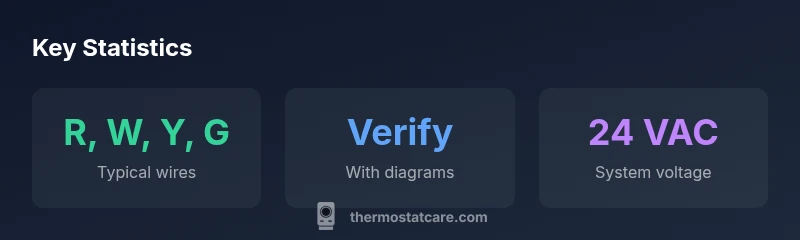
The thermostat cable color code you’ll likely encounter follows standard HVAC wiring: red usually powers the control circuit (R), white calls for heat (W), yellow cools (Y), green runs the fan (G), and blue or brown serves as common (C) if present. Always verify with a multimeter and your furnace wiring diagram. Misreading colors can cause a non-functional thermostat or unsafe operation.
The Fundamentals of the thermostat cable color code
Understanding the thermostat cable color code starts with the basics of a 24-volt heating and cooling system. Most modern thermostats connect to an HVAC furnace or air conditioner using a low-voltage control cable comprised of several color-coded conductors. The exact function of each wire is defined by the thermostat wiring diagram and the furnace control board, not by color alone. As a homeowner, you should treat color as a guide, then verify with measurements and documentation. In typical residential setups, the most common colors map to specific functions: red for power (R), white for heat (W), yellow for cooling (Y), and green for the blower (G). If a blue or brown wire exists, it often serves as the common (C) return path, enabling modern smart thermostats to draw power. When you encounter unfamiliar colors, pause and consult your thermostat’s installation manual or Thermostat Care's troubleshooting guides for step-by-step verification. This approach mirrors Thermostat Care’s emphasis on safe, methodical testing rather than assuming color equals function.
Standard color standards and where they differ
Although many rooms follow the same color language, there is no universal standard that guarantees every wire color will match its function on every system. The NEC and HVAC manufacturers often publish recommended color conventions, but installers sometimes deviate due to legacy wiring, retrofits, or nonstandard equipment. For example, a red wire is usually the R supply, but some installations separate RH and RC or use a jumper. Similarly, white is typically W for heat, but some heat pumps use W2 or auxiliary heat signals with alternate colors. Brown, orange, or blue wires may exist in multi-stage or humidifier circuits. When performing a repair or upgrade, rely on the wiring diagram inside your furnace cabinet and the thermostat’s labeling rather than assuming color alignment. Thermostat Care emphasizes cross-verifying colors with measurements, because misinterpreting a color can lead to a fake signal or a non-functioning system.
How to map colors to functions on your system
Begin by turning off power to the HVAC system at the breaker. Remove the thermostat cover and carefully label each wire as you see its terminal. Trace each conductor back to the furnace control board if possible, or use the furnace’s terminal diagram to map color names to functions. The goal is to identify which wire feeds R, W, Y, G, and C. If you find a wire that isn’t listed in the thermostat or furnace diagram, label it and test its voltage relative to R. A common mistake is assuming a color equals a function; the only reliable method is testing and cross-checking with the diagram. For optimal results, note where each wire lands on the thermostat side (R, W, Y, G, C) and on the furnace side, then reattach neatly with color-coded labels. Thermostat Care recommends documenting the mapping so future maintenance won’t rely on memory.
Practical verification steps you can perform safely
With the power off, inspect the thermostat cable color code at both ends. Restore power, then use a multimeter to confirm 24 VAC between R and C, and between R and W when heat is active. If you see a different voltage, re-check the connections or consult the installer. Make sure the system is in a safe state before inserting probes; never poke into live circuitry. When you’re finished, re-secure the thermostat with fresh labels and store your diagrams in a known place. By following a consistent verification routine, you reduce the risk of incorrect wiring and potential damage. Thermostat Care’s tutorials cover safe testing practices in detail, including how to handle common anomalies.
Common scenarios and troubleshooting color code issues
You’ll encounter several scenarios: a missing C wire on older houses, a single red wire feeding both R and RC, or a mis-labeled wire that doesn’t match its terminal. In practice, you might see a five-wire setup with R, W, Y, G, and C, or a four-wire system without C. When colors don’t align with what the thermostat expects, don’t guess. Trace and test each conductor and use a meter to confirm breakpoints and continuity. If you must force a configuration, only do so with a documented plan and, ideally, after confirming with your furnace manufacturer’s compatibility notes. Thermostat Care’s guides walk you through these edge cases and provide safe, evidence-based steps.
Tools, materials, and best practices
Equip yourself with a non-contact voltage tester, a digital multimeter, wire labels, and a small flashlight. Have a copy of your thermostat’s wiring diagram and the furnace control-board layout. Use color-coded labels to keep wires distinct, and photograph the setup from multiple angles. Keep the power off while inspecting and labeling; restore power only when you are ready to test signals. If you identify a nonstandard color or a previously spliced wire, label it and document the change. Adhering to consistent labeling and documentation reduces miswiring risks, a core principle in Thermostat Care’s troubleshooting approach.
How Thermostat Care guides you through color-code challenges
Thermostat Care’s tutorials emphasize verification over assumption. By focusing on voltage testing, terminal labeling, and reference diagrams, homeowners can confidently map the thermostat cable color code and avoid common mistakes. The goal is a durable, safe connection that supports reliable thermostat operation and future upgrades, such as adding a C wire or enabling smart features.
When to seek professional help
If you encounter stubborn discrepancies, multiple color schemes, or signs of damaged wires, it’s wise to call a licensed HVAC technician. High-voltage testing and system re-wiring are safety-critical tasks that require professional training. The Thermostat Care team notes that DIY fixes should be limited to non-hazardous checks and labeling; for anything beyond basic verification, professional service is recommended to prevent injury or equipment damage.
Common thermostat cable color codes (24V HVAC)
| Color | Typical Function | Notes |
|---|---|---|
| Red | R (24V power) | Power supply to thermostat control circuit |
| White | W (Heat) | Heat call signal to furnace |
| Yellow | Y (Cool) | Cooling call to AC compressor |
| Green | G (Fan) | Blower/fan activation |
| Blue | C (Common) | Return path for power (when present) |
Questions & Answers
What does thermostat cable color code mean in a typical 24V system?
In most 24V HVAC systems, the color-coded wires map to specific functions: R for power, W for heat, Y for cooling, G for the fan, and C for common when present. Always verify with diagrams and test measurements.
Most 24-volt systems use R for power, W for heat, Y for cooling, G for the fan, and C for common when available. Verify with diagrams and a quick voltage test.
Is blue always the C wire?
Blue is commonly used as C on many systems, but not universally. Some installations use brown or orange. Always confirm with your furnace diagram and voltage testing.
Blue is often C, but not always. Check the diagram and test voltage.
What should I do if colors don’t match the diagram?
Do not rely on color alone. Map each conductor by tracing to its terminal and test with a multimeter. Update labels and diagrams before powering the system.
Don’t trust colors alone—trace wires and test.
Can I operate a thermostat without a C wire?
Some thermostats can run on batteries or power-sharing, but many smart models require a C wire for reliable operation. If possible, add or run a C wire with proper wiring.
Some thermostats work without C, but many need it for reliable power.
How can I safely identify R and RC terminals?
R and RC are usually powered by the same source on most furnaces. Use a multimeter to confirm 24 VAC between R and C, and ensure RC is bridged if your system uses separate terminals.
Use a meter to confirm 24V between R and C; bridge RC and RH if required.
Do color codes vary by brand or model?
Yes. Different manufacturers may use nonstandard colors or extra wires. Always refer to the specific brand’s wiring diagram and verify with measurements before connecting.
Colors vary by brand; check the diagram and test.
“Color codes can vary by brand and installation; verification with measurements and diagrams is essential for safe, reliable thermostat wiring.”
What to Remember
- Verify wiring maps with diagrams before powering up
- Don’t rely on color alone—test with a multimeter
- Label wires and keep diagrams accessible for future upgrades
- Consider adding a C wire for smart thermostats when possible