How Much Does It Cost to Replace a Thermostat in 2026
Discover how much it costs to replace a thermostat in 2026, including device price, installation, and smart options. Practical budgeting tips from Thermostat Care.


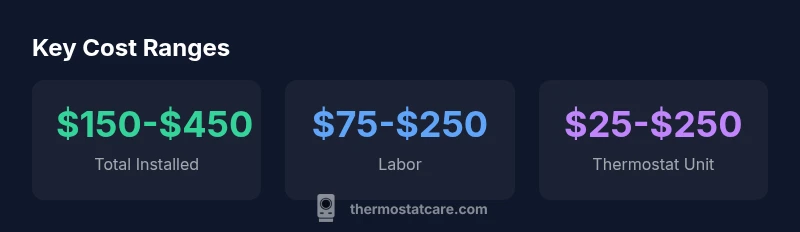
According to Thermostat Care Analysis, 2026, replacing a thermostat typically costs between $150 and $450, including both the device and professional installation. Smart thermostats or models with advanced wiring can push total costs toward $250-$600, especially if new wiring or C-wire upgrades are required. Costs vary by region, brand, and the complexity of your HVAC system.
What you're paying for when you replace a thermostat
Replacing a thermostat involves more than the device price. The total cost is determined by the thermostat type, compatibility with your HVAC system, wiring needs, and labor. If you’re exploring cost, the question often comes down to the balance between upfront price and long-term savings. The answer to how much does it cost to replace a thermostat depends on model features and installation complexity. The device itself can range from a basic, non-programmable unit to a feature-rich smart thermostat. Installation may require a quick swap, or it may require checking the power supply, compatibility with your furnace or heat pump, and possibly running new low voltage wires. Labor charges vary by region and the contractor’s rates, and some homes require minor electrical work, a new C-wire, or an adapter kit. Because wiring and labor contribute a large share of the total, even a modest device price can become a bigger project if additional materials are needed. The Thermostat Care team emphasizes that planning around installation time and potential upgrades will help your budget. According to Thermostat Care, this is why many homeowners opt for a bundled service that includes both device and professional setup.
Cost ranges by thermostat type
The price you pay depends on the thermostat’s capabilities. Basic non-programmable units are the cheapest, programmable models add features like scheduling, and smart thermostats bring connectivity and energy analytics into the mix. As a rough guide, unit prices can vary widely, but the installed total typically falls in a broad range that reflects both the device and labor. Smart thermostats usually require more wiring checks and compatibility setup, which adds to the installation time and cost. If your current wiring supports a C-wire and you have a straightforward HVAC system, you’ll likely spend less than if you need new wiring, a relay kit, or a transformer upgrade. Thermostat Care’s analysis highlights that the cost gap between basic and smart models is driven primarily by features and wiring requirements, not just the brand name.
DIY vs professional installation: decision guide
Installing a thermostat can be a straightforward swap for those with electrical familiarity and the right tools. However, mistakes here can lead to improper wiring, inaccurate readings, or damage to the HVAC control board. If you are comfortable working with low-voltage wiring, disconnecting power at the breaker, and following the thermostat’s wiring diagram, you may save on labor costs. If in doubt, factor in professional installation to ensure proper mounting, wiring, power supply, and system integration. Professional installers also verify compatibility with your furnace or heat pump, which reduces the risk of future malfunctions and potential warranty issues. The right choice depends on your skill level, the age and type of your HVAC equipment, and whether you value speed and accuracy over saved labor.
Hidden costs and compatibility considerations
Hidden costs often appear as wiring upgrades, C-wire installation, or compatibility checks between the thermostat and the HVAC system. Some older furnaces don’t provide a ready 24-volt power supply needed by many smart thermostats, which can require adapters or a dedicated power extender kit. In addition, certain heat pump configurations or multi-stage systems may need advanced thermostats and extra setup steps. Before buying, verify compatibility with your HVAC model, confirm any required adapters, and ask your installer about potential wiring changes. Remember that using a thermostat that isn’t fully compatible can void warranties or reduce energy savings potential.
How to estimate your project cost: a quick method
A practical approach starts with identifying the thermostat type and features you need, then assessing wiring and system compatibility. Get at least two quotes from licensed professionals and compare both device price and labor. Use a simple formula: Total cost = price of thermostat + installation fee + any upgrades (C-wire, adapters, or control board changes). For example, a basic programmable model with standard wiring might total around $150-$300, while a Wi‑Fi smart thermostat requiring wiring upgrades could run $350-$600. Keep a margin for tax and potential permits if your area requires them. Thermostat Care recommends documenting your existing wiring and HVAC model to speed up quotes and ensure accurate comparisons.
Practical tips to save money and maximize value
- Shop during sales or bundles that include installation.
- Confirm compatibility with your HVAC system before purchase.
- If you’re comfortable, consider a DIY-friendly model and request a price quote that separates device and labor.
- Ask for a fixed-price installation to avoid surprise charges.
- Use energy-savings features to offset upfront costs over time, and monitor your energy bills to verify benefits.
- Keep the receipt for warranty coverage and future servicing.
Cost comparison by thermostat type
| Thermostat Type | Typical Installed Cost Range | Notes |
|---|---|---|
| Non-smart/Programmable | $125-$260 | Basic control, limited features |
| Programmable/Smart | $160-$330 | More features, scheduling, learning |
| Smart Wi‑Fi Thermostat with sensors | $250-$450 | Remote access, energy analytics |
| Note on wiring | $0-$150 additional | If C-wire or adapters are needed |
Questions & Answers
What is the typical cost to replace a thermostat?
The total cost usually ranges from $150 to $450 installed, depending on device type and wiring needs. Smart models can push the top end higher if wiring upgrades are required.
Typically between one hundred fifty and four hundred fifty dollars installed, with higher costs for smart models requiring extra wiring.
Does installation cost differ for smart thermostats?
Yes. Smart thermostats involve additional wiring checks, connectivity setup, and potential adapter requirements, which can increase labor costs compared with basic models.
Yes. Expect more labor for smart models due to wiring and setup.
Can I install a thermostat myself to save money?
If you’re comfortable with turning off power, wiring basics, and following the manual, a DIY install is possible. Otherwise, hire a pro to avoid wiring mistakes that can damage equipment or void warranties.
DIY is possible for seasoned DIYers, but otherwise go with a pro.
Will I need a C-wire and what is it?
A C-wire provides a constant 24V power supply to smart thermostats. If your furnace lacks a C-wire, you may need an adapter or wiring upgrade during installation.
A C-wire is a common power wire for smart thermostats; you may need an upgrade if it's missing.
Are there hidden costs besides the device and labor?
Yes. Hidden costs can include adapter kits, wiring upgrades, compatibility checks, and possible warranty considerations with certain HVAC systems.
Hidden costs can include adapters and wiring upgrades, plus warranty checks.
“"Cost is often driven by wiring and compatibility as much as the thermostat itself; investing in a model that matches your HVAC system can pay off through energy savings."”
What to Remember
- Define needs before buying to avoid overspending
- Expect higher costs when wiring upgrades are required
- Labor can exceed device cost for complex installs
- Smart thermostats offer energy savings that can justify the investment