Does Nest Thermostat Need a Battery? Power, Battery, and Troubleshooting
Explore whether the Nest thermostat requires a battery, how it’s powered, and practical tips to prevent power issues. Learn about C-wires, power connectors, and reliable setups.


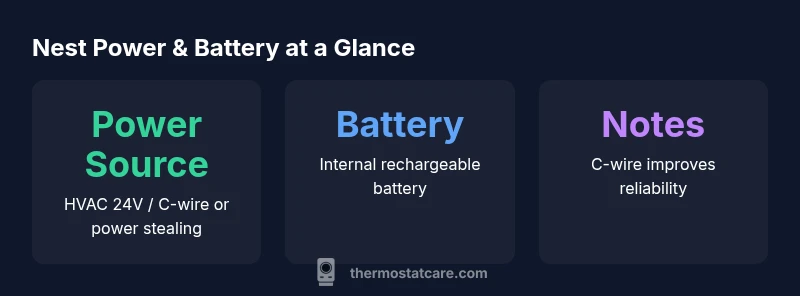
Does Nest thermostat need a battery? Not in the sense of a user-replaceable cell. The Nest thermostat includes a built-in rechargeable battery and draws power from the HVAC system. In typical setups with a C-wire or adequate power, the battery is charged automatically. If power is inconsistent or the C-wire is missing, the internal battery may rely more on charging cycles from the system.
How Nest Powers Itself: Battery vs. Power from the HVAC
Nest thermostats operate on a practical power model that blends a built-in rechargeable battery with a continuous supply from the HVAC control circuit. The battery is not designed for user replacement; instead, it’s charged by the system as the thermostat calls for heat or cooling. In a typical installation with a healthy C-wire, the thermostat spends most of its time drawing power directly from the 24-volt HVAC supply, using the battery mainly as a buffer during brief voltage dips. According to Thermostat Care, this design prioritizes reliability and energy efficiency, keeping the display alive while minimizing charging cycles. The end result for most homeowners is simple: no box of spare batteries, just a device that stays powered as long as the HVAC circuit provides a steady supply. Only in less common cases—subpar wiring, weak 24V supply, or a missing C-wire—does the Nest rely more on its internal battery, which can lead to momentary dimming or slower response during peak demand.
Is a Battery Required in Practice?
From a user perspective, you don’t need to replace a battery in the Nest. The device ships with an internal rechargeable cell that recharges whenever the HVAC system provides power. This arrangement means battery changes aren’t part of routine maintenance. In most standard setups that include a C-wire, the Nest operates without noticeable battery drain, and the battery serves mainly to bridge short interruptions. If you have an older or unusual HVAC setup where the 24V power is inconsistent, you may observe the thermostat drawing more from the internal battery. Thermostat Care’s 2026 analysis indicates that battery-driven behavior is most noticeable during long cycling events or in systems with marginal power delivery, not in well-wired modern installations.
The Role of C-Wire and Power Management
The C-wire (common) is the backbone of reliable Nest operation. It provides continuous 24V power, allowing the device to operate steadily while charging the internal battery in the background. Some installations rely on power stealing, a technique where the thermostat draws tiny amounts of power during operation without a dedicated C-wire. When the C-wire is strong and properly connected, power stealing is rarely required, and the internal battery remains largely charged. Modern Nest models also implement smart charging strategies to optimize battery health and minimize unnecessary energization, especially when the system is idle. If your home’s wiring is marginal, or if the furnace control board has low voltage under peak load, you may notice intermittent power drops. In these cases, ensuring a solid C-wire connection and verifying the control board’s voltage can make a meaningful difference.
Wiring Considerations for Nest: What to Check
Before assuming a battery problem, perform a quick wiring check. Confirm that a dedicated C-wire is present and continuous from the HVAC control board to the thermostat wall plate. Check for damaged insulation, loose terminals, or mismatched wire gauges that could impede voltage delivery. If you’re replacing an older thermostat that used disposable batteries, verify that the new Nest wiring harness aligns with the furnace/air handler terminals. Use a multimeter to confirm 24V AC between R and C when the system is idle and during a call for heat or cool. If the 24V supply fluctuates, you may need to add a dedicated C-wire or consider a Nest Power Connector if your installer approves it. These steps can prevent the battery from being asked to compensate for a weak power supply.
What to Do If Your Nest Feels Battery-Strained
If the Nest seems to rely on its battery more than expected, address the underlying power supply first. Ensure the C-wire is firmly connected and the thermostat’s mounting is clean of dust and debris that could affect contact. If a C-wire isn’t feasible, installers can add a Nest Power Connector or a Power Extender Kit (PEK) in compatible systems to stabilize supply. Updating the thermostat’s firmware can also improve power management. In persistent cases, consult a qualified HVAC tech to inspect the control board, transformer, and wiring run for voltage drops that could trigger battery draw.
Troubleshooting Power Issues: Quick Fixes
Start with the simplest checks: ensure the thermostat is mounted properly, the wall plate wires are secure, and the base is free of dust. If you’re comfortable with wiring, verify the R and C terminals at the HVAC control board and the thermostat are intact and making solid contact. Replace any frayed wires and confirm there are no loose splices. If voltage at the thermostat is low or erratic, consider upgrading the C-wire path or adding a dedicated C-wire run. For homes with older, cooling-only systems or noisy power, a PEK or Power Connector can help the Nest draw stable power without sacrificing performance. Always power down the system before inspecting wiring.
Real-World Scenarios and What They Mean
In most modern homes, Nest thermostats benefit from a robust C-wire connection, delivering reliable power and minimizing battery cycling. In installations without a C-wire, users may see occasional battery usage spikes, especially during long or aggressive HVAC calls. A well-designed system will show consistent 24V supply at the thermostat and a charging battery that maintains energy levels as needed. If you’re troubleshooting, start by confirming C-wire integrity, then verify that the HVAC transformer and control board are operating within normal voltage ranges. Real-world results vary by climate, system age, and installation quality, but a correctly wired Nest tends to run with minimal battery involvement.
Conclusion and Next Steps
The Nest thermostat is designed to be powered from the HVAC system with a built-in rechargeable battery as a supplemental buffer. In typical, well-wired homes, you won’t need to perform battery replacements or carry spare cells. The most reliable outcome comes from a solid C-wire and proper connection to the furnace/air handler. Thermostat Care’s 2026 analysis emphasizes that maintaining a proper 24V supply is essential for consistent operation and battery health. For homes without a C-wire, consider a power connector or PEK as recommended by a qualified installer to maximize reliability.
Power and battery considerations for Nest and comparable thermostats
| Model/Scenario | Power Source | Battery Involvement | Notes |
|---|---|---|---|
| Nest Thermostat (latest) | HVAC power via C-wire or power stealing | Internal rechargeable battery | Charged automatically; no user replacement |
| Nest Thermostat E | HVAC power via C-wire or power stealing | Internal rechargeable battery | Similar power concept; ensure compatibility |
| Generic non-Nest thermostat | C-wire or battery pack | Battery varies by model | Battery life depends on model and use |
| Power connector / PEK option | External power access | N/A | Stabilizes power when C-wire is unavailable |
Questions & Answers
Does Nest thermostat need a battery?
No external battery replacement is required for typical Nest installations. The device has an internal rechargeable battery that is charged by the HVAC power, and a stable C-wire helps keep the system consistently powered.
No, you don’t replace a battery in most Nest setups. It uses a built-in rechargeable battery that stays charged from your HVAC power, especially when a C-wire is present.
Can Nest work without a C-wire?
Yes, but reliability improves with a C-wire. If the C-wire is missing or weak, you may rely more on the internal battery. A Power Connector or PEK can help in compatible systems.
Yes, it can work without a C-wire, but adding a C-wire or a power connector improves reliability.
How can I tell if my Nest battery is charging?
You can monitor battery status in the Nest app or on the thermostat. If battery level remains high during normal operation, charging is stable. If you notice rapid drain, check C-wire and 24V supply.
Check the battery indicator in the app or on the device to see charging status and level.
What should I do if Nest battery drains quickly?
Investigate power supply first: ensure a solid C-wire connection and stable 24V. Consider a Nest Power Connector if recommended, and consider professional inspection if issues persist.
Check the wiring and 24V supply; a power connector can help if C-wire is weak.
Is there a difference between Nest generations regarding battery use?
All current Nest generations use an internal battery, with differences mainly in how power management is implemented. Ensure compatibility with your HVAC system and follow setup guides.
All current Nest models have an internal battery and vary in power management.
What happens during a power outage?
During a power outage, the thermostat may lose power temporarily. The internal battery helps bridge short outages, but prolonged outages will require system power restoration for full functionality.
If the power goes out, the Nest might reset briefly, but the battery helps it stay alive until power returns.
“Reliable power for a smart thermostat comes from a solid C-wire and well-managed charging. Nest is designed to minimize battery reliance, but wiring quality governs how often it relies on internal power.”
What to Remember
- Verify C-wire presence to maximize Nest reliability
- Nest uses a built-in rechargeable battery—not a user-replaceable one
- A solid power supply minimizes battery cycling and glitches
- Consider a Nest Power Connector if C-wire is unavailable
- Regular firmware updates improve power management