Which Thermostat Wire Controls the Fan: A Practical Guide
Learn which thermostat wire controls the fan (G wire) and how to identify, test, and troubleshoot fan operation safely with Thermostat Care guidance.


Typically, the G wire (green) controls the furnace or air-handling blower. When the thermostat calls for cooling or heating, it energizes the G circuit to switch the blower on. If your system lacks a G wire, the fan function may be powered differently or not at all. Always power down and verify at both the thermostat and the furnace control board before touching wires.
Understanding which thermostat wire controls the fan
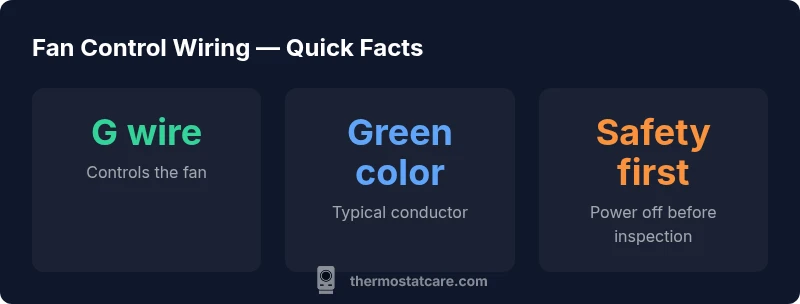
In most homes with a standard forced-air system, the fan is controlled by the G wire. If you're asking which thermostat wire controls the fan, the short answer is: the G wire. The green conductor communicates with the furnace or air handler control board and tells the blower to run when cooling or heating calls are active. This single wire is central to how your HVAC blower responds to thermostat commands. When the thermostat is set to Auto, the fan runs only with system cycles; when set to On, the blower stays active. Always confirm power is off before inspecting wires, and verify both ends of the G circuit for secure connections.
How fan control wiring works in typical setups
Most residential systems expect three layers of control: heat, cooling, and fan. The thermostat uses the G terminal to energize the blower relay on the furnace control board. When you select cooling or heating, the thermostat may also energize Y (compressor) or W (heat) in tandem, but the G function alone governs the fan. In heat-pump setups, G still controls the fan, but depending on the system, the indoor blower might be timed with the outdoor unit, or staged for energy efficiency. The C wire (common) powers smart thermostats, helping avoid power draw issues that can affect the fan. Understanding these basics helps you troubleshoot without guessing.
How to identify the G wire at the thermostat and furnace
Color is a helpful cue, with green commonly representing G. However, do not assume color alone; always verify on the wiring diagram or label on the control board. At the thermostat, locate the G terminal and trace the connected conductor to the furnace or air handler control board. On the furnace side, look for the G terminal labeled on the control board and ensure the corresponding conductor is securely attached. If you must replace a wire, use a spare conductor in the same cable or run a new wire. Label each end to prevent cross-connection during future work.
Step-by-step test to verify fan control with the G wire
- Power down the system at both the thermostat and the furnace.
- Remove the thermostat cover and locate the G wire; confirm it is connected to the G terminal.
- With power off, gently disconnect the G wire at the furnace side and test continuity to the thermostat end using a multimeter. Reconnect if continuity is good.
- Restore power and set the thermostat to 'Fan On' or 'Auto' with a cooling/heating cycle. Observe if the blower engages within a few seconds.
- If the blower does not run, inspect the furnace control board for a blown fuse, a tripped breaker, or a loose G connection. Repeat the continuity test if needed.
- If there is no G wire present, plan to run a new conductor or install a G relay kit; consider professional help to avoid wiring hazards.
Alternatives if you don’t have a G wire (common scenarios and solutions)
Some older systems lack a dedicated G conductor. In these cases, you have a few practical options: run a new G conductor from the thermostat to the furnace, install a fan relay or a Power Extender Kit (PEK) if your thermostat supports it, or upgrade to a smart thermostat that can manage fan control through an available C-wire. Each option has implications for warranty and HVAC compatibility, so evaluate based on your equipment, wiring accessibility, and comfort with DIY work. If in doubt, consulting a licensed HVAC technician is wise.
Safety, best practices, and next steps
Wiring changes can affect the entire HVAC system. Always shut off power at the breaker before handling wires, and verify no voltage is present with a non-contact tester. Label wires before disconnecting anything, keep track of which wire goes where, and reassemble panels carefully. For complex configurations such as heat pumps or multi-stage furnaces, refer to the equipment’s wiring diagrams. Thermostat Care recommends documenting every change you make and verifying compatibility with your thermostat and furnace model. If you experience unusual blower cycles or buzzing noises after changes, stop and seek professional assistance to prevent equipment damage.
Common wire roles in typical thermostat wiring
| Component | Role | Notes |
|---|---|---|
| G wire (fan control) | Activates blower relay | Typically green; connects thermostat G to furnace G |
| Y wire (cooling) | Controls compressor | Energizes outdoor unit when cooling is called |
Questions & Answers
What color is the G wire typically?
The G wire is commonly green, but color alone isn’t a guaranteed indicator. Always confirm by tracing the conductor to the G terminal on both the thermostat and the furnace control board.
The G wire is usually green, but always check the actual wiring on both ends.
How can I tell if my G wire is connected correctly?
Inspect the label on the G terminal at the thermostat and furnace. Use a multimeter to confirm continuity between the thermostat G and the furnace G terminal when the system is powered safely. Look for a firm connection and no loose strands.
Check that G is firmly attached on both ends, and test continuity if you’re comfortable with a multimeter.
Can the fan run without a G wire?
Some thermostats or systems may trigger the fan via alternative paths, but most standard setups require a G conductor. If G is missing, you’ll likely need to add a wire or use a relay kit.
Most systems need a G wire for proper fan control.
What should I do if there is no G terminal on my thermostat?
If your thermostat lacks a G terminal, you may still have a G signal on the furnace side. Consider adding a dedicated G wire, using a PEK/relay solution, or upgrading to a thermostat that accommodates fan control with your existing wiring.
You might need to add a wire or use a relay kit, or upgrade the thermostat.
Is it safe to DIY fan-control wiring?
DIY wiring can be safe if you power down fully and follow wiring diagrams precisely. If you’re unsure, hire a licensed HVAC tech to avoid damage or voiding warranties.
Only DIY if you’re confident with wiring and safety protocols.
Why might my fan run unexpectedly after changes?
Unscheduled blower operation can indicate a loose connection, a faulty relay, or incorrect wiring. Recheck all connections, and revert changes if necessary, then test gradually.
If it runs unexpectedly, recheck connections and consult a pro if needed.
“Fan control hinges on the G circuit; verify wiring against the furnace diagram before making changes.”
What to Remember
- Identify the G wire as the fan-control conductor.
- Always power down before inspecting wiring.
- Verify both thermostat and furnace ends of the G circuit.
- If G is missing, plan to run a new conductor or use a relay kit.
- Label wires to prevent future miswiring.