Thermostat Wire Size Guide: How to Choose the Right Gauge
Learn how to choose the correct thermostat wire size for reliable control, safe connections, and long-term HVAC performance. Practical sizing tips, common wire gauges, and mistakes to avoid.


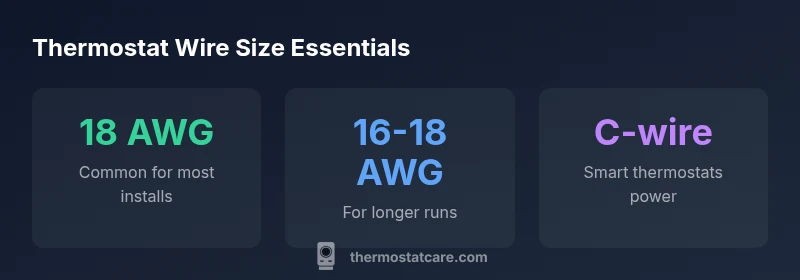
Choosing the right thermostat wire size is essential for reliable HVAC control and safety. For most homes, 18 AWG is the standard conductor for 24V thermostat circuits, with 16 AWG recommended for longer runs or higher-load setups. Avoid undersizing, which can cause voltage drop and intermittent power. Always verify wire gauge before installation.
What is thermostat wire size and why it matters
According to Thermostat Care, the most common mistake in residential thermostat wiring is undersizing the conductor gauge, which can lead to voltage drop, intermittent power, and unreliable HVAC operation. The thermostat wire size you choose directly influences how much current your thermostat can draw, how far it can safely travel, and how robust the connection remains over time. For most 24V control circuits, the standard starting point is 18 AWG copper. If your run is longer than typical or you’re upgrading to a smart thermostat that relies on a consistent power source, you may need thicker gauge or a dedicated C-wire. Understanding the basics helps homeowners avoid common wiring pitfalls and ensures safe, long-lasting performance.
Common wire sizes for low-voltage thermostat circuits
In most homes, 18 AWG copper conductors are the default for 24V thermostat circuits. If your distance is significant or you’re integrating multiple devices, electricians may opt for 16 AWG to reduce voltage drop. Very short runs or extension wiring for sensors may use 20 AWG or 22 AWG, but these are not typical for primary thermostat power. When planning, check your thermostat’s documentation and the HVAC equipment’s wiring requirements, and remember that many modern thermostats demand a C-wire for continuous power.
How to determine the correct wire size for your system
Start by checking your thermostat manual and the HVAC equipment documentation for recommended conductor sizes. Measure the total run length from the furnace or air handler to the thermostat, accounting for any bends, walls, or insulation that could affect resistance. Consider future upgrades (like a smart thermostat that needs a constant power source) and whether a dedicated C-wire is available. If in doubt, opt for a larger gauge (e.g., 16 AWG) to minimize voltage drop, especially on longer runs.
Safety considerations and code basics
Low-voltage thermostat wiring is generally governed by local electrical code and HVAC manufacturer guidelines. Use stranded copper conductors for flexibility and secure passes through walls with proper grommets or conduit. Keep all connections inside an access panel or electrical box, and avoid running thermostat wires in parallel with high-ampere lines to reduce interference. Always install with the power off and verify continuity and insulation integrity before powering the system.
Upgrading or adding features: C-wire and smart thermostats
Smart thermostats typically require a continuous power source, often via a C-wire. If your existing cable lacks a C-wire, you can run a new line or use a common power adapter when permitted by code. Some installations employ power-stealing mechanisms or internal batteries, but these can be unreliable long-term. When upgrading, confirm the wire size supports both control signals and the extra current draw, and consider having a professional install or verify compatibility with your HVAC equipment.
Wiring best practices and troubleshooting tips
Use color-coded conductors and secure all splices with approved wire nuts. Keep thermostat cables away from heat sources and ensure a clean, straight path through walls. If you experience thermostat power issues, first check the wire size and run length, then test for proper voltage at the thermostat terminals. A loose connection or undersized wire is a frequent culprit for erratic thermostat behavior.
Practical sizing scenarios and checklists
For a standard 24V thermostat with a run under 60 feet, 18 AWG is typically sufficient. If the run exceeds 60–80 feet or you add a cooling stage, consider 16 AWG. For smart thermostats requiring a C-wire, ensure you have an available conductor that can carry the required current without excessive resistance. Use the checklist: confirm gauge, verify run length, inspect insulation, and review manufacturer guidance before finalizing the wiring plan.
Comparison of common thermostat wiring sizes
| Wire Size | Common Use | Notes |
|---|---|---|
| 18 AWG | Most 24V thermostat runs | Balanced flexibility and current capacity |
| 16 AWG | Longer runs / higher load | Lower resistance; use when distance is large |
| 20 AWG | Short runs / accessory wires | Limited to low-current circuits; not standard for main thermostat power |
| 22 AWG | Sensor wires / extensions | Typically not used for main thermostat power |
Questions & Answers
What wire size is best for most residential thermostats?
For typical 24V thermostat systems, 18 AWG is standard. If the run is unusually long or you’re adding a smart thermostat, 16 AWG is often preferred. Always consult the device manual and local codes.
For most homes, start with 18 AWG; upgrade to 16 AWG for longer runs or smart thermostats.
Can I use smaller gauge wire for thermostat power?
Undersizing can cause voltage drop, flickering displays, or intermittent power. Use the gauge recommended by your thermostat and HVAC equipment manuals.
No—don’t go smaller than the recommended gauge; it risks power problems.
Do smart thermostats require a C-wire?
Most smart thermostats require a C-wire for consistent power. If a C-wire isn’t present, options include running a new conductor or using a compatibility adapter, following manufacturer guidance.
Yes, smart thermostats usually need a common wire; if you don’t have one, plan an upgrade.
What about long runs and outbuildings?
For longer runs, use a thicker gauge like 16 AWG and consider voltage drop. Check with your HVAC installer and reference the thermostat’s documentation.
Long runs often need thicker wire to prevent voltage loss.
Is thermostat wiring the same as typical 24V HVAC wiring?
Thermostat wires are typically 24V low-voltage conductors. Gauge choice depends on distance and load; always align with equipment specs and local codes.
Thermostat wiring is low voltage; gauge varies with run length and device load.
How can I tell if my wire size is too small?
Signs include power issues at the thermostat, flickering displays, or frequent resets. Use a multimeter to verify voltage at the thermostat terminals and compare against the required spec.
If the thermostat acts up or shows low voltage, size may be too small.
“Correct thermostat wiring is not optional—it's essential for safety and reliable HVAC control. Proper sizing prevents voltage drop and intermittent operation.”
What to Remember
- Start with 18 AWG for most installations
- Upgrade to 16 AWG for longer runs or higher loads
- Check C-wire needs for smart thermostats
- Avoid undersizing to prevent voltage drop and power issues
- Follow manufacturer guidelines and local codes