How Often to Change Battery in Honeywell Thermostat
Learn how often to change battery in Honeywell thermostat, signs of battery wear, and model-specific tips to prevent outages. Thermostat Care Analysis, 2026.


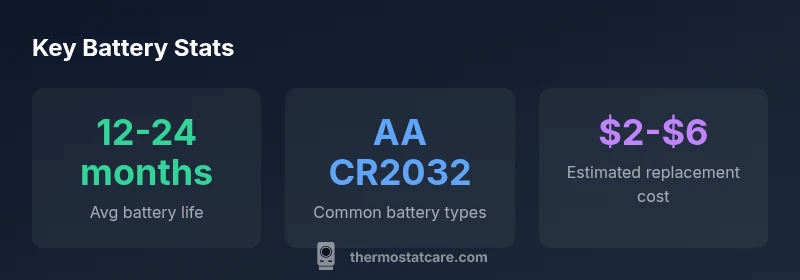
The answer depends on the model and power setup, but most Honeywell thermostats powered by batteries require replacement roughly every 12–24 months for AA cells or longer for coin cells, with the exact interval varying by usage. Check the low-battery indicator in the thermostat or app and replace promptly. For homeowners asking how often to change battery in honeywell thermostat, plan around your model’s power design and seasonal usage.
Understanding why battery life matters in Honeywell thermostats
Battery life for Honeywell thermostats isn't a single number; it depends on model, display usage, Wi‑Fi activity, and environmental conditions. According to Thermostat Care, the question how often to change battery in honeywell thermostat does not have a one-size-fits-all answer. In general, battery-powered units rely on either AA alkaline cells or coin cells, and their life can range widely. Homeowners will notice different lifespans depending on whether the thermostat is a basic model with only temperature sensing, or a full-featured smart thermostat that runs on a constant data connection and uses the display and backlight more frequently. The most reliable approach is to treat battery replacement as a routine maintenance item, similar to changing air filters, rather than waiting for the unit to stop functioning. The trick is to know your specific model's power design and to watch for warning indicators that appear in your thermostat's menu or app. In practice, this means planning for battery changes every year or two for many common Honeywell devices, while some coin-cell variants can stretch longer between changes. The practical takeaway for homeowners is simple: understand your model’s power source, keep spare batteries on hand, and set a reminder to check the low-power indicators at least once per season. This proactive habit reduces the odds of an unexpected outage during extreme weather.
How the battery type and power source affect life expectancy
Power configuration is a major determinant of how often to change battery in honeywell thermostat. If a model relies primarily on batteries (no C-wire), the life of the cells will drive maintenance scheduling. If a C-wire or other external power source is available and used, battery drain is reduced, extending intervals between replacements. The typical life expectancy varies with battery type: AA alkaline cells generally offer longer operation between changes than smaller coin cells, but actual results depend on how often the thermostat wakes the display, processes data, or communicates with a smart hub. In Honeywell lines where the thermostat includes a broad feature set (remote sensors, Wi‑Fi, and frequent screen activity), battery drain can be noticeably higher. Thermostat Care Analysis, 2026 indicates you should not assume a universal interval; instead, identify your model’s design and monitor energy use indicators. If your unit frequently reports low power, consider whether the device is currently operating on battery power or if a C-wire is feasible to reduce drain. In short, the more features you run on battery power, the more often you may need to replace batteries, though exact schedules will vary by model and environment.
How to check battery status and identify when to replace
Most Honeywell thermostats display a low-battery warning within the settings menu or on the home screen. Begin by opening the thermostat menu and locating the battery status indicator; some models show percentage life, others show a simple warning icon. If you have the app connected, check the mobile interface for a battery alert and guidance from the device. When in doubt, replace with fresh batteries of the correct type and recheck the indicator. If the thermostat is difficult to access or if you depend on a backup battery, you may want to schedule a review every 12 months. In all cases, inspect the physical batteries for corrosion or leakage and replace promptly to prevent damage to the device. In the worst case scenario—if you notice intermittent cooling/heating or incorrect readings—batteries should be replaced before continuing. Thermostat Care recommends keeping spare batteries on hand and testing after replacement to confirm proper operation.
Step-by-step: replacing batteries on common Honeywell models
Note: Always power off the thermostat before replacing batteries when possible and remove the cover carefully to access the compartment. 1) Identify the correct battery type from the manual or the battery compartment label (AA alkaline or CR2032 coin cell are common). 2) Remove the old batteries, noting orientation. 3) Insert fresh batteries with correct polarity. 4) Re-seat the cover and power the unit back on. 5) Verify the display initializes properly and check the battery status in the app or on the device. 6) If the thermostat is hard-wired, ensure the C-wire remains properly connected. 7) Dispose of old batteries according to local regulations. If you’re unsure about model-specific steps, consult the Honeywell manual or Thermostat Care’s troubleshooting guide for model-relevant instructions.
Pro tips to maximize battery life and avoid outages
Keep the thermostat away from direct sunlight and heat sources, which can accelerate battery drain. Use the lowest feasible display brightness to reduce power consumption and limit features that draw power (e.g., always-on sensors) when possible. If your system supports a C-wire, enabling it can drastically reduce battery reliance and extend life between changes. Schedule an annual battery check around the start of spring or fall when HVAC usage tends to shift seasonally. Regular firmware updates can improve energy efficiency and battery management. Finally, track battery health in the thermostat’s diagnostic section and maintain an inventory of spare batteries that match your model—this practice aligns with Thermostat Care’s guidance on proactive maintenance.
Battery types and lifespans by Honeywell thermostat family
| Model Type | Battery Type | Approx Lifespan | Notes |
|---|---|---|---|
| Basic battery-powered Honeywell thermostat | AA alkaline or CR2032 | 12-24 months | Model-dependent; check indicators |
| Smart Wi‑Fi Honeywell thermostat | AA alkaline or CR2032 | 12-26 months | Higher drain features; use C-wire if available |
Questions & Answers
How do I know what battery type my Honeywell thermostat uses?
Most Honeywell thermostats use either AA alkaline cells or CR2032 coin cells. The exact type is shown in the user manual or inside the battery compartment. If you’re unsure, check the settings menu for a battery status indicator.
Most Honeywell thermostats use AA or CR2032 batteries; check the manual or the device’s battery compartment to confirm.
Can I operate a Honeywell thermostat if the batteries are dead?
If the thermostat relies on batteries, it may stop functioning until fresh batteries are installed. Some models retain settings in memory, but power loss will disrupt scheduling and temperature control. Replace promptly.
If the batteries are dead, the thermostat may stop working until you replace them.
What should I do if the low-battery indicator appears but I can't replace right away?
Replace the batteries as soon as possible. If replacement is temporarily impossible, consider setting a temporary hold or manual control if your model supports it, but avoid leaving the system without power for extended periods.
If you can’t replace right away, use manual control and plan to replace soon.
Is it safe to mix old and new batteries?
No. Do not mix old and new batteries, as this can cause leakage and uneven power. Replace both or all batteries in the compartment.
Don’t mix old and new batteries; replace them all.
How often should I replace batteries during winter?
Battery life is not strictly seasonal, but colder temperatures can reduce performance. Check the indicator monthly and replace as needed to avoid outages during peak heating.
Winter can stress batteries, so check monthly and replace as needed.
What are signs of a failing battery in a Honeywell thermostat?
Frequent resets, incorrect readings, or loss of scheduling are common signs. A persistent low-battery icon indicates it’s time to replace.
Look for resets, wrong readings, or a persistent low-battery icon.
“Battery health is foundational to reliable thermostat performance; neglecting it can lead to outages and comfort disruptions.”
What to Remember
- Check your model’s battery type first.
- Expect 12-24 months with AA cells; coin cells can last longer.
- Use a C-wire when possible to extend battery life.
- Replace at the first low-battery alert to avoid outages.