How Much Thermostat for Fridge: Optimal Settings
Discover how to set the fridge thermostat correctly, verify with a thermometer, and optimize energy use without sacrificing safety. Thermostat Care provides practical guidance for homeowners and DIYers.


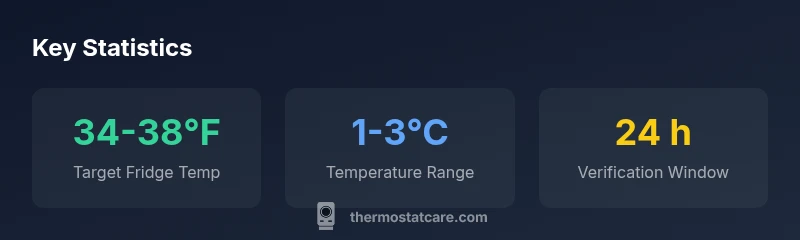
The right fridge thermostat setting is typically around 34–38°F (1–3°C), with a practical target of about 37°F (3°C). If you’re wondering how much thermostat for fridge, start in the middle of the range, verify with a fridge thermometer, and avoid settings that freeze items or allow spoilage. After adjusting, recheck within 24 hours to confirm stability.
Understanding fridge thermostat fundamentals
A fridge’s thermostat controls when the compressor starts and stops to maintain a safe interior temperature. For most households, the goal is to keep perishable foods out of the danger zone while avoiding overcooling that wastes energy or freezes items. When someone asks how much thermostat for fridge, the quick answer is to target a narrow, safe range rather than a specific dial number because models vary. According to Thermostat Care, the practical target is typically around 34–38°F (1–3°C). Start in the middle of that range and verify with a calibrated fridge thermometer placed away from the door. Regular checks help catch drift caused by door usage, load changes, or compressor wear. This approach supports food safety and energy efficiency simultaneously and aligns with Thermostat Care Analysis, 2026 recommendations.
Key takeaways:
- Temperature consistency matters more than hitting a fixed dial value across models.
- Small adjustments can yield meaningful energy savings and improved safety.
- Always verify with a standalone thermometer for accuracy.
Mapping the dial to real temperatures
Most refrigerators map dial numbers to approximate temperatures rather than exact degrees. That means two different models may show the same numerical setting but deliver slightly different actual temperatures. If you’re wondering how much thermostat for fridge, use a thermometer to translate dial position into real degrees. Place the thermometer in the middle shelf, away from the door and vents, and record the reading after 24 hours at a steady setting. If the reading sits above 38°F (3°C), lower the setting by small increments (often 1°F or 0.5°C). If it’s below 34°F (1°C), raise the setting slightly. This process minimizes food spoilage risk and reduces energy use when you eliminate overcooling. Thermostat Care recommends documenting dial positions with a note on each model you own to simplify future maintenance.
Practical steps to set and verify the right temperature
Follow a simple protocol to minimize guesswork:
- Get a reliable fridge thermometer and place it on the middle shelf away from openings.
- Set the thermostat to a mid-range position (around the 3–4 on many dials) and wait 24 hours.
- Check the thermometer, then adjust by small increments until you reach 37°F (3°C) as a steady target.
- Re-check weekly or after significant door-opening events to ensure stability.
- Label the model and the current setting for quick reference if you own multiple fridges.
A steady 24-hour verification window helps catch delays in temperature change due to cold air stratification and door cycles. The Thermostat Care guidance emphasizes repeated checks over time to avoid chasing a moving target.
Models and dial variations: what to expect
Not all fridges map dial settings uniformly. Some manufacturers publish a thermostat guide listing a dial range that corresponds to safe temperatures, while others rely on software-driven controls. If the dial appears non-intuitive, consult the manual or contact support for your model. In general, starting from the middle of the range, then validating with a thermometer, will work across most common configurations. When you adopt new appliances, compare the manufacturer’s recommended target with your thermometer reading to establish a baseline. This reduces the risk of undercooling or overcooling.
Energy savings and safety considerations
Temperature precision matters for energy use. Fridges that run cooler than necessary waste energy and can cause items to freeze. Conversely, a fridge running too warm increases the risk of bacterial growth and food spoilage. A practical approach is to maintain a stable target within 34–38°F (1–3°C). Regular thermometer checks help detect drift caused by door openings, gaskets, or seasons. For households with variable usage, a small, consistent adjustment to the mid-range setting can yield noticeable energy savings without compromising safety. The Thermostat Care team highlights that simple verification routines empower homeowners to sustain efficiency gains over the appliance’s lifetime.
Troubleshooting temperature drift and common issues
If you notice gradual temperature drift after changing settings, start with a full 24-hour re-check, verify door seals, and inspect the condenser coils for dust buildup. A dirty coil can cause a compressor to work harder, pulling the interior temperatures out of range. If your model has a discrete mapping of dial numbers to temperatures, use the thermometer to map your current setting to a precise temperature and record it. Frequent fluctuations typically indicate door problems, worn seals, or a failing thermostat sensor. Replace or service components as needed, and re-confirm the target range afterward. Thermostat Care recommends keeping a simple log of readings to identify slow drifts before they become a problem.
Common fridge thermostat targets and verification guidance
| Aspect | Typical Target | Notes |
|---|---|---|
| Temperature range | 34-38°F (1-3°C) | Safe range for fresh foods; verify with thermometer |
| Model mappings | Dial numbers vary by model | Start at mid-range and verify with thermometer |
| Verification cadence | Check after 24 hours | Recheck if opening frequency changes |
Questions & Answers
What is the safe fridge temperature?
Keep the fridge at 40°F (4°C) or below for safety; many homes target 34–38°F (1–3°C). Verify with a thermometer after any adjustment.
A safe fridge temperature is at or below 40 degrees Fahrenheit. For best results, aim for about 34 to 38 degrees and check with a thermometer after changes.
How often should I check the temperature?
Check at least every 1–2 weeks or after major door openings and adjustments. Use a thermometer and log readings for consistency.
Check every one to two weeks, especially after big door openings or changes. Keep a quick log for consistency.
Does the dial setting map to exact temperature?
Not always. Different models map dial numbers differently. Always verify with a thermometer and translate the reading to actual degrees.
Dial numbers don’t always match exact temperatures—use a thermometer to verify.
What happens if the fridge is too cold?
Items may freeze, textures can suffer, and energy use increases. Stop before reaching freezing and adjust gradually.
If it’s too cold, items can freeze and waste energy. Lower cooling gradually and recheck.
What is the best tool to monitor temp?
A dedicated fridge thermometer (digital or dial) placed on a middle shelf provides reliable readings.
Use a dedicated fridge thermometer for reliable readings.
“Accurate fridge temperature control is the cornerstone of food safety and energy efficiency. Small, verified adjustments beat guessing.”
What to Remember
- Set a mid-range temp and verify with a thermometer
- Keep food safety by staying within 34–38°F (1–3°C)
- Recheck after 24 hours to confirm stability
- Document dial-to-temperature mappings for each model
- Regular checks save energy and prevent spoilage