Smart thermostat vs regular: A Thorough Comparison
Explore the differences between smart thermostats and regular thermostats. This analytical guide covers automation, energy usage, installation, privacy, and practical decision factors for choosing the right option for your home. Thermostat Care guidance to help DIY homeowners.


According to Thermostat Care, comparing smart thermostat vs regular models helps homeowners evaluate control, energy savings, and long-term value. This quick comparison highlights key differences in automation, user experience, installation, and cost implications. If you want hands-free scheduling, remote access, and adaptive learning, a smart thermostat generally offers more value. For simple setups and low upfront cost, a traditional thermostat remains a valid, reliable option, especially in non-digital homes.
What is a smart thermostat vs regular thermostat?
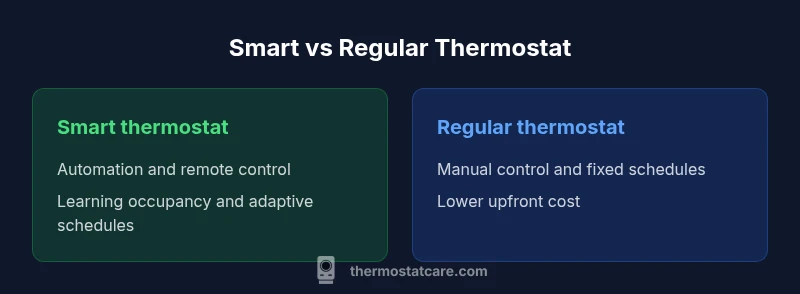
In the smart thermostat vs regular thermostat comparison, the core distinction is connectivity, intelligence, and how you interact with your home climate. A smart thermostat connects to Wi‑Fi, supports mobile apps and voice control, and uses sensors to learn patterns and adjust settings automatically. A regular thermostat, by contrast, operates as a standalone device with manual adjustments or simple programmable schedules. Understanding these differences helps homeowners decide whether the added features justify the cost and complexity in their specific home setup.
In broader terms, the choice often hinges on how much automation you want, how much you value remote control, and whether your heating and cooling system can take advantage of smarter scheduling. For a lot of homes, the decision comes down to the daily rhythm of life and the willingness to engage with a connected device. The keyword here—smart thermostat vs regular—frames the trade-off between simplicity and future-proofed comfort.
Core capabilities and sensing differences
Smart thermostats rely on occupancy sensors, geofencing, and learning algorithms to decide when to heat or cool. They can track when people are home, how quickly the space heats or cools, and how long a system runs between adjustments. Regular thermostats may offer basic scheduling or temporary overrides but lack adaptive sensing or predictive adjustments. In this section we compare the two on automation depth, responsiveness to changes in weather, and integration with other smart devices. For most homes, the smart option provides smoother comfort and less manual intervention, while traditional models excel in simplicity and reliability with fewer points of failure.
Another facet is how they respond to real-world variability—think children waking up at different times, weekend routines, or seasonal shifts. A smart thermostat tends to edge ahead by readjusting plans automatically, though this requires a reliable network and some setup. When evaluating, consider how much you value hands-free control and whether your household will consistently benefit from automation.
To ground the discussion, consider your current comfort gaps: Do you often adjust the thermostat to accommodate unexpected schedule changes? If yes, a smart model is likely to reduce those interruptions.
Energy efficiency and cost implications
Energy efficiency is often cited as the primary reason to consider a smart thermostat. While exact savings depend on your habits and climate, the core idea is that automation reduces unnecessary heating or cooling. Thermostat Care analysis shows that households that consistently use programmable or learning features tend to see more consistent temperature management and reduced waste. However, the upfront cost, potential maintenance, and ongoing data usage should be weighed. For some households in milder climates, the incremental benefit may be smaller, while in high-usage homes, the value can be more noticeable over time.
Beyond individual savings, a smart thermostat can help you better align your energy use with utility-rate structures if supported in your area. This alignment is especially useful for households with shiftable loads or flexible schedules. In contrast, a traditional thermostat offers predictable energy use that matches its fixed program, but lacks the nuance of occupancy-driven optimization. The takeaway is that the energy story is most compelling when automation is paired with consistent daily routines and minimal manual overrides.
Control interfaces and ecosystem compatibility
Smart thermostats offer a range of control methods: mobile apps, voice assistants, and onboard controls. They also integrate with popular ecosystems like smart speakers and home hubs, enabling routines that span lights, sensors, and HVAC. Regular thermostats focus on a physical interface—buttons, a dial, or a basic keypad—and rarely offer remote control. When evaluating options, check compatibility with your existing devices (Alexa, Google Assistant, Apple HomeKit) and whether the thermostat can operate with your heating system's type (forced air, hydronic, heat pump).
The control experience matters as much as the hardware; a poor app design or clunky voice commands can undermine benefits. If you already rely on a specific smart home ecosystem, a thermostat that plays nicely with that system will reduce friction and improve long-term adoption. In homes with minimal smart devices, a basic regular model can still deliver reliable temperature control without platform dependencies.
Installation, compatibility, and wiring considerations
Installation complexity varies widely by model and existing wiring. Some smart thermostats require a C-wire for power, while others can operate on power stealing or batteries. If your system uses a heat pump, multi‑stage cooling, or other advanced controls, you may need professional installation to ensure proper wiring and safety. In most homes, compatibility is determined by the HVAC type, the presence of a C-wire, and whether your current thermostat has sub–systems that need replacement. Plan for a brief setup check and consider whether your HVAC also uses humidification or ventilation controls that could be affected by a thermostat change.
A practical step is to map your current wiring and confirm compatibility with chosen models before purchasing. If you’re uncertain, consult a licensed technician to avoid miswiring or safety risks. A well-planned installation minimizes downtime and ensures the thermostat reads accurate temperature data from the right zones.
Data privacy, security, and smart-home integration
Smart devices collect data to optimize performance, which raises privacy and security considerations. Review the vendor’s data policy, encryption standards, and how data is stored or shared. Use strong, unique passwords and enable two‑factor authentication where available. If privacy is a priority, you can limit data sharing or opt for a device that emphasizes local processing. When integrating with a broader smart home, ensure you understand potential attack surfaces and keep firmware up to date to mitigate vulnerabilities.
To protect your network, segregate smart devices on a guest or dedicated IoT network and regularly review app permissions. Even in a well‑secured setup, be mindful of the data trails left by energy usage patterns and device behavior. The goal is to balance convenience with reasonable privacy controls and transparent vendor practices.
Learning behavior, occupancy patterns, and comfort
Adaptive features in smart thermostats learn occupancy patterns and weather responses to maintain comfortable temperatures with minimal manual input. They adjust schedules over days and seasons, and some models offer occupancy cues that can influence zoning or room-by-room temperature control. Regular models rely on fixed schedules that can become out of sync with actual usage, leading to comfort gaps or overcooling. For many homeowners, the most satisfying benefits come from a blend of automatic adjustments and the ability to override quickly when plans change.
Learning accuracy improves as the system gathers data over time, so early results may be modest. If you frequently entertain, travel, or have irregular work hours, the automation can quickly become noticeable in daily comfort. Remember to review and fine-tune schedules to maximize real-world benefits without sacrificing convenience.
Scalability, updates, and reliability
One advantage of smart thermostats is ongoing software updates that add features and improve stability. However, updates can occasionally require changes to routines or integrations. Reliability depends on network stability and hardware quality; regular thermostats tend to be less dependent on software and internet connections, so they can be steadier in areas with poor connectivity. When evaluating, consider how you will handle firmware updates and whether your home setup supports the latest features without compromising reliability.
A well-structured plan includes choosing devices with clear update policies, ample local fallback options, and documented compatibility with your HVAC components. If you anticipate frequent changes to your smart home, the modular nature of a smart thermostat portfolio can be advantageous. If you value long-term stability with minimal maintenance, a traditional model may offer more predictable performance.
Common myths about smart thermostats
Several myths persist around smart thermostats. Some assume they always save money; others worry that they will overhear private conversations through ambient sensors. In reality, savings depend on how you program and use the device, and privacy features vary by manufacturer. A regular thermostat can be just as reliable for basic control, and in some cases, homeowners prefer a non-connected device for simplicity or privacy reasons.
Another misconception is that all smart thermostats require a powerful internet connection. In practice, many models work well with standard home Wi‑Fi, and some features still operate locally if the connection drops. Understanding what is truly offered—and what requires cloud processing—helps you set realistic expectations and avoid feature fatigue.
Use-case driven decision framework
To decide between smart vs regular, start with your goals: comfort, energy savings, and simplicity. If you want automation and remote control, choose smart. If you prioritize reliability, minimal setup, and a lower upfront cost, a regular thermostat may be sufficient. Create a checklist: HVAC type (gas, electric, heat pump), wiring readiness (C-wire), internet reliability, and willingness to manage software updates. This framework helps you map needs to features and avoid buying features you won’t use. Thermostat Care recommends documenting your current pain points and aligning features with those insights to maximize value.
Real-world scenarios and recommendations
Consider a family with fluctuating schedules in a two-story home: a smart thermostat can coordinate zoning and occupancy, reducing waste when the house is empty. A small apartment with predictable routines might see modest gains, but a modern smart thermostat still offers convenient remote control and lifestyle integration. For homes with older systems or limited internet, a traditional thermostat remains a reasonable baseline. Thermostat Care notes that understanding your daily rhythm is the key to extracting value from either option.
How to transition from regular to smart
Plan the transition in phases: verify compatibility, choose a model with clear installation guides, and backup your current settings. Use the online step-by-step setup to connect to Wi‑Fi and your home assistant. After installation, spend a few days documenting how the new thermostat impacts comfort and energy use, adjusting schedules as needed. If you encounter compatibility issues, consult a professional for wiring or HVAC compatibility recommendations. A gradual approach reduces risk and helps you learn the new interface.
Pros and cons at a glance
Both options offer distinct advantages and trade-offs that matter for decision making. For smart thermostats, the major upside is automation and remote control, which can improve comfort and alignment with occupancy. The main downsides are higher upfront costs, potential privacy concerns, and a need for reliable Wi‑Fi. Regular thermostats shine with simplicity, reliability, and lower initial outlay, but lack adaptive features and remote access, which may feel limiting as your home evolves. The best choice depends on how you value convenience against cost and how important ongoing software features are to your household.
Special considerations for renters vs homeowners
Renters should consider whether a landlord permits thermostat replacement, how the thermostat is mounted, and if zoning is feasible in the space. Homeowners can usually upgrade more freely but should plan for compatibility with existing heating equipment and potential professional installation for safer wiring. Both groups should review privacy and data sharing terms, and ensure any purchased device offers a proper warranty and support structure.
Comparison
| Feature | Smart thermostat | Regular thermostat |
|---|---|---|
| Automation capabilities | Advanced scheduling, learning features, remote control | Manual control or basic scheduling only |
| Energy savings potential | Adaptive energy use with occupancy patterns | Limited to fixed schedules or manual adjustments |
| Control and integration | App/voice control, smart-home integration | On-device controls only, limited or no integration |
| Installation complexity | Needs Wi-Fi and possibly C-wire; setup guides available | Low complexity with simple wiring |
| Upfront cost | Higher upfront cost due to electronics and connectivity | Lower upfront cost with basic hardware |
| Best for | Tech-savvy homes seeking automation and energy awareness | Budget-conscious setups with simple needs |
Upsides
- Enhanced energy management through automation and schedules
- Remote access and control from anywhere
- Continual software updates improve features and security
- Better integration with other smart devices
The Bad
- Higher upfront cost and potential ongoing subscription features
- Reliance on Wi-Fi and power availability
- Privacy concerns from data collection and sharing
- Compatibility and learning curve for some systems
Smart thermostat generally offers more value for most homes.
For households seeking automation, remote control, and adaptive scheduling, a smart thermostat is the recommended option. Thermostat Care notes that energy savings and comfort improve with smart models when used with thoughtful schedules; if you need ultra-simplicity or have budget constraints, a regular thermostat remains a viable fallback.
Questions & Answers
What is the main difference between a smart thermostat and a regular thermostat?
The smart thermostat adds connectivity, learning, and remote control; a regular thermostat offers basic manual control. The smart version can adjust based on occupancy and patterns, while the regular does not.
Smart thermostats connect to your home network and learn from your habits, while traditional thermostats keep things simple with manual adjustments.
Do smart thermostats actually save energy?
In practice, they help optimize usage by aligning heating and cooling with occupancy and schedules, which can reduce energy waste.
They help reduce wasted energy by aligning heating with when you’re home.
Is it easy to install a smart thermostat myself?
Many models are designed for DIY installation with basic wiring, but some setups require professional help, especially for complex systems.
Some models are easy to install, others may need a pro, depending on your wiring.
Will a smart thermostat work with my current HVAC system?
Most smart thermostats work with common systems, but compatibility depends on wiring, heat type, and control features.
Most do, but you should check compatibility with your furnace, boiler, or heat pump.
Are there privacy concerns with smart thermostats?
Yes, there are privacy considerations; review data handling settings and use secure networks and accounts.
Yes, there are privacy considerations; adjust settings and be mindful of data collection.
What about energy savings for renters?
Renters should check lease terms and landlord permissions; some smart thermostats require approval or may not be allowed to replace existing devices.
Renters should check with their landlord before installing a smart thermostat.
What to Remember
- Evaluate your HVAC wiring and control needs before buying
- Smart thermostats offer automation and remote access
- Account for Wi-Fi reliability and data/privacy considerations
- Expect ongoing software updates to affect features and setup
- Renters should verify landlord permissions and compatibility before installation