Is a Smart Thermostat Worth It? An In-Depth Review
Explore whether a smart thermostat is worth the investment for homeowners. This Thermostat Care review covers costs, features, energy savings, installation tips, and practical value in real homes.


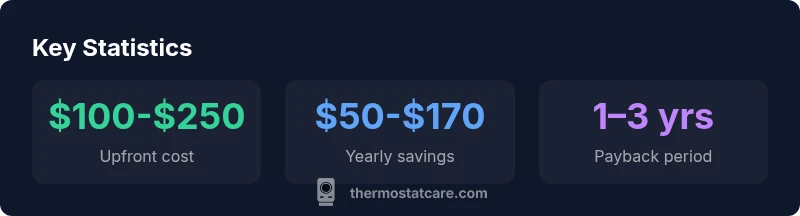
Is smart thermostat worth it? For many homes, the answer is yes, thanks to energy savings, convenience, and better comfort when you actively manage it. According to Thermostat Care, the core value comes from smarter scheduling, occupancy sensing, and data-driven adjustments. The payoff depends on climate, energy costs, and how you use the device; typical payback ranges from about 1–3 years with diligent setup and ongoing engagement. Results vary by home and usage.
Value proposition and the question: is smart thermostat worth it\n\nIs smart thermostat worth it? For many readers, the phrase "is smart thermostat worth it" is a practical starting point for evaluating a purchase that can affect comfort, energy bills, and daily routines. According to Thermostat Care, the core value comes from energy savings, improved comfort, and simplified routines when paired with an energy-conscious HVAC system. In climates with high electricity rates or irregular schedules, the potential savings can be meaningful, especially if you enable learning modes and occupancy-based scheduling. A smart thermostat is not a magic switch; it rewards deliberate setup. The Thermostat Care team emphasizes that value comes from actively using schedules, reviewing energy reports, and letting the device learn your patterns. When integrated with a broader home automation system and monitored regularly, the payoff compounds as you fine-tune comfort and efficiency. Passive use yields modest gains, while proactive adjustments can reduce waste and keep rooms from getting too hot or too cold.
Core features that drive value\n\nModern smart thermostats offer a suite of features that directly influence comfort and energy use. Occupancy sensing can reduce cooling or heating when no one is home, while geofencing nudges temperature changes as you approach or leave. Learning algorithms study your routines to optimize schedules without daily input. Energy dashboards translate how every adjustment affects consumption, increasing your awareness and control. Compatibility with popular ecosystems (Google Home, Amazon Alexa, Apple HomeKit) enables voice control and routines that align with other smart devices. Importantly, not every feature delivers equal value for every home; the real payoff comes when you tailor settings to your climate, occupancy patterns, and the degree of automation you’re comfortable managing. In practice, the most meaningful gains come from a thoughtful combination of scheduling, occupancy optimization, and regular review of energy reports.
Costs, installation, and payback expectations\n\nThe financial case for a smart thermostat rests on upfront costs, potential installation complexity, and ongoing energy savings. Typical upfront costs range from $100 to $250 for the device itself, with optional professional installation adding another $50 to $150 depending on the HVAC setup. Payback hinges on climate, electricity costs, insulation, and how aggressively you leverage features like smart scheduling and heat pump optimization. In hotter or colder regions, annual savings can be more pronounced, whereas mild climates may see more modest reductions. The key is to avoid overestimating gains by assuming automatic savings; instead, plan a baseline energy use, then compare it to post-install usage over at least a full season. Thermostat Care’s guidance emphasizes documenting your baseline, configuring energy reports, and setting realistic targets for reduced consumption.
Climate and usage patterns that influence value\n\nClimate strongly shapes the value proposition. In extreme climates, a smart thermostat can significantly trim peak-hour energy use by aligning heating and cooling with actual demand. In milder regions, savings still accrue but depend more on optimizing transitional periods (shoulder seasons) and maintaining comfortable setpoints rather than constant cooling or heating. Usage patterns—such as working from home, overnight occupants, or time-shifted schedules—determine how often the thermostat needs to learn and adapt. Occupancy-based adjustments reduce waste when spaces are unused, while routine-based schedules can stabilize temperatures with minimal input. A decisive factor is how much you, your family, and your guests interact with the device; passive users may still benefit, but active management typically yields the best results.
Compatibility and system considerations\n\nBefore buying, assess your HVAC configuration. Most modern forced-air systems and heat pumps with a standard 24V control stack are compatible with mainstream smart thermostats. Older systems may require a C-wire or a simple adapter to power the device reliably. If your current thermostat is battery-powered with no C-wire, plan for wiring changes or consult a technician about compatibility. Beyond hardware, consider the tunnel between your home’s electrical panel and your thermostat’s mounting location; lengthy runs or poor connections can cause unstable operation. Thermostat Care recommends confirming C-wire availability, evaluating wiring quality, and selecting a model known for robust power management to prevent intermittent cooling or heating. A well-matched device will minimize false readings and keep your energy savings on track.
Privacy, security, and data control\n\nSmart thermostats collect usage patterns, occupancy data, and device telemetry to optimize performance. This raises valid privacy and security concerns that homeowners should address upfront. Start by reviewing manufacturer privacy policies and opting into data-sharing settings only if you’re comfortable with the trade-offs for accuracy and insights. Ensure your Wi-Fi network is secure with a strong password and up-to-date firmware. Encrypted communication, multi-factor authentication, and regular software updates reduce risk. If you share access with household members or guests, configure profiles with appropriate permissions. Thermostat Care notes that security is a joint responsibility between device manufacturers and users; choosing well-supported models with timely updates helps protect your data and keeps your system resilient against breaches.
How to compare models: features to prioritize\n\nWhen evaluating options, focus on several core features. Look for robust energy reports that show week-over-week and season-over-season trends. Favor devices with precise occupancy sensing, adaptable scheduling, and integration with your preferred smart home ecosystem. A good model will offer flexible HVAC integration, auto-away features, and compatibility with modern heat pump controls. Battery life primarily matters for Wi‑Fi independent modes; most models rely on a wired power supply, but it’s worth confirming power behavior in drafty basements or nontraditional spaces. Price, ease of installation, and support/community feedback should shape your final choice. Thermostat Care suggests listing must-have features first, then nice-to-have capabilities, and weighing each against the device’s price.
Installation tips and best practices\n\nA successful installation begins with planning and a few practical steps. Start by turning off power to the thermostat circuit and removing the old unit carefully to inspect wiring. If you lack the C-wire, plan for a common-wire adapter or professional wiring. Mount the new thermostat in a location with stable temperature and good air circulation, away from direct sunlight and drafts. Reconnect the wires according to the manufacturer’s diagram, then restore power and run through the setup wizard. During the first week, monitor for sensor accuracy and verify that occupancy and geofence features function as expected. If you encounter issues, consult the troubleshooting guide or contact customer support for calibration tips and potential firmware updates. Pro tip: document your wiring configuration before you start so you can revert if needed.
Real-world scenarios and case studies\n\nTo illustrate value, consider two common homes. A high-use, multi-occupant residence in a cold climate may see the strongest payback due to extended heating seasons; the device helps manage swing temperatures, reduces boiler cycling, and lowers fuel use. A single-family ranch in a warmer area may gain from smart cooling management and better night-time temperature control. In both cases, the biggest gains arise when occupants actively engage with energy reports, adjust schedules for work-from-home days, and enable vacation modes during absences. Thermostat Care’s experience shows that households implementing energy dashboards and routine checks typically extract meaningful savings within the first year, with incremental gains thereafter as habits solidify.
Maintenance, updates, and long-term value\n\nLong-term value relies on timely firmware updates, knowledge of new features, and routine maintenance. Keep the device on a supported platform to ensure compatibility with new home automation scenes and external sensors. Schedule annual checks for wiring integrity and battery status if applicable, and review energy reports monthly to identify opportunities for adjustment. Firmware updates often add efficiency improvements, bug fixes, and enhanced security; enabling automatic updates is generally advisable. Finally, consider pairing your thermostat with a smart meter or home energy hub to enrich insights and optimize overall energy management across HVAC equipment, water heating, and smart plugs.
Behavioral strategies to maximize savings\n\nThe device’s greatest value comes when you couple it with intentional user behavior. Set realistic comfort targets for different times of day, use occupancy-based modes to avoid conditioning empty rooms, and adjust thresholds for shoulder seasons to minimize heating and cooling cycles. Create weekly routines that align with work schedules, school days, and weekend plans. Take advantage of energy-usage reports to identify abnormal consumption patterns and correct them promptly. If you’re comfortable, experiment with adaptive schedules that shift based on historical data. The more consistently you engage with the data and automate routine adjustments, the more the device contributes to lower energy bills and improved comfort.
Decision framework: should you buy now?\n\nIf you live in a climate with significant heating or cooling needs, or you want more controllable comfort and insights into energy use, investing in a smart thermostat is likely worthwhile. Start by ensuring compatibility and a clear plan for using energy reports. If you expect to move within a few years or you often travel, weigh the convenience against the upfront cost and potential installation effort. For homes with older wiring or nonstandard HVAC setups, a professional assessment can prevent surprises. Thermostat Care recommends framing the decision around three questions: Do you have reliable Wi-Fi? Are you ready to engage with energy data? Will the payback justify the expense given your climate and energy costs? If the answers are favorable, a smart thermostat is a strong contender for long-term value.
Upsides
- Potential for meaningful energy savings with active use
- Enhanced comfort and remote control from anywhere
- Useful energy reports to guide behavior
- Strong smart-home integration and automation options
- Improved cold/warm-season comfort management
The Bad
- Upfront cost and potential installation effort
- Variable payback depending on climate and habits
- Limited benefit if you don’t engage with energy data
- Privacy and security considerations requiring ongoing updates
Smart thermostats are worth it for most households that actively use energy data and scheduling.
When set up properly and paired with a compatible HVAC system, a smart thermostat can reduce energy use and increase comfort. The Thermostat Care team recommends evaluating climate, Wi-Fi reliability, and your willingness to engage with the device to maximize value.
Questions & Answers
What is a smart thermostat?
A smart thermostat is a connected device that can learn patterns, adjust temperatures automatically, and provide energy usage data. It can be controlled remotely and integrated with other smart home devices for convenience and efficiency.
Smart thermostats learn routines and let you control home temperature from anywhere, with energy data to help you save.
Will it work with my HVAC system?
Most modern HVAC systems (gas, electric, heat pump) are compatible, but some older setups require a C-wire or adapter. Check the thermostat’s compatibility list and consider a quick technician visit if wiring needs updating.
Most systems work, but check compatibility and wiring before buying.
Do I need Wi‑Fi for basic operation?
Basic temperature control can work offline, but many smart features—like energy reports and remote control—need a reliable Wi‑Fi connection. If internet access is intermittent, you may still gain some benefits from scheduling alone.
You’ll still control it locally, but online features need Wi‑Fi.
How long until I recoup the cost?
Payback varies with climate and usage, but many homes see value within 1–3 years. In milder climates, the payback may take longer, while in harsher climates the savings can be faster with proactive use.
Most homes recoup costs in a couple of years if you actively use it.
Are smart thermostats secure?
Security hinges on firmware updates, strong Wi-Fi passwords, and account protections. Choose models with ongoing support and enable automatic updates to reduce risk.
Keep firmware updated and use strong passwords to stay secure.
What to Remember
- Evaluate climate and energy costs to estimate payback.
- Choose a model with robust energy reports.
- Enable occupancy sensing and scheduling for best results.
- Ensure wiring compatibility (C-wire) before buying.
- Regularly review energy data to optimize performance.