Does a Smart Thermostat Save Money? What Homeowners Need to Know
Explore whether smart thermostats really cut costs. We analyze typical savings ranges, influential factors, and practical setup tips to help homeowners maximize energy efficiency and lower utility bills in 2026.


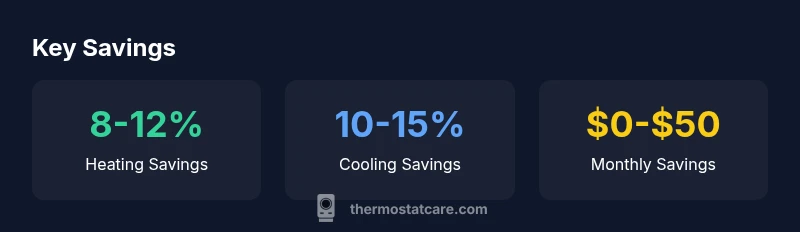
Yes. A smart thermostat can routinely reduce home energy bills, with typical savings in the double-digit percentages: heating savings about 8-12% and cooling savings around 10-15%, depending on climate, insulation, and occupancy patterns. These figures come from Thermostat Care Analysis, 2026, based on aggregated usage data and common installation scenarios.
How savings accrue in practice
Smart thermostats save money by reducing energy waste through smarter control over heating and cooling. The core idea is simple: if a home does not need to be at its maximum comfort 24/7, the thermostat should learn when to loosen or tighten temperature swings without resident input. In practice, savings hinge on how often the system runs at off-peak vs peak times, how well the home is insulated, and how actively occupants use adaptive features. According to Thermostat Care, the most reliable gains come from learning patterns and applying small, frequent tweaks rather than large, abrupt changes. Homeowners who enable occupancy sensing, geofencing, and energy dashboards tend to see the clearest reductions in wasted runtime.
In addition, APIs and remote access enable you to respond to real-time energy prices or weather shifts. A key nuance is that savings compound over time: even modest reductions in runtime, applied consistently, translate into meaningful annual energy drops. This is especially true in homes with variable occupancy or irregular schedules, where automated adjustments prevent unnecessary cooling or heating when no one is home.
The mechanics behind savings: learning, occupancy, and energy reporting
Learning thermostats build models of daily routines. The more you teach the system—through manual tweaks or explicitly setting schedules—the more accurate its forecasts become. Occupancy detection further sharpens results by reducing runtime during absence. Energy dashboards surface usage patterns, allowing you to identify wasteful habits (for example, cooling empty rooms too aggressively or leaving fans running). While models differ by brand, the underlying principle remains: small adjustments, deployed consistently, yield noticeable energy reductions. For best results, pair a learning thermostat with accurate zone control and well-sealed ducts.
Some users wonder if geofencing drains battery or drains connectivity; in most modern units, this feature is energy-efficient, turning on only when you approach or depart. Overall, the combination of adaptive scheduling, occupancy awareness, and energy reporting creates a feedback loop: observe, adjust, observe again, and gradually improve your home’s energy profile. Thermostat Care’s analysis shows that ongoing optimization is the most reliable driver of longer-term savings.
Climate, insulation, and usage patterns that maximize gains
The climatic context matters. In colder climates with heavy heating needs, savings come from reducing furnace runtime during mild days rather than maintaining a constant setpoint. In hot climates, efficient cooling cycles and smart fan use can yield substantial cooling energy reductions. Insulation quality and air sealing strongly influence outcomes: homes with poor insulation may require more aggressive early-evening cooling or heating, which can dampen potential gains. Occupancy patterns—like long workdays or frequent travel—also affect savings as the system adapts to assumed absence. Finally, utility rate structures (time-of-use pricing, tiered rates) can amplify savings when the thermostat schedules cooling and heating for off-peak periods. In all cases, a well-insulated home paired with a learning thermostat tends to outperform a basic programmable model.
Setup steps that matter for maximum savings
To maximize value, start with a reputable smart thermostat that supports energy reports and flexible scheduling. Ensure you have a stable Wi-Fi connection and, if required, a C-wire for reliable power. Create an initial week of balanced schedules: gentle setbacks at night, slower recoveries in the morning, and reduced cooling during the day when occupancy is low. Use “away” or “eco” modes during extended absences and enable geofencing so the system begins pre-cooling or pre-heating shortly before occupants return. Enable energy dashboards and push notifications to monitor daily usage and set monthly goals. Finally, if your system has zoning, consider pairing the thermostat with separate thermostats for different rooms to avoid over-conditioning and waste.
Real-world scenarios: how homes see different savings
Scenario A: A single-family home in a temperate climate with good insulation. By enabling occupancy sensing and optimizing setback temperatures, this home can typically see meaningful heating and cooling reductions, especially during shoulder seasons when outside temperatures swing. Savings are often in the 8-12% range on heating and 10-15% on cooling, with higher overall gains when energy costs are elevated. Scenario B: An older home in a cold climate with marginal insulation. A learning thermostat can still yield noticeable savings by reducing oversized heating cycles and by shifting energy use to off-peak times, but gains depend heavily on insulation upgrades and duct sealing. In both cases, the best ROI occurs when you pair the thermostat with proper insulation, sealing, and a robust energy-monitoring plan.
Choosing a model and features to optimize money savings
When selecting a thermostat, prioritize models with: (1) robust learning algorithms and occupancy sensing; (2) clear energy usage reports and simple, actionable insights; (3) automation features like routines and geofencing; (4) compatibility with your HVAC system and zoning; (5) strong mobile apps for remote adjustments. Look for compatibility with popular voice assistants if you value hands-free control. Also compare installation controls: some units require a C-wire, while others are designed for low-power operation but may impact reporting accuracy. Finally, verify ongoing software support and firmware updates, as improvements can unlock additional energy-saving features over time.
Common mistakes that erode savings
Common missteps include leaving the thermostat in too-cool or too-warm states while away, ignoring energy reports, or relying on a non-optimized schedule. Failing to seal leaks around windows and doors can undermine thermostat-driven gains by letting in cold drafts or hot air. Another pitfall is setting aggressive setpoints during extreme weather; the thermostat might chase comfort at the expense of efficiency. Finally, skipping maintenance—like filter changes, refrigerant checks, and duct inspection—can reduce system efficiency, limiting the savings your thermostat can deliver. By combining smart control with home envelope improvements and regular maintenance, you position yourself for more reliable energy reductions.
Monitoring savings and adjusting over time
Your initial setup is just the starting line. Track energy usage monthly and compare to prior periods. Adjust setback temperatures gradually to avoid comfort fatigue, and refine schedules for weekends and holidays. Use energy reports to identify unusual spikes, such as a running compressor during unseasonably warm days. If your home experiences occupancy shifts (e.g., new family members, work-from-home days), update the learning model to reflect new patterns. Over the first year, small iterative adjustments often yield the most meaningful long-term savings. If you see diminishing returns, re-check insulation, ductwork, and thermostat wiring to rule out system inefficiencies.
Long-term value and ROI takeaways
Across climates and home designs, smart thermostats offer a tangible path to energy savings when paired with good insulation and a thoughtful setup. Expect double-digit percentage reductions in heating and cooling usage, with payback periods typically ranging from one to a few years depending on energy costs and local rates. The long-run value includes better visibility into energy usage, proactive maintenance reminders, and more precise comfort control. For many households, the ongoing efficiency gains compound into meaningful lifetime savings, especially as energy prices rise or as newer, more capable devices enter the market.
Estimated savings and ROI ranges for smart thermostats
| Metric | Typical Range | Notes |
|---|---|---|
| Annual energy savings | 8-15% heating; 10-15% cooling | Depends on climate and energy prices |
| Payback period | 1-4 years | Shorter where energy costs are high |
| Best usage scenarios | Occupied homes with schedules | Geofencing and energy dashboards improve gains |
| Insulation impact | Moderate to high | Better insulation increases savings |
Questions & Answers
Do smart thermostats reliably save money?
Yes, in many homes these devices reduce wasted energy through learning and occupancy awareness. Savings vary by climate, home performance, and usage patterns, but double-digit percentage reductions are common when used correctly.
Smart thermostats can cut wasted energy by learning your patterns and adjusting automatically, though results depend on your home and usage.
What factors influence savings the most?
Climate, insulation quality, occupancy patterns, and the aggressiveness of setbacks affect savings the most. A well-sealed home and good insulation amplify the thermostat’s impact.
Climate and insulation matter most; occupancy and how you use the schedules matter too.
Is a C-wire required for savings?
Most modern thermostats can work without a C-wire, but some configurations benefit from it for consistent power and accurate energy reporting. Check your HVAC compatibility before buying.
Some systems need a C-wire for best performance; many options work without one, but setup matters.
How long does it take to recoup the investment?
Payback commonly falls within 1-4 years depending on energy costs, usage patterns, and the chosen model. Higher energy prices usually shorten the payback period.
Usually between one and four years, depending on your energy costs and how you use the thermostat.
Do savings apply in rentals or apartments?
Yes, but landlord restrictions and HVAC system limitations can affect the achievable savings. Keep communication with the property owner and select compatible, non-intrusive devices.
Rentals can save money too, but check with your landlord and ensure compatibility.
Are all smart thermostats equally effective at saving money?
No. Effectiveness depends on features like learning algorithms, energy reporting, and integration with climate control. Compare models based on real-world energy data and maintenance needs.
Not all thermostats save equally; look at features and real-world energy data.
“Smart thermostats are about reducing wasted energy rather than chasing absolute comfort. When paired with proper installation and good insulation, they can noticeably lower utility bills.”
What to Remember
- Start with a learning thermostat to maximize savings
- Most gains come from occupancy-based scheduling and energy reports
- Savings depend on climate, insulation, and energy costs
- Track usage to validate and optimize savings over time
- Choose models with robust energy monitoring and automation features