Who Do You Hire to Install a Thermostat? A Homeowner's Guide
Learn who to hire for thermostat installation, what credentials to verify, and how to choose between DIY vs professional service. Practical guidance for homeowners and DIYers from Thermostat Care.


To install a thermostat, hire a licensed HVAC technician or a qualified electrician with thermostat experience. Many smart thermostats require power wiring in the control circuit (C-wire), so an HVAC pro ensures safe, code-compliant installation and proper wiring. If you have a simple battery-powered thermostat, a DIY-friendly handyman may suffice, but check local codes and warranty terms.
What professional installation means for your thermostat
Installing a thermostat is more than snapping a device onto a wall. It involves electrical wiring, load assessments, compatibility checks, and careful configuration of your heating and cooling system. Hiring a professional ensures wiring is safe, the thermostat correctly communicates with the HVAC system, and the installation complies with local electrical codes. According to Thermostat Care, a correct install reduces the risk of short circuits, thermostat resets, and future warranty issues. It also sets you up for reliable performance from day one and preserves any manufacturer guarantees. In short, a professional install is an investment in safety, accuracy, and long-term comfort. A professional installer will also verify that the thermostat is compatible with your existing HVAC equipment, and they will ensure that you receive the full benefits of energy-saving features, scheduling options, and remote access. If you are replacing an older thermostat, the installer will check the wiring, ensure the C-wire is present, and confirm that the new device can share data with your HVAC controller.
Who is qualified to install a thermostat?
Qualified installers typically fall into two categories: licensed HVAC technicians and licensed electricians who specialize in thermostat wiring. In many regions, a contractor who holds both electrical and HVAC credentials is ideal, especially for complex systems with multiple stages or heat pumps. Manufacturers often require professional installation to validate warranty terms, and some models demand a dedicated C-wire or power-sharing mechanism that non-experts may overlook. When you hire, request proof of license and insurance, and ask for a written warranty on labor. A reputable installer should also provide a short commissioning checklist to confirm that all functions—heating, cooling, fan, and smart features—work as intended. According to Thermostat Care, verifying credentials upfront reduces risk and increases the likelihood of a smooth, trouble-free setup.
DIY vs professional installation: when to go pro
If your thermostat is battery-powered and you only need to replace a simple unit in a standard control box, a confident DIYer can usually manage the job. However, most modern thermostats require a C-wire for consistent power, proper wiring for heat and cool stages, and sometimes integration with a home automation platform. In those cases, attempting DIY installation can void warranties and lead to intermittent operation or system damage. A professional will also handle safety concerns, such as disconnecting power at the breaker and testing circuits after wiring. Thermostat Care notes that while DIY can be satisfying, the risks of miswiring or leaving live conductors exposed outweigh the benefits in many homes.
What happens during a professional installation
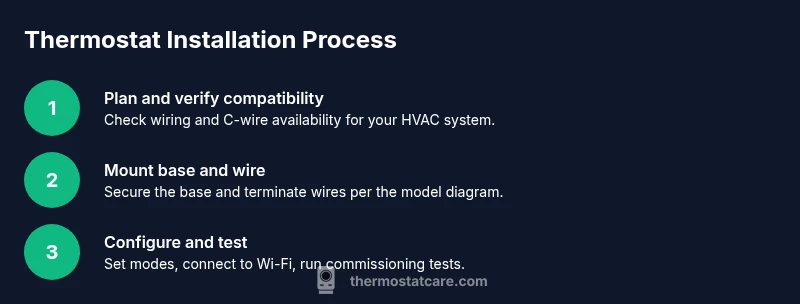
During a professional installation, the technician begins with an assessment: compatibility with your HVAC system, available wiring, and the presence of a functioning C-wire. Next, power is safely interrupted, and the old device is removed with care. The installer then mounts the new base, connects wires to the correct terminals, and follows the wiring diagram specific to your thermostat model. After securing the device, they configure system settings (heat, cool, auto modes, and fan), connect the thermostat to your Wi-Fi if applicable, and run a commissioning sequence to verify proper communication with the furnace or air handler. Finally, they document the installation, save settings, and provide guidance for future firmware updates.
Tools, materials, and preparations
Before the installer arrives, you can prepare by clearing the wall area and ensuring easy access to the HVAC control panel. Typical tools and materials used in a professional install include a voltage tester, a screwdriver set with various bits, wire nuts, and electrical tape. The technician may bring specialty tools or a C-wire adapter if your system lacks a common wire. If you are attempting a DIY install, a basic toolkit with a non-contact voltage tester and wire-strippers can be helpful, but only if you are confident in your electrical work. Always plan for a short downtime while the system is tested after wiring.
Costs, warranties, and guarantees
Prices for thermostat installation vary by region, system complexity, and the model you choose. In general, you should expect to pay for labor, any necessary parts, and potential diagnostic or permit charges. The exact figure is determined by local rates and the scope of work (single-stage vs multi-stage systems, and whether Wi-Fi or smart-home integration is included). A reputable installer will provide a written estimate before starting work and a warranty on labor. Energy-saving features and proper commissioning often justify higher upfront costs, because they deliver long-term comfort and efficiency with fewer callbacks.
Safety, codes, and safety checks
Electrical safety is the top priority during thermostat installation. Always turn off power at the circuit breaker before touching wiring, and use a voltage tester to confirm there is no live current. Respect local electrical codes and building regulations; improper wiring can cause short circuits or damage to the HVAC equipment. A licensed professional should also verify that the thermostat's wiring complies with the manufacturer's guidelines and that the control wiring is correctly terminated at the furnace or air handler. Finally, ensure the device is installed securely and that the wall box is rated for the thermostat weight.
How to choose the right installer
To select the best installer for your home, compare credentials, customer reviews, and written warranties. Ask for a site visit and a transparent written estimate that outlines labor, parts, and any potential extra charges. Check that the installer is comfortable with your thermostat model, and confirm they can assist with app setup and remote access if you want smart-home integration. A clear communication plan and a fixed-schedule window reduce disruption and lead to a smoother installation experience. According to Thermostat Care, prioritize providers who offer post-install support and a validation checklist.
Quick-start installation-day checklist
Before the installation day, verify model compatibility by reviewing the thermostat’s wiring diagram and your HVAC system’s manual. On the day of installation, ensure the power is off at the breaker, the workspace is clear, and the old thermostat is still available for reference. Have a plan for labeling wires and confirming terminal connections. After installation, test all modes—heat, cool, auto, fan—and verify that the device communicates with your HVAC equipment and, if applicable, your home network. Keep the receipt, model information, and any warranty documents in a safe place for future reference.
Tools & Materials
- Voltage tester(Non-contact preferred; verify circuits are dead before touching wires.)
- Screwdriver set (Phillips & flat-head)(For mounting plates and terminal screws.)
- Wire nuts(Secure splices and tidy wiring connections.)
- Electrical tape(Insulate exposed terminals and wire joins.)
- Pliers and wire cutters(Helpful for trimming wires if needed.)
- C-wire adapter or jumper wires(Use if your system lacks a dedicated C-wire.)
- Safety gear (gloves, safety goggles)(Basic protection during electrical work.)
Steps
Estimated time: 2-4 hours
- 1
Verify compatibility and plan wiring
Review the thermostat model’s wiring diagram and confirm compatibility with your HVAC system. Check whether a C-wire is present and identify any unusual wire colors or multi-stage configurations. This upfront planning reduces surprises on installation day.
Tip: Have the HVAC system model and thermostat manual handy for quick cross-checks. - 2
Choose a qualified installer and schedule
Contact licensed HVAC technicians or licensed electricians who specialize in thermostat installs. Get written estimates, confirm license and insurance, and ask about a labor warranty. Schedule a convenient time with minimal disruption to daily routines.
Tip: Ask for a fixed quote and a detailed scope of work to avoid hidden fees. - 3
Prepare the space and power down
Clear the wall area, locate the HVAC access panel, and switch off power at the circuit breaker designated for the system. This reduces the risk of electric shock and accidental short circuits during wiring.
Tip: Label wires from the old thermostat to simplify the transfer to the new unit. - 4
Mount the base and connect wires
Secure the thermostat base to the wall, then attach wires to their corresponding terminals according to the wiring diagram. Double-check that the C-wire and any control wires are firmly terminated and insulated.
Tip: If wires look frayed, do not force them; trim and strip properly or request professional replacement. - 5
Configure settings and connect to network
Power on the system, configure heat/cool modes, fan settings, schedule, and any Wi-Fi or app integration. Verify that the thermostat reports the correct temperature and communicates with the HVAC controller.
Tip: Record the initial settings and any app credentials for future reference. - 6
Test, document, and finish
Run multiple cycles (heat, cool, fan) to confirm stable operation. Confirm that all features work, save settings, and collect warranty paperwork. Keep the old thermostat as a reference for a smoother handover if needed.
Tip: Request a commissioning checklist to ensure everything is captured in writing.
Questions & Answers
Do I need a licensed professional to install a thermostat?
In most cases, yes—licensed HVAC technicians or licensed electricians are recommended, especially for wired or smart-thermostat installations. They ensure safe wiring, proper calibration, and compliance with local codes.
Yes. For wired or smart thermostats, a licensed HVAC technician or electrician is typically required to ensure safety and code compliance.
Can I install a thermostat myself if it’s battery-powered?
Battery-powered models are often simpler, but you should still review wiring diagrams and ensure you’re not bypassing any safety features. If in doubt, consult a professional to protect warranties.
Battery-powered models can be DIY if you follow the manual, but check warranty terms first.
How long does thermostat installation take?
For standard setups with a straightforward swap, installation can take a couple of hours. More complex systems or smart-network configurations may take longer, up to several hours.
Most swaps take a few hours; complex jobs can take longer.
Will installing a thermostat affect my warranty?
Improper installation can void warranties. Using a qualified installer helps protect warranty coverage and ensures proper commissioning.
Yes, proper installation protects warranty rights.
Do I need a permit for thermostat installation?
Permit needs vary by region and project scope. A licensed pro can advise if a permit is needed for wiring changes or new circuits.
Permits depend on your area and job complexity; check with a pro.
What should I do if my C-wire is missing?
If the C-wire is missing, the installer may run a new wire, use a C-wire adapter, or choose a battery-only model. Don’t improvise a power source into the system.
A missing C-wire usually requires an adapter or new wiring by a pro.
Watch Video
What to Remember
- Hire licensed pros for wired installs.
- Confirm compatibility before scheduling.
- Warranty and post-install support matter.
- DIY is feasible for simple battery-powered models.