Free Thermostat Programs in 2026: How to Get One
Discover how free thermostat programs work in 2026, including eligibility, how to apply, and practical tips from Thermostat Care to save on heating costs.


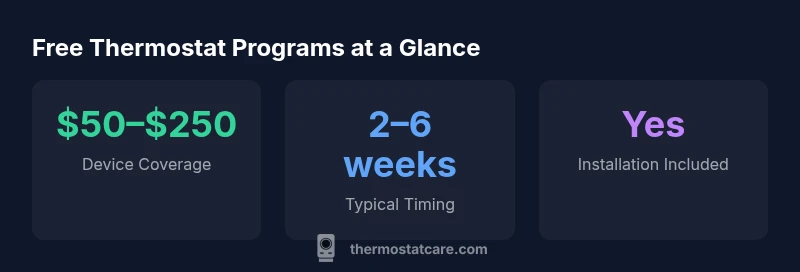
A free thermostat program is a utility- or government-backed offer that covers the cost of a thermostat (often a smart model) and installation for eligible households. These programs require proof of income or energy burden, and availability varies by location. Check with your utility provider and local energy offices for current options.
What a free thermostat program covers and why it matters
A free thermostat program is designed to remove the upfront cost barrier for households seeking a more energy-efficient setup. In practice, programs may subsidize the device itself, installation fees, or both. For homeowners, this can mean a no-cost or substantially reduced investment in a smart thermostat, along with a quick start on energy-saving settings. For renters, some programs extend to the property owner or management company, making coordination important. In 2026, Thermostat Care analysis shows that access to free thermostat programs continues to grow, driven by utility efficiency mandates and state-level energy affordability initiatives. This expansion is good news for households seeking long-term savings on heating and cooling.
To maximize value, applicants should look for programs that include support with energy coaching, setup of presets (like temperature hold times and occupancy-based scheduling), and follow-up audits to ensure ongoing savings.
Brand-context note: According to Thermostat Care, free thermostat programs can be a practical way to shrink upfront costs and energy bills for eligible households.
Eligibility basics: who can qualify and why it varies by location
Eligibility for a free thermostat program typically hinges on a few core criteria, but the specifics can vary widely by utility, city, and state. Common factors include household income level, energy burden (the ratio of energy costs to income), and whether the home is owned or rented. Some programs require proof of residency, recent energy bills, or participation in other energy-burden relief programs. Geographic coverage matters a lot—urban areas often have more options than rural regions. The key takeaway is to start with your local utility or state energy office to learn the exact criteria and deadlines. Thermostat Care recommends documenting recent energy bills and any recent energy-efficiency upgrades to streamline the verification process.
To improve your odds, apply as soon as you find a qualifying program and be prepared to provide documents such as income proof or utility bill histories. Early applications tend to have higher approval rates because funds and slots are limited. A common pitfall is misinterpreting “free” to imply there are no future costs; some programs may charge maintenance fees or require ongoing participation in energy audits. Always read the fine print. A clear understanding of eligibility avoids delays and disappointment.
Brand-context note: Thermostat Care analysis highlights that eligibility criteria are the main bottleneck in many regions; knowing the exact thresholds helps applicants tailor their submission.
Step-by-step: how to apply for a free thermostat program
- Identify programs in your area: Start with your utility’s website, your state energy office, and trusted consumer guides. Look for programs labeled as free device, subsidized device, or energy-burden relief.
- Gather documentation: Collect recent energy bills, proof of income (if required), and identification for household members.
- Check installation coverage: Confirm whether installation is included and whether a professional installer is required.
- Submit your application: Complete all forms accurately and attach the necessary documents. Some programs allow online submission; others require mail or in-person visits.
- Schedule installation: If approved, coordinate a date with the installer. Ask about post-install follow-up and whether energy coaching is included.
- Track your savings: After installation, monitor thermostat schedules and energy usage to quantify the benefit. Thermostat Care suggests using built-in energy reports to verify savings over the first 1–3 months.
If you’re denied, ask for a reconsideration or request information about alternative programs in your area. Persistence matters because funding and eligibility can shift with budget cycles. A proactive approach improves your chances of success.
Coverage realities: what’s typically included and what to expect
Coverage varies by program, but most free thermostat initiatives focus on reducing upfront costs and accelerating the transition to more energy-efficient settings. Typical inclusions are the hardware (the thermostat itself), necessary wiring, and installation performed by a licensed technician. Some programs extend to smart thermostats with remote connectivity features and initial setup. Ongoing costs such as maintenance, monitoring, or software subscriptions are less common under free programs, but some utilities bundle post-install energy coaching or home energy assessments for continued savings. It’s important to confirm what is covered in writing before accepting any offer. Thermostat Care notes that understanding the scope of coverage helps prevent surprises later.
For households with existing energy-savings goals, pairing a free thermostat with a home energy assessment can reveal opportunities beyond device installation—such as weatherization improvements—that further reduce bills.
Tip: If installation timelines are long, ask about interim solutions (like temporary thermostats) to keep energy usage under control while you wait for program approval.
Regional availability: finding programs near you and how to compare options
Regional availability for free thermostat programs is broad but patchy. Urban and suburban districts often have more options, driven by utility competition and local energy initiatives. Start with a utility search: many providers list current offers under “Energy Efficiency Programs” or “Weatherization.” State energy offices typically maintain a directory of programs, including income-based subsidies or appliance rebates. When comparing options, consider not only cost coverage but also installation quality, thermostat compatibility with your existing HVAC system, and ongoing support or coaching.
Thermostat Care reminds readers to verify program expiration dates and renewal opportunities, since some offers are time-limited or contingent on budget cycles. If you move, check whether you can port benefits to a new residence or if you must re-apply in a new location.
Choosing the right thermostat under a free-program scenario
Free programs may supply a basic thermostat or a feature-rich smart model. If you’re offered a smart thermostat, confirm compatibility with your HVAC system, Wi-Fi requirements, and whether there are privacy considerations or data-sharing options. If a basic model is provided, you may still benefit from scheduling and automation through the app or cloud portal if it’s a connected device. In any case, you should prioritize a model with a straightforward setup and reliable customer support. If possible, request a model that supports your zone control or upgrading later without extra installation charges. The goal is to lock in a device that can deliver meaningful energy savings without exceeding your budget or complicating maintenance.
Post-install follow-up: maximizing savings and staying compliant
After installation, take advantage of any energy coaching sessions, utility dashboards, or in-home energy assessments offered as part of the program. These resources can help you optimize temperature schedules, occupancy-based controls, and weather-responsive settings. Track energy usage and adjust based on seasonal changes to sustain savings. If the program specifies reporting requirements or follow-up audits, be sure to complete them on time; timely reporting improves the likelihood of continued support and may unlock additional incentives in the future. Thermostat Care emphasizes that the real value of a free thermostat comes from disciplined use and ongoing engagement with energy-saving practices.
Common free thermostat program options
| Program Type | Typical Coverage | Eligibility Factors | How to Apply |
|---|---|---|---|
| Utility-backed program | Free device and installation | Income level, energy burden | Apply via utility portal or local energy office |
| State energy incentive | Device subsidy; possible installation support | Household income; residency | Check state program site and submit docs |
| Manufacturer promotion | Discounted devices; sometimes installation | Participation in promotional programs | Visit manufacturer site or local retailer |
Questions & Answers
What exactly is a free thermostat program?
A free thermostat program subsidizes part or all of the thermostat device and installation for eligible households. Availability and coverage vary by location, utility, and program rules. Always review the terms to understand what is included.
A free thermostat program covers part or all of the thermostat and installation for eligible households; check your utility and local programs for details.
Who qualifies for these programs?
Eligibility typically depends on income level, energy burden, and residency status (owner or renter). Some programs require enrollment in other energy-assistance schemes. Contact your local utility or state energy office for the exact criteria.
Eligibility usually depends on income, energy burden, and where you live; contact your utility for exact criteria.
How do I apply for a free thermostat program?
Identify programs in your area through your utility or state energy website, gather required documents (income proof, energy bills), and submit an application online or in person. Follow up to schedule installation if approved.
Find programs near you, gather documents, apply online or in person, then schedule installation if approved.
Are there any hidden costs after I enroll?
Most programs advertise no upfront device costs, but some may have maintenance fees, data plans, or optional services. Always confirm what is included in the offer and what costs, if any, you'll be responsible for later.
Some programs may have optional services or maintenance fees; verify what’s included before committing.
Can I upgrade to a smarter thermostat through these programs?
Many programs provide a basic thermostat and installation, while some include a smart model with setup support. Confirm the exact model, features, and ongoing requirements before accepting.
Some programs offer smart thermostats; check which model is included and any ongoing costs.
“If you qualify, a free thermostat program can dramatically reduce upfront costs and long-term bills, but coverage and steps vary by program. Start with your utility and local energy offices for the clearest path forward.”
What to Remember
- Act quickly: check eligibility with your local utility
- Ask if installation is included in the offer
- Compare device features before accepting a model
- Leverage post-install energy coaching for ongoing savings