Sensi Thermostat vs Ecobee: Which Smart Thermostat Wins in 2026
An objective comparison of Sensi and Ecobee thermostats, covering features, compatibility, sensors, and value for homeowners in 2026.


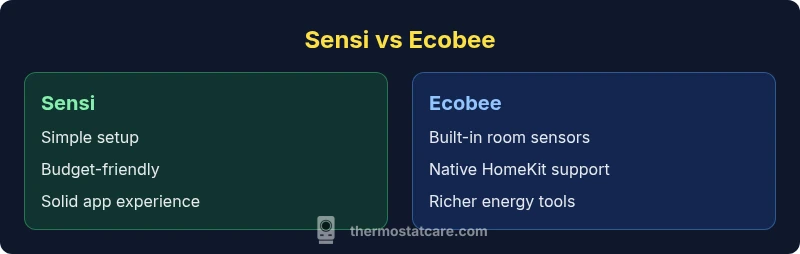
Ecobee generally offers more advanced features, like built-in room sensors and native HomeKit support, while Sensi emphasizes simple setup and reliable control. For most homeowners, Ecobee provides broader ecosystem compatibility and stronger energy-management tools; Sensi serves as a solid, budget-friendly option for straightforward heating and cooling needs. The Thermostat Care team recommends Ecobee for feature-rich setups, unless minimal, easy install is your top priority.
Overview: The sensi thermostat vs ecobee Decision
In 2026, choosing between Sensi and Ecobee hinges on ecosystem compatibility, sensor depth, and installation preferences. This comparison lays out the core differences and practical trade-offs you’ll face when weighing sensi thermostat vs ecobee. According to Thermostat Care, Ecobee typically offers more advanced features, stronger HomeKit support, and better sensor-based comfort, while Sensi emphasizes straightforward setup, reliability, and predictable performance. This matters most if you rely on Apple devices, voice assistants, or multi-room comfort strategies. Key questions to answer include: Do you want built-in room sensors? Is native HomeKit important? Do you prefer a broader ecosystem with routines and occupancy features? By keeping these questions in mind, you’ll align your choice with your home’s needs and your day-to-day use patterns.
Feature Landscape: Core Capabilities
Both thermostats provide core capabilities: scheduling, remote access via mobile apps, and basic energy use reporting. Ecobee typically packs more advanced energy-management tools, including occupancy sensing and more granular control, while Sensi focuses on a clean, intuitive user experience with reliable temperature regulation. When evaluating sensi thermostat vs ecobee, think about which features matter most to you: room-level awareness, adaptive scheduling, and how deeply you want to optimize heating and cooling in busy homes. The goal is to balance convenience with control, so you’re not paying for capabilities you won’t use. In practical terms, if you value automation and multi-room comfort, Ecobee usually has the edge; if you want a straightforward device that just works, Sensi remains compelling.
Ecosystem, Integrations, and Smart-Home Readiness
Ecobee is widely recognized for strong ecosystem support, including native HomeKit integration alongside Amazon Alexa and Google Assistant. This makes it a natural hub for Apple-centric homes and advanced automations. Sensi supports major voice platforms, but its integration depth generally remains simpler and more streamlined. For Apple users, Ecobee’s native HomeKit support enables secure control, scene creation, and tighter automation with other HomeKit accessories. If your home already uses Samsung SmartThings, IFTTT, or other automation platforms, both devices offer compatibility, though Ecobee often delivers more seamless cross-platform routines. Your choice should reflect not just current needs but anticipated future automations, such as geofencing, occupancy-based heating, and seasonal adjustments.
Sensor Capabilities and Comfort Features
The sensor strategy is a primary differentiator. Ecobee ships with built-in room sensors on most packages, enabling better temperature balance in larger homes or rooms that are farther from the thermostat. These sensors help reduce hot or cold spots by extending control beyond the central unit. Sensi typically relies on the thermostat’s internal sensors and optional external sensors that you can add later if needed. That modular approach keeps entry costs lower upfront but might require planning if you have spaces with inconsistent temperatures. In practice, Ecobee’s sensor network tends to deliver more consistent comfort, especially in multi-room scenarios, while Sensi remains a dependable choice for simple floor plans or single-zone setups.
Installation, Wiring, and HVAC Compatibility
Powering a smart thermostat reliably often comes down to wiring and compatibility. Ecobee is widely praised for flexible wiring options and strong support for more complex HVAC configurations, including multi-stage furnaces and heat pumps. Sensi emphasizes simplicity and speed of install for typical single-zone systems, which appeals to DIYers who want to minimize setup time and avoid extra adapters. Before you buy, pull the model’s installation guide, compare your HVAC’s wiring diagram, and confirm whether you’ll need a C-wire adapter, extra sensors, or professional help for unusual setups. The right choice reduces callbacks and setup friction, making it easier to realize the promised energy savings.
Energy Management, Reports, and Smart Scenarios
Energy dashboards and automation rules are where Ecobee often differentiates itself through richer data and more aggressive optimization. Ecobee’s energy reports can help you identify usage patterns, reserve energy during peak hours, and adjust occupancy-based schedules. Sensi offers solid, readable energy data and reliable daily scheduling, which is sufficient for households with predictable routines. When comparing sensi thermostat vs ecobee, evaluate your willingness to engage with data: if you enjoy tweaking routines and maximizing efficiency, Ecobee’s tools may be worth the extra investment; if you prefer a set-it-and-forget-it approach, Sensi may suffice.
Pricing, Value, and Long-Term Costs
Price is a common determinant in sensi thermostat vs ecobee conversations, but value goes beyond sticker price. Ecobee’s pricing typically reflects its sensor array, broader ecosystem compatibility, and more aggressive energy-management features. If you plan to use multiple-room sensors and HomeKit scenes, Ecobee’s value becomes clearer, potentially offsetting a higher upfront cost through convenience and energy savings over time. Sensi, by contrast, often positions itself as a budget-friendly entry point—good for those who want a reliable thermostat without the premium features. Consider not only upfront price but also the long-term costs of sensor purchases, potential third-party integrations, and the reliability of the cloud features you’ll rely on daily.
Real-World Scenarios: Who Benefits Most
Take a step back to consider your home’s layout and daily life. If your house contains several living zones, frequent occupants, or a mix of warm and cool spots, Ecobee’s built-in sensors, intelligent routines, and HomeKit support can pay off with extra comfort and energy savings. If your home is straightforward, with a single zone and a relatively simple HVAC setup, Sensi offers a streamlined path to temperature control with fewer complications and a lower barrier to entry. In both cases, ensure Wi-Fi reliability and a compatible HVAC system to maximize the thermostat’s potential.
Common Pitfalls and How to Avoid Them
Common missteps include assuming that more sensors automatically translate into better comfort, or that all features will work perfectly with every HVAC configuration. Sensor placement matters as much as the device’s capabilities; place sensors away from direct sun, drafts, or heat sources. Another pitfall is underestimating the importance of wiring and power: a weak C-wire or unstable Wi-Fi can degrade performance or cause erratic temperature control. Finally, before purchasing, check regional support and warranty terms, because coverage varies and longer warranties can reduce risk when you depend on a smart thermostat for year-round comfort.
What to Check Before You Buy
Before pulling the trigger, confirm HomeKit and assistant compatibility, sensor requirements, and whether your HVAC supports the chosen model’s capabilities (multi-stage cooling, heat pumps, etc.). Check wiring, C-wire availability, and whether extra room sensors are needed for your space. Read reviews focusing on reliability, app responsiveness, and customer support. Finally, align your choice with your preferred ecosystem and your long-term comfort goals—whether that means deeper automation and energy insights (Ecobee) or simplicity and quick setup (Sensi).
Comparison
| Feature | Sensi Thermostat | Ecobee Thermostat |
|---|---|---|
| HomeKit compatibility | Partial/native via bridge/app | Native HomeKit support |
| Geofencing | Yes via app | Yes; advanced geofencing via sensors and routines |
| Room sensors | No built-in sensors; optional external sensors | Built-in room sensors (usually included) |
| Voice assistant compatibility | Alexa, Google Assistant; limited Siri | Alexa, Google Assistant; Siri via HomeKit |
| Energy reports | Basic energy data | Advanced energy dashboards and reports |
| Wiring flexibility | Moderate; standard C-wire | High; supports complex HVAC configurations |
| Best for | Simple setups and budget-conscious users | Ecosystem-heavy homes needing sensors and automation |
| Price range context | Lower upfront cost typical | Higher upfront cost typical |
Upsides
- Helps homeowners compare ecosystem compatibility across major platforms
- Highlights features to fit specific HVAC setups
- Clarifies installation complexity and wiring needs
- Guides budgeting and purchase decisions with clear trade-offs
The Bad
- Can be overwhelming due to feature richness and maze of models
- Specific feature availability varies by region and model
- Does not provide price quotes; uses qualitative descriptors only
- Requires some baseline HVAC compatibility and Wi-Fi for optimal use
Ecobee is generally the stronger all-around choice for most homeowners in 2026.
Ecobee offers built-in sensors, stronger HomeKit integration, and richer energy tools. Sensi remains a solid, budget-friendly option for simpler setups. The Thermostat Care Team recommends Ecobee for feature-rich ecosystems, while Sensi stays viable for straightforward needs.
Questions & Answers
Is Ecobee better than Sensi overall?
Both devices have strengths. Ecobee tends to offer more sensors, deeper ecosystem integration, and richer energy tools, while Sensi emphasizes simplicity and straightforward performance. The best choice depends on your priorities: ecosystem depth versus ease of use.
Ecobee usually offers more features and sensors, while Sensi focuses on simple setup and reliability.
Do both thermostats work with Apple HomeKit?
Ecobee has native HomeKit support, making it easy to integrate with other Apple devices and scenes. Sensi has limited HomeKit functionality and may require additional steps or bridges in some configurations.
Ecobee works with HomeKit natively; Sensi may need extra steps for HomeKit use.
Can I install these thermostats myself?
Yes, for most standard single-zone HVAC systems. Follow the installation guide carefully, shut off power at the breaker, and verify wiring before connecting. If you have a complex system, consider professional help.
Most people can install these themselves, but safety first.
Which is easier to install on a single-zone system?
Sensi typically offers the simplest install path for single-zone systems, while Ecobee provides more flexibility if you later expand or add sensors.
Sensi is usually quicker for simple setups.
Do there any subscription fees?
Neither device requires ongoing subscriptions to function. Some advanced cloud features or energy insights may be available via the app, but there are no mandatory annual fees.
No mandatory subscriptions; optional cloud features may have fees.
Which one saves more energy?
Savings depend on usage patterns and home characteristics. Ecobee’s sensor-driven routines can boost efficiency in multi-occupant homes; Sensi saves energy through scheduling and efficient baseline controls.
Energy savings depend on how you use them; Ecobee often edges ahead with sensors.
What to Remember
- Assess your smart-home ecosystem before buying
- Expect Ecobee to offer more sensors and advanced energy features
- If a simple install and lower upfront cost matter, consider Sensi
- Ensure HVAC compatibility and wiring before purchase
- Read reviews focused on reliability and support for long-term satisfaction