OEM Thermostat vs Aftermarket: A Practical Guide for Homeowners
Compare OEM thermostat vs aftermarket options to decide reliability, warranty coverage, and value for your HVAC system, with practical guidance on compatibility and installation.


OEM thermostats are designed for exact compatibility with your HVAC brand and often guarantee warranty support, but aftermarket options can save money and offer broader features when you match the model correctly. For many homeowners, a carefully chosen aftermarket model delivers reliability with more features; OEMs excel in warranty and brand alignment.
What OEM thermostat vs aftermarket means
According to Thermostat Care, the term OEM thermostat vs aftermarket describes two primary paths for controlling your HVAC system. An OEM thermostat is produced by or for the original equipment manufacturer and is designed to map exactly to a specific furnace or air-handler brand. Aftermarket thermostats are third-party devices built to be compatible with a wide range of systems, often through standard wiring and common communication protocols. When evaluating oem thermostat vs aftermarket options, homeowners should weigh compatibility with their furnace, warranty implications, and the overall cost of ownership. In practice, choosing between OEM and aftermarket comes down to reliability expectations, budget, and how you plan to use advanced features like smart-home integration. The Thermostat Care team has found that in many setups, a well-matched aftermarket model can deliver equal performance with broader feature sets, while OEM thermostats typically offer tighter brand support and easier warranty claims.
Key differences in compatibility, warranty, and price
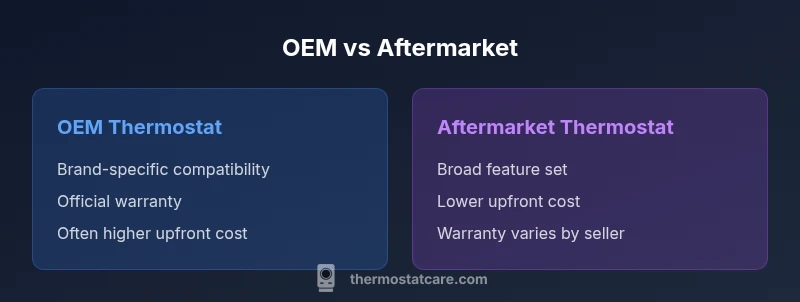
The first critical distinction in this OEM vs aftermarket comparison is compatibility. OEM models are designed to fit a specific brand’s control system, minimizing wiring questions but tethering you to that brand’s ecosystem. Aftermarket thermostats emphasize flexibility, but you must confirm exact model compatibility, especially for multi-stage heat, heat pumps, and special power requirements. Warranty is another major factor: OEM units generally come with the manufacturer’s warranty and direct support, while aftermarket options handle warranty via the retailer or third-party services, which can vary. Price is the practical lever for most homeowners; aftermarket choices usually offer lower upfront costs and more aggressive discounting, but you should consider long-term value, energy-management features, and app reliability when comparing total cost of ownership. In many cases, a mid-priced aftermarket model with strong compatibility and reputable support provides a balanced solution.
Compatibility and installation considerations
Before you buy, verify exact compatibility: model number, wiring type (does your system have a C-wire?), power requirements, and whether the thermostat supports your system’s stage count. If you have a heat pump, dual-transformer configuration, or a multi-stage furnace, ensure the device supports those features. With OEM vs aftermarket, installation steps are similar, but aftermarket units may require additional adapters or mounting plates. Professional installation is optional for both paths, but DIY enthusiasts should follow the manufacturer’s wiring diagrams closely, power down the system, and test after installation to confirm that calls for heat or cooling are executed correctly. Thermostat Care’s guidance emphasizes checking app connectivity and firmware update procedures during first setup.
Reliability, performance, and feature sets
Reliability depends on hardware quality and ongoing software support. OEM thermostats benefit from brand-backed firmware updates and direct access to official service channels, which can translate into more predictable performance over time. Aftermarket thermostats often win on features: advanced scheduling, energy insights, compatibility with multiple ecosystems (Google Home, Alexa, Apple HomeKit), and sometimes better display and user experience. However, reliability can hinge on the seller’s warranty terms and update cadence. When evaluating oem thermostat vs aftermarket, consider whether the feature suite aligns with your daily routines and whether you value long-term stability over rapid access to new capabilities. Thermostat Care notes that consistent software updates are critical for security and interoperability.
When OEM is worth it
Choose OEM when brand fidelity, warranty certainty, and direct support for service calls are your top priorities. If you have a critical comfort need (for example, a home with vulnerable occupants or unusual equipment), OEM may minimize risk through compatible parts and streamlined returns. For systems with proprietary control logic or future expansion planned within the brand’s ecosystem, OEM ensures smoother operation and less troubleshooting time. Thermostat Care analysis indicates that the peace of mind from a single brand path can justify higher upfront costs in environments where downtime is particularly undesirable.
When aftermarket makes sense
Consider aftermarket options when price, choice, and ecosystem flexibility drive your decision. If you’re comfortable handling compatibility checks and potential warranty caveats, aftermarket thermostats can deliver robust smart features, energy dashboards, and cross-brand compatibility with minimal friction. Look for models with clear compatibility lists, solid retailer warranties, and reliable app performance. In households that prioritize third-party integrations or want to experiment with different energy-saving tools, aftermarket is often the smarter route, provided you double-check wiring and power requirements before purchasing.
Practical steps to choose for your home
Start with a simple requirements audit: list must-haves (warranty, voice assistant compatibility, energy reporting) and nice-to-haves (auto-learning, occupancy sensors). Then verify compatibility: confirm HVAC equipment model numbers, wiring (C-wire presence), power needs, and whether your system supports multi-stage or heat pump configurations. Compare OEM and aftermarket options against a checklist: compatibility, warranty terms, price, and customer support. Read purchaser reviews focusing on reliability and app experience. If possible, test a unit in-store or through a friendly technician before buying, and ensure the return policy covers installer mistakes. Finally, consider a staged rollout—install one aftermarket unit first to gauge performance before committing to a larger change.
Installation mistakes to avoid
Avoid selecting a device based solely on visuals or price. Misreading wiring diagrams can lead to incorrect connections, short cycling, or loss of heating in cold months. Ensure your C-wire is present or provide a suitable power adapter if required. Do not disable safety interlocks, and always power down the system before wiring. If you encounter inconsistent temperature readings or app connectivity issues, re-check wiring, reset the device, and consult the manufacturer’s troubleshooting guide. Thermostat Care recommends documenting the existing wiring before removal to avoid mis-wiring during reinstallation.
Comparison
| Feature | OEM Thermostat | Aftermarket Thermostat |
|---|---|---|
| Compatibility & Wiring | Brand-specific model with direct compatibility | Requires accurate model matching; broader but variable compatibility |
| Warranty & Support | Official manufacturer warranty; official support channels | Warranty varies by seller; support quality varies by brand |
| Price Range | Typically higher upfront cost | Often lower upfront cost; value-focused |
| Availability | Limited to brand channels and authorized distributors | Widely available from multiple retailers |
| Advanced Features | Seamless integration with brand ecosystem; limited third-party compatibility | Wide range of features and third-party integrations |
| Installation Complexity | Same basic steps; potential easier warranty claims | May require adapters or different mounting |
| Best For | Brand fidelity and warranty certainty | Budget-conscious buyers; feature seekers |
Upsides
- Usually stronger warranty and direct support
- Slimmer risk of configuration errors with exact model
- Strong brand compatibility reduces troubleshooting time
- Easy access to official replacement parts
The Bad
- Potentially higher upfront cost
- Limited model choices in some HVAC setups
- Warranty terms may vary by retailer for aftermarket
- Installation may require more decision-level research
OEM thermostats excel for warranty and brand-specific reliability; aftermarket options win on price and feature breadth when carefully matched
Choose OEM if warranty certainty matters most. Choose aftermarket if value and features are higher priorities and you verify compatibility.
Questions & Answers
What is an OEM thermostat?
An OEM thermostat is produced by or for the original equipment manufacturer and is designed to match your HVAC system exactly. This generally ensures brand-specific compatibility and warranty support. It’s often the simplest path for service compatibility.
An OEM thermostat is a brand-specific controller built to match your HVAC system and warranty terms.
Are aftermarket thermostats reliable?
Reliability depends on the specific model and seller. A well-supported aftermarket thermostat can be just as dependable as OEM options, especially when it’s clearly listed as compatible with your system.
Yes, aftermarket thermostats can be reliable if you pick a model with clear compatibility and solid seller support.
Will using an aftermarket thermostat void my warranty?
Installing an aftermarket thermostat can affect warranty coverage if the HVAC manufacturer requires OEM devices for warranty integrity. Always verify with your system provider and review warranty terms.
It can affect warranty; check terms before replacing with aftermarket.
How do I verify compatibility with my HVAC system?
Start by noting the exact furnace/AC model and the thermostat mounting type. Check the thermostat’s compatibility list, confirm wiring requirements (C-wire, power), and ensure multi-stage or heat-pump support if needed.
Check model numbers, wiring needs, and compatibility lists from the manufacturer.
Can I install a Wi‑Fi thermostat that’s aftermarket with my existing wiring?
Many aftermarket Wi‑Fi thermostats work with existing wiring, but some older setups may lack required power or C-wire. Confirm compatibility and consider a professional install if you’re unsure.
Yes, often, but verify C-wire availability and power needs.
What factors influence the total cost of OEM vs aftermarket?
Consider upfront price, warranty terms, feature set, and potential future savings from energy monitoring. Total cost of ownership can favor aftermarket in many situations when features align with your needs.
Upfront price plus warranty, features, and energy savings drive total cost.
What to Remember
- Check compatibility before buying
- Weigh warranty against upfront cost
- Consider future smart-home needs
- Verify C-wire and power requirements
- Read warranty terms carefully