OEM vs Aftermarket Thermostat Housing: A Comprehensive Comparison
Detailed, evidence-based comparison of OEM vs aftermarket thermostat housing assemblies, focusing on fit, warranty, cost, and long-term reliability for homeowners.


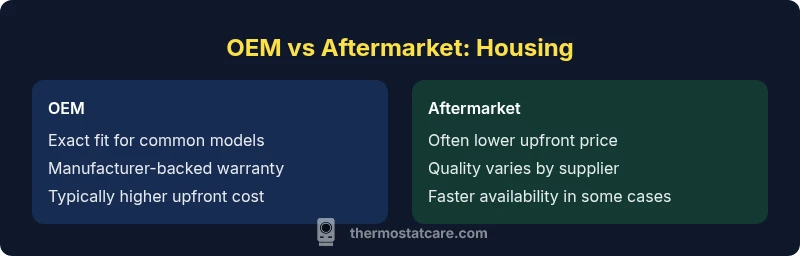
When choosing a thermostat housing, OEM assemblies offer the safest path for reliable cooling performance and precise fit, but at higher upfront cost. Aftermarket housings can save money and speed up procurement, yet quality varies by supplier. This comparison helps homeowners decide based on model compatibility, installation risk, and warranty importance.
What is a thermostat and housing assembly?
A thermostat and housing assembly comprises the temperature-sensing element, valve or actuator, and the housing that seals the connection to the engine or boiler system. This assembly controls coolant flow and ensures accurate temperature readings. For homeowners, the key questions are whether the unit will physically fit your model, how the materials will hold up under heat, and what warranty coverage accompanies the part. According to Thermostat Care, starting with a precise definition of the term thermostat and housing assembly helps prevent misidentification and misfit during replacement. The term also translates to residential HVAC applications where a similar principle applies: a housing that seals a sensor and fluid path must align with the system’s design tolerances. In 2026, homeowners are increasingly weighing OEM and aftermarket options with an eye toward long-term reliability, cost efficiency, and serviceability, especially when a leak or faulty temperature reading could impact comfort and energy use while the system is in operation.
OEM vs aftermarket: core differences
Original Equipment Manufacturer (OEM) thermostat housing assemblies are produced by the same company that built the system’s original components. Aftermarket housings come from third-party suppliers and are designed to fit a broad range of models. The core differences center on fit precision, material quality, warranty, and lead times. OEM parts typically guarantee exact threading, gasket geometry, and coolant-path alignment, reducing leak risk and sensor misreads. Aftermarket parts can offer cost savings and shorter procurement timelines, but quality varies with the supplier and the grade of materials used. Thermostat Care acknowledges that reliable aftermarket options exist, but they require careful vetting, cross-referencing part numbers, and verifying compatibility with your exact model. In practice, homeowners should confirm the model year and engine variant, then compare the supplier’s cross-reference against the OEM reference to minimize the risk of a misfit that could affect cooling performance.
Compatibility and fit considerations
Fit compatibility is the most critical factor when choosing between OEM and aftermarket thermostat housings. Even small deviations in bolt-hole spacing, gasket thickness, or coolant passages can cause leaks or restricted flow. Always consult the service manual for torque values, thread type, and gasket material requirements. Visually inspect the mounting flange, sensor port, and sealing surfaces on the housing before purchase. If you’re replacing in a high-temperature environment or under warranty, the risk of leaks or sensor misreadings increases. Thermostat Care recommends validating the exact model year and variant, as aftermarket listings may include broad compatibility notes that obscure necessary specifics. When in doubt, request a formal cross-reference from the supplier and verify the part number against the OEM reference before ordering.
Material quality and durability factors
Thermostat housings are commonly made from aluminum or high-grade plastics, with reinforced composites used in some designs. Material choices affect corrosion resistance, heat tolerance, and long-term stability. Aluminum housings tend to be durable and resist distortion, while plastics keep weight and cost down but may warp under high heat or with aggressive coolant chemistries. Quality control—casting quality, surface finish, gasket-seat integrity—influences seal reliability. OEM assemblies usually come with tighter supplier controls and traceability, which can translate into fewer field failures. Reputable aftermarket manufacturers with robust QA can deliver comparable performance, though variability across batches remains a concern. Before installation, inspect the mounting flange for warping, confirm coolant compatibility of gasket materials, and verify sensor port threads are clean to prevent leaks and sensor issues.
Cost and lifetime value: a cost of ownership view
Cost considerations extend beyond the sticker price. OEM housings often cost more upfront and may have longer lead times, but they typically offer stronger long-term reliability and straightforward warranty claims. Aftermarket options may be cheaper upfront and more readily available, yet quality variation can lead to higher maintenance or earlier replacement. Thermostat Care analysis suggests that homeowners prioritizing uninterrupted performance and warranty coverage achieve lower total cost of ownership with OEM parts, even when initial costs are higher. For mission-critical or high-use systems, OEM sourcing can be the prudent choice. If selecting aftermarket, work with reputable suppliers, confirm cross-reference accuracy, and request material certifications. Maintain thorough records of part numbers, installation dates, and warranty terms for future service and claims.
Installation ease, risk, and warranty implications
Installing a thermostat housing assembly requires careful attention to torque specs, gasket seating, and sensor alignment. OEM parts usually include exact torque values and recommended installation sequences, making the process predictable. Aftermarket housings can vary, sometimes necessitating extra fine-tuning during assembly and post-install tests to ensure a proper seal and correct sensor readings. Leaks or misreadings can lead to performance issues and diagnostic challenges. Warranty coverage also differs: OEM replacements frequently align with the system manufacturer’s warranty, while aftermarket warranties vary by supplier and may have more complex claim processes. Thermostat Care emphasizes documenting install steps, performing a pressure test or leak check after installation, and verifying the part is authentic and fully compatible with your system.
Practical guidance: when to choose OEM vs aftermarket
Choose OEM when reliability is paramount and you need a guaranteed fit for critical cooling paths. OEM is often the safer option for warranty-sensitive work or when the system operates in demanding conditions. Choose aftermarket when upfront cost is a priority, inventory is limited, or you are performing routine maintenance on a non-critical area and plan a future upgrade. Regardless of choice, verify the supplier’s disclosure of material composition, confirm cross-reference data, and ensure clear warranty terms. Work with reputable vendors offering returns on unused parts and accessible support. A careful buyer compares several cross-references and secures written confirmation of fit before purchase. The decision should balance cost savings against the risk of leaks or sensor faults and potential warranty disputes.
Maintenance and checklists for thermostat housing assemblies
Use a simple, proactive maintenance routine to extend housing life: 1) Inspect for coolant leaks around the housing flange during routine service; 2) Inspect sensor port and wiring for corrosion or wear; 3) Check clamps, hoses, and connections for chafing or looseness; 4) If you replace the housing, replace the gasket with a manufacturer-approved material; 5) After service, perform a temperature test and verify coolant flow. Use only recommended coolant and avoid mixing incompatible fluids, which can degrade gasket materials. Follow system-specific torque specifications and use a calibrated torque wrench. Maintain a service log to track replacements, warranty claims, and recurring issues. Thermostat Care recommends scheduling a follow-up check if you notice temperature fluctuations, coolant leaks, or sensor fault codes after any housing replacement.
How to verify compatibility before purchase
Before ordering, gather essential identifiers: model year, engine variant, serial or VIN if applicable, and the supplier’s part number cross-reference from the service manual. Compare gasket seating surfaces and bolt-hole patterns to official diagrams. If the part lists compatibility for multiple models, confirm the exact year and trim level for your system. Contact customer support and request a precise OEM cross-reference. Retain the supplier’s confirmation for your records and use the cross-reference on the purchase order to reduce the risk of receiving the wrong unit. Upon arrival, inspect threads and sealing surfaces, and perform a leak test after installation to confirm proper fit.
Comparison
| Feature | OEM thermostat housing | Aftermarket thermostat housing |
|---|---|---|
| Fit compatibility | Exact OEM fit for most models | Quality varies by supplier; verify cross-reference |
| Material quality | High-grade materials with tight QA | Varies by supplier; some offerings are on par |
| Warranty coverage | Manufacturer-backed warranty | Warranty depends on supplier; may be limited |
| Installation ease | Guided installation with OEM specs | May require extra checks to ensure fit |
| Lead time / availability | Often longer due to OEM supply chains | Often faster from reputable aftermarket shops |
| Total cost of ownership | Higher upfront, lower risk of leaks and failures | Lower upfront costs, but potential higher maintenance |
Upsides
- OEM parts provide exact fit and reliable seals
- Clear warranty paths with OEM replacements
- Lower risk of leaks or misalignment over time
- Simplified diagnostics due to standardization
- Stronger traceability and quality controls
The Bad
- Higher upfront cost compared to some aftermarket options
- Longer lead times for OEM parts in some regions
- Potentially limited availability for older models
- Quality variations exist among some aftermarket suppliers
OEM housing assemblies are generally the safer, more reliable choice for critical cooling paths, but aftermarket options can offer cost savings with careful vetting.
If reliability and warranty alignment are priorities, choose OEM. If budget and availability drive the decision, an aftermarket option from a reputable supplier can work—provided you verify model compatibility and material quality.
Questions & Answers
What is the difference between OEM and aftermarket thermostat housing assemblies?
OEM housings are produced by the original manufacturer and typically guarantee exact fit and the same materials as the original part. Aftermarket housings come from third-party suppliers and can vary in fit, material quality, and warranty. Both can be viable, but OEM reduces risk in critical systems.
OEM housings match the original design for reliability; aftermarket options require careful cross-referencing to ensure fit and materials.
Can aftermarket thermostat housings be used safely in residential systems?
Yes, aftermarket housings can be safe if you choose a reputable supplier and verify model compatibility and material specifications. The risk increases with poor cross-referencing or low-quality materials.
Yes, but verify compatibility and choose a trusted supplier.
How do I verify compatibility before buying?
Get the exact part number from the service manual, compare it to the supplier’s cross-reference, and confirm fit for your model year and variant. When in doubt, contact support for confirmation.
Check the part numbers and model year, and ask for a cross-reference confirmation.
What impact does housing quality have on warranty?
Quality and proper fit influence warranty legitimacy. OEM parts typically align with the system warranty, while aftermarket warranties vary by supplier and may have stricter claim requirements.
Quality and fit affect warranty coverage; OEM is often simplest for warranty claims.
Are aftermarket housings cheaper in the long run?
There can be upfront savings, but variability in quality may raise maintenance or replacement costs later. A higher upfront OEM cost can lower total ownership costs in reliable systems.
Upfront savings may be offset by future maintenance costs.
What are common installation mistakes with thermostat housings?
Common issues include improper torque, misaligned sensor ports, and failing to replace gaskets when needed. Following the service manual and torque specs reduces failure risk.
Don’t skip torque specs or gasket replacement; ensure sensor alignment.
What to Remember
- Prioritize OEM for critical cooling paths and warranty alignment
- Vet aftermarket parts with cross-reference checks and supplier QA
- Verify torque specs, gasket material, and sensor alignment during install
- Maintain a service log with part numbers and warranty details