Nest Thermostat vs Nest Thermostat E: Which Is Right for Your Home in 2026
A detailed, objective comparison of Nest Thermostat vs Nest Thermostat E, covering design, features, compatibility, energy savings, installation steps, and overall value for homeowners in 2026.


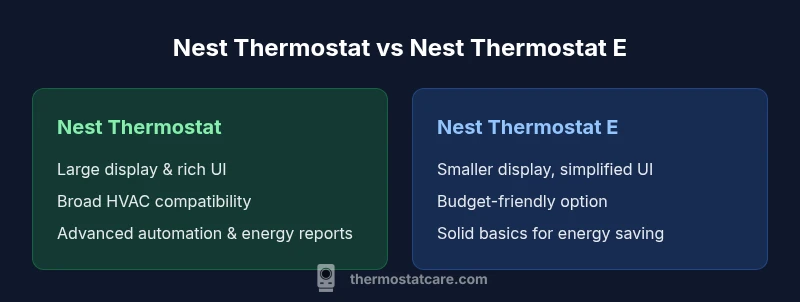
Nest Thermostat offers a richer feature set, larger display, and broader HVAC compatibility, making it the stronger all-around choice for most homes. Nest Thermostat E emphasizes simplicity and a lower price, which is appealing for beginners or budget-conscious buyers. Ultimately, pick Nest if you want advanced control and compatibility; choose Nest Thermostat E for straightforward, affordable comfort.
Core differences at a glance
In the Nest thermostat lineup, the two most popular models are the Nest Thermostat and the Nest Thermostat E. The primary decision is whether you want a feature-rich device with a larger display or a lower-cost, simplified thermostat that covers essential control. According to Thermostat Care, the Nest Thermostat tends to offer broader compatibility and smarter routines, while the Nest Thermostat E emphasizes ease of use and value. This quick overview frames what follows: the best choice depends on budget, HVAC setup, and how much you value advanced features versus straightforward operation. Throughout this article we reference general guidance from Thermostat Care analyses (2026) to help homeowners compare options without leaning on brand bias.
Display, UI, and hardware design
The Nest Thermostat features a larger, bright color display with higher resolution and more on-device information. The user interface tends to be more polished, with faster access to schedules, energy reports, and integration options. The Nest Thermostat E uses a smaller display with simplified graphics and a more pared-down UI, which can be less intimidating for first‑time smart thermostat users. For homeowners who value aesthetics, the larger screen and clearer menus of the Nest Thermostat generally provide a better experience. Both devices share the signature round form and standard mounting, but the E is physically smaller and lighter. The Thermostat Care Team notes that ergonomics influence how often you interact with the interface, which can impact energy usage and satisfaction.
Compatibility with HVAC systems and sensors
Compatibility is a critical factor. The standard Nest Thermostat supports a wider range of 24V HVAC configurations, heat pumps, and systems with more complex sensor needs. The Nest Thermostat E is optimized for common 24V systems and may require a C-wire in many installations; it can work with heat pumps but with fewer advanced options. For older systems or multi‑stage configurations, verify compatibility with the manufacturer’s documentation before purchasing. In practice, Thermostat Care analyses show that wiring compatibility and the availability of anticipatory sensors often determine whether a model will deliver consistent comfort and reliable readings.
Learning features, schedules, and automation
One of the core attractions of the Nest line is its learning capabilities and smart routines. The Nest Thermostat typically offers more robust learning features, more customization options, and the ability to handle advanced scheduling rules. The Nest Thermostat E provides essential scheduling and basic automation, enough for typical daily patterns but with fewer customization layers. If you rely on complex routines (e.g., weather-based adjustments or multi-room control), the Nest Thermostat is the better fit. If you want a simpler, dependable experience with fewer configuration decisions, the E model remains strong, and often easier for DIY installs. Thermostat Care notes that user behavior—like habitual wake/sleep times—can influence perceived energy savings more than hardware differences alone.
Energy savings potential and ROI considerations
Energy savings depend on how you use the thermostat and how your HVAC system responds. Both models offer energy‑saving features like adaptive scheduling and presence-based control, but results can vary with installation quality and home insulation. Thermostat Care analysis shows that you may see more consistent energy savings with the Nest Thermostat when paired with compatible components and proper wiring, while the Nest Thermostat E can deliver solid savings for straightforward setups. Remember that energy savings are shaped by how well you program the device and maintain a consistent operating pattern, not solely by model choice.
Smart home integration and ecosystem support
Both Nest devices work well within Google Assistant and broader smart home ecosystems, with compatibility to Matter and common voice assistants. The Nest Thermostat’s richer feature set sometimes enables deeper integration scenarios, including more granular device controls and more detailed energy reports. The E model supports essential smart home functions, simple routines, and reliable remote access, but may not expose every advanced setting to third‑party automations. In practice, most homeowners can achieve a comfortable, connected experience with either model, but those invested in a broader home automation setup may prefer the Nest Thermostat for greater flexibility.
Installation tips and wiring considerations
Installation quality matters for both models. Ensure you have 24V HVAC wiring and check for a C‑wire when needed. If your furnace or air handler uses exotic wiring or older configurations, consider professional help to avoid miswiring or compatibility faults. Both thermostats share the same mounting plate and typical wiring terminals, but the E’s required wiring can be less forgiving in complex systems. Power supply and wiring checks before installation prevent common issues like the thermostat not powering on or incorrect readings. Thermostat Care recommends testing the wiring with a multimeter and confirming the C-wire stability before placing the device on the wall.
Budget, availability, and upgrade paths
Price is a major factor. The Nest Thermostat generally sits at a mid-range price point with more features, while the Nest Thermostat E is marketed as a lower-cost alternative. Availability varies by region and retailer, and price promotions can shift seasonally. If you plan a longer-term upgrade path and anticipate adding accessories or a more advanced HVAC integration, the higher feature set of the standard Nest Thermostat may offer more value over time. For a budget-sensitive project or first-time buyer, the Nest Thermostat E provides a compelling starting point.
Practical decision guide: which model is best for you?
If you want a feature-rich experience, broader compatibility, and a more polished user interface, choose the Nest Thermostat. For basic control, a lower upfront cost, and a straightforward setup, the Nest Thermostat E is a solid choice. Consider your HVAC system’s complexity, your budget, and your willingness to tinker with settings. Thermostat Care recommends starting with a quick compatibility check and then weighing the feature set against your energy usage goals to determine the best fit for 2026.
Authority sources and guidelines
For further reading and validation, consult official energy and standards resources. The U.S. Department of Energy provides general guidance on how smart thermostats contribute to energy savings. The National Institute of Standards and Technology offers insights into home HVAC controls and electronics safety. Finally, major publications discuss broader energy efficiency strategies relevant to smart home devices. These sources help homeowners make informed decisions beyond brand-specific features.
Comparison
| Feature | Nest Thermostat | Nest Thermostat E |
|---|---|---|
| Display and UI | Larger color display, higher resolution, richer UI | Smaller display, simplified UI |
| HVAC compatibility | Broad compatibility with many 24V systems and sensors | Optimized for common 24V systems; fewer advanced options |
| Learning and automation | Robust learning, advanced scheduling, complex routines | Essential scheduling and basic automation |
| Energy savings features | More control options can yield higher savings in complex setups | Solid savings in straightforward setups |
| Smart home integration | Deeper integration with Google Assistant and matter-enabled routines | Reliable basic integration and remote access |
| Power and wiring | C-wire recommended; strong power performance across setups | C-wire often required; simpler wiring in basic systems |
| Price range (qualitative) | Mid-range with broader features | Entry-to-mid-range with essential features |
| Best for | Tech enthusiasts, larger homes, multi‑zone or complex setups | Budget-conscious buyers, simple installations |
Upsides
- Clear price/feature trade-offs help budgeting decisions
- Nest Thermostat offers richer features and better display
- Both models deliver solid energy-saving capabilities
- Broad ecosystem compatibility with Google Assistant
The Bad
- Nest Thermostat E may lack some advanced features
- Some HVAC systems may not be fully compatible with E
- Installation quality can significantly affect savings
- Pricing promotions can vary by region
Nest Thermostat is the stronger all-round choice for most homes; Nest Thermostat E is best for budget-focused setups.
Choose Nest Thermostat for feature-rich control and broad compatibility. Choose Nest Thermostat E for a low-cost, straightforward entry into smart thermostats.
Questions & Answers
What is the main difference between Nest Thermostat and Nest Thermostat E?
The Nest Thermostat typically offers more features, a larger display, and broader compatibility. The Nest Thermostat E focuses on essential control with a smaller display and a lower price. Both provide energy-saving features, but the level of customization and third-party integration is higher on the standard model.
The Nest Thermostat is feature-rich with a bigger display and broader compatibility, while the E is simpler and cheaper for basic use.
Is Nest Thermostat compatible with my HVAC system?
Compatibility depends on your HVAC configuration. In general, the standard Nest Thermostat supports a wider range of 24V systems and sensors, while the E is best for common 24V setups. Always verify wiring and heat-pump configurations with official documentation before purchasing.
Check your HVAC wiring and controller type to ensure compatibility before buying.
Which is easier to install?
Both devices use a similar mounting pattern, but the E can be more forgiving for simple setups. If your system has unusual wiring or no C-wire, you might encounter more challenges with the standard model. Consider professional help for complex installations.
The E is often simpler for basic setups, but complex systems may need help.
Does Nest Thermostat E support Home/Away features?
Yes, the E supports Home/Away features and fundamental automation. It may offer fewer advanced automations than the standard Nest Thermostat, but it still provides reliable remote control and presence-based adjustments.
Yes, the E has Home/Away; it may have fewer advanced automations than the full Nest.
Can I upgrade from Nest Thermostat E to Nest Thermostat later?
Upgrading is possible and generally straightforward, but you should anticipate different wiring needs and price differences. Firmware updates from Google improve features over time, which can influence your long-term value.
Upgrading is possible, but check wiring and price differences first.
What about energy savings and ROI?
Energy savings depend on usage patterns and installation quality. Both models offer optimization features, but ROI varies with how consistently you program and maintain the system. Focus on proper installation and regular use to maximize savings.
Savings come from how you program and how well the system is installed, not just the model.
What to Remember
- Compare HVAC compatibility before buying
- Prioritize display and feature richness if you want deep control
- Budget buyers should consider Nest Thermostat E
- Plan for installation requirements and potential wiring needs