Nest Thermostat vs: A Thorough Side-by-Side Guide
An objective Nest Thermostat vs comparison by Thermostat Care. We analyze learning, sensors, energy data, and ecosystem compatibility to help homeowners pick the right smart thermostat.


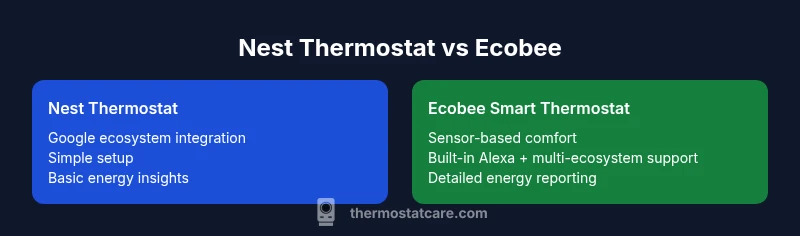
In the nest thermostat vs landscape, the choice usually comes down to ecosystem alignment, sensor strategy, and ease of use. According to Thermostat Care, Nest shines for Google-centric homes with simple setup, while Ecobee offers robust sensor-based comfort and broader voice assistant options. This quick comparison highlights the core trade-offs to help you decide quickly.
nest thermostat vs: Context and Core Differences
When evaluating nest thermostat vs, homeowners should focus on ecosystem compatibility, sensor strategy, and automation depth. According to Thermostat Care, the primary decision often hinges on whether you want deep Google ecosystem integration (Nest) or broader sensor-based comfort and cross-platform flexibility (Ecobee). This section lays out the core distinctions that drive most buying decisions.
- Ecosystem alignment: Nest is tightly integrated with Google Home and Google Assistant, delivering a streamlined experience for Google-centric homes.
- Sensor strategy: Ecobee emphasizes room sensor coverage with multiple sensors for consistent comfort; Nest relies on built-in sensors with optional accessory sensors.
- Learning and automation: Nest learns routines over time; Ecobee offers scheduling templates and sensor-driven automation with more manual customization.
- Energy optics: Both provide energy history, but Nest prioritizes simplicity while Ecobee often delivers more granular data through its sensor network.
- Installation and compatibility: Most modern 24V heating systems work with both brands, but some setups benefit from accessory kits for Ecobee or specific Nest configurations.
This overview sets the frame for a data-informed, fair comparison that helps you map features to your home profile.
Nest Learning and Automation Philosophy
Nest’s core promise is ease of use and automatic adaptation. The Nest Learning Thermostat (and newer Nest models) quietly studies your temperature preferences, occupancy patterns, and manual adjustments to optimize schedules over weeks. The result is a thermostat that reduces manual input while delivering comfort when you return home. Thermostat Care notes that this learning curve is particularly appealing for busy households that want a ‘set-it-and-forget-it’ experience. However, early adopters may sometimes find the initial weeks require a nudge in the right direction to refine routines. In contrast, Ecobee emphasizes explicit control: users can craft detailed schedules, create multiple comfort zones with remote sensors, and tailor room-by-room comfort using its sensor network. The comparison here isn’t about which is faster to learn, but which philosophy better matches your daily routines and desired level of control.
Ecosystem and Voice Assistant Support
When choosing nest thermostat vs, ecosystem compatibility largely drives the decision. Nest is designed to live inside the Google ecosystem, with strongest performance when paired with Google Assistant and Google Home devices. If your smart home already relies on Google services, Nest offers a cohesive experience with straightforward setup. Ecobee, meanwhile, provides a broader voice-control footprint: built-in Alexa support along with strong Google Assistant compatibility, plus its own robust app and web dashboard. For households that use multiple voice assistants or want flexible integration into non-Google devices, Ecobee may offer more flexibility. Thermostat Care suggests evaluating your current smart speakers and hubs before choosing, to minimize friction across routines and scenes.
Sensor Strategy and Comfort Zoning
Sensor strategy is a pivotal factor in nest thermostat vs decisions. Ecobee ships with multiple room sensors in its typical package, enabling more precise temperature distribution across large or multi-room homes. This supports comfort zoning and minimizes cold or hot spots, particularly in spaces far from the main thermostat. Nest, on the other hand, emphasizes a simpler sensor set-up: built-in sensors plus optional Nest Temperature Sensors sold separately. For many homes, a single location suffices, but larger or multi-story residences often benefit from Ecobee’s sensor network. Thermostat Care emphasizes evaluating floor plan and occupancy patterns to determine how many sensors you truly need to maintain consistent comfort.
Installation, Wiring, and Compatibility Considerations
A smooth installation is often the deciding factor in nest thermostat vs. similar devices. Both brands support common 24V HVAC systems and offer step-by-step installation guides. Nest typically aims for a straightforward swap with minimal wiring changes, which appeals to DIYers seeking a quick upgrade. Ecobee’s setup can involve more components (sensors, potentially a Power Extender Kit for certain systems), but it grants greater flexibility for complex or older systems. If you’re unsure about wiring, Thermostat Care recommends turning off power at the breaker and verifying compatibility with your HVAC control board before purchasing. In some cases, hiring a licensed technician ensures a clean installation with proper wire labeling and safe commissioning.
Energy Management and Reporting
Energy data is a core differentiator in nest thermostat vs. the broader smart thermostat landscape. Nest focuses on intuitive energy history and basic usage insights that help users spot trends without overwhelming details. Ecobee offers more granular energy reporting, especially when room sensors are active, enabling homeowners to see how different zones contribute to overall energy use. Thermostat Care notes that while granular data is valuable, the best outcome is translating data into concrete changes—scheduling adjustments, sensor placement, and occupancy-based modes that reduce wasted heat or cooling. Both platforms encourage active review of energy dashboards to maximize seasonal savings and comfort.
Privacy, Data Handling, and Security
Privacy considerations are integral to any thermostat comparison. Nest, backed by Google, may align with Google’s data policy models, including how usage data could inform product improvements or features. Ecobee emphasizes user privacy through transparent data controls and clear opt-out options for sharing diagnostic data. In practice, homeowners should review each platform’s data collection settings, understand what is logged (temperature, occupancy, usage patterns), and adjust privacy controls accordingly. Thermostat Care recommends enabling local processing when possible and limiting cloud-based data sharing if privacy is a primary concern.
Cost, Warranties, and Long-Term Value
Price is a practical factor in nest thermostat vs. alternatives. Nest typically positions itself as a mid-range option with an emphasis on simplicity and ecosystem cohesion; Ecobee often carries a higher upfront value due to its sensor network and feature set. Warranty terms vary by region and model, and both brands offer support through official channels and online communities. When evaluating long-term value, consider not just the upfront price but sensor longevity, potential replacement parts, and the likelihood of software updates that extend device usefulness. Thermostat Care encourages evaluating total cost of ownership, including sensor accessories and optional add-ons, to determine true value over five to seven years.
Practical Scenarios and Quick-Decision Guide
Different living situations tilt the nest thermostat vs balance. If your home is already built around Google devices and you want a simple installation with reliable daily comfort, Nest often wins for its lean, easy-to-use design. If you have a larger home with multiple rooms or zones, or you desire more precise control over individual spaces, Ecobee’s sensor network may deliver measurable comfort improvements and energy savings. Thermostat Care suggests mapping your priorities—ease of setup, control depth, sensor coverage, or privacy—and ranking features accordingly. A quick decision guide: (1) Google-centric homes → Nest; (2) multi-zone comfort and flexible voice control → Ecobee; (3) privacy-first users → carefully compare data controls across both platforms.
How to Decide: A Final Checklist
To wrap up nest thermostat vs decision factors, use this concise checklist: 1) Identify primary ecosystem (Google or multi-platform). 2) Assess home size and zones to determine sensor needs. 3) Review HVAC compatibility and whether a Power Extender Kit is required. 4) Compare energy reporting preferences and UI simplicity. 5) Consider privacy controls and data sharing preferences. The Thermostat Care Team recommends prioritizing ecosystem alignment and sensor coverage first, then weighing energy features and cost to select the thermostat that best fits your home.
Comparison
| Feature | Nest Thermostat | Ecobee Smart Thermostat |
|---|---|---|
| Learning and automation | Adaptive learning with minimal user input | Sensor-driven templates and flexible schedules |
| Geofencing | Yes, built-in geofence via app | Yes, geofencing with app and sensors |
| Room sensors included | Limited sensors; optional Nest Temperature Sensor(s) | Multiple sensors included in kit |
| Voice assistant and ecosystem | Google Assistant; Google Home integration | Built-in Alexa support; strong Google Assistant compatibility |
| Energy reporting | Energy history focused on simplicity | Detailed energy reports and zone-level insights |
| Platform and app experience | Lean, streamlined app and web controls | Feature-rich app with robust dashboards |
| HVAC compatibility | Widely compatible with common 24V systems | Broad compatibility; may require Power Extender Kit |
| Price tier | Mid-range, straightforward hardware | Mid-to-high range with sensors and features |
| Warranty and support | Warranty terms vary; official Nest support | Warranty terms vary; Ecobee support network |
Upsides
- Easy setup for Google-centric homes
- Strong energy history with a clean UI
- Reliability and straightforward troubleshooting
- Sensor flexibility with optional accessories
- Low learning curve for casual users
The Bad
- Limited multi-brand ecosystem flexibility
- Sensor options can add to total cost
- Less granular data without external sensors (Nest)
- More features and sensors mean higher upfront cost (Ecobee)
Nest is the better pick for Google-centric homes; Ecobee wins for sensor-rich comfort and cross-ecosystem flexibility
Choose Nest if you want a streamlined, easy-to-use experience tightly integrated with Google devices. Opt for Ecobee if you value zone-based comfort, broader voice control, and more sensor-driven customization. Thermostat Care’s verdict favors matching your ecosystem and sensor needs to the home profile.
Questions & Answers
What is the main difference between Nest Thermostat and Ecobee?
The main difference is ecosystem and sensor strategy: Nest emphasizes Google-integrated simplicity, while Ecobee focuses on sensor-driven comfort and broader voice control. Both offer energy insights, but the approach to automation and multi-room comfort differs.
The big difference is the ecosystem and sensors. Nest is best if you use Google devices; Ecobee shines when you want sensor-based comfort across rooms.
Is Nest Thermostat compatible with Google Home and Google Assistant?
Yes. Nest is designed to work seamlessly with Google Home and Google Assistant, delivering simple setup and cohesive voice control within the Google ecosystem.
Yes—Nest works great with Google Home and Google Assistant.
Do both thermostats offer energy history and savings insights?
Yes, both provide energy history and tips. Nest emphasizes a straightforward view of usage, while Ecobee offers more granular, zone-based energy data when sensors are active.
Both show energy history; Ecobee gives more details if you have room sensors.
Can I install these thermostats myself?
In most cases, yes, with the caveat that complex systems may require professional help. Follow the manufacturer guides and turn off power before starting. If in doubt, a licensed technician can ensure proper wiring and safe commissioning.
Yes, most people can install them themselves, but if your system is complex, a pro can help.
Do they support geofencing and remote sensors?
Both support geofencing and remote sensors, though Ecobee typically provides more built-in sensor options. Geofence features help automate heating and cooling when you leave or return home.
Both have geofencing; Ecobee offers more sensor options for finer control.
Which is better for renters?
For renters, Nest often offers a simpler, less invasive setup with Google ecosystem familiarity. Ecobee can still be used, but sensor-based setups and possible kit requirements may be less convenient in rental spaces.
If you’re renting, Nest is usually easier to move and set up, but Ecobee works too if you want more control.
What to Remember
- Prioritize ecosystem alignment (Google vs multi-platform)
- Consider room sensors for zone-based comfort
- Weigh upfront cost against long-term energy insights
- Factor privacy controls into data-sharing decisions
- Use the final checklist to avoid feature gaps