Digital Thermostat vs Mechanical: A Practical Guide
Compare digital thermostat vs mechanical options to understand control, energy use, installation, maintenance, and long-term costs for a typical home across different climates.


TL;DR: Digital thermostats offer precise control, energy reporting, and flexible scheduling, and they unlock smart features and remote access. Mechanical thermostats provide rugged simplicity and long-term reliability with fewer electronics. The right choice depends on your climate, budget, and comfort goals; for many homes, digital yields greater value, especially with smart options. However, in power outages or very simple setups, a mechanical unit can perform adequately.
Why the difference matters for homeowners
For many households, choosing between digital thermostat vs mechanical is not just about price—it shapes daily comfort, monthly energy bills, and how you interact with your home's heating and cooling system. At its core, digital thermostats substitute electronic sensors and microprocessors for the traditional bimetallic mechanism used by mechanical units. This shift changes how the thermostat reads temperature, stores settings, and communicates with HVAC equipment. According to Thermostat Care, the choice often hinges on how you value precision and convenience versus simplicity and ruggedness. The Thermostat Care team found that homeowners who want more precise control over temperature, detailed energy feedback, and the ability to use scheduling or smart features generally gravitate toward digital models. Those who prioritize straightforward operation, minimal maintenance, and proven durability may prefer mechanical units. The decision affects compatibility with your existing HVAC system, wiring constraints, and potential future upgrades such as smart-home integration. In climates with rapid swings, digital control can improve comfort and efficiency; in calmer climates, the durability of mechanical thermostats remains appealing, especially in homes where power reliability is a concern.
Core features: Digital vs Mechanical in practice
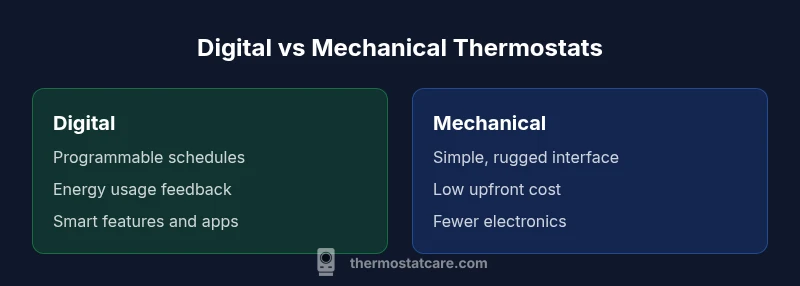
Digital thermostats replace mechanical temperature sensing with electronic sensors and a microcontroller, enabling features such as programmable schedules, hold options, and sometimes learning modes. They often include a backlit display, multiple temperature setpoints, and real-time feedback on energy use. Mechanical thermostats, in contrast, rely on aging mechanical components—often a bimetal strip or a simple dial—to turn the furnace or cooling system on and off. That simplicity generally means fewer failure points and less susceptibility to software glitches, but also limited customization and no on-device energy reporting. In practice, most households will notice digital models provide clearer visuals, easier adjustments with gloves on, and the ability to store multiple schedules for weekdays and weekends. Mechanical thermostats appeal when a homeowner wants nothing to worry about after installation and prefers a straightforward dial-based interface. The design choice can influence how quickly the system responds to temperature changes and how well it sustains a steady indoor climate.
User experience and programming: ease vs restraint
The user experience with each type of thermostat varies widely based on the model and its software. Digital thermostats typically feature intuitive menus, touch or button controls, and customizable holds—allowing separate comfort settings for weekdays and weekends. Some units offer learning algorithms that adjust schedules based on occupancy patterns, reducing manual input over time. Conversely, mechanical thermostats rely on physical movement of a dial or slider, offering immediate feedback and tactile control without the need to navigate screens. This simplicity minimizes confusion for users who prefer a “set it and forget it” approach, but it can feel inflexible if your routine changes often. For households with kids, pets, or variable schedules, digital options usually translate into easier daily adjustments and clearer status indicators. The Thermostat Care team notes that, in practice, homeowners who value visibility of energy use and programmable flexibility tend toward digital models, while those prioritizing robust, low-maintenance operation may lean toward mechanical designs.
Energy performance and cost implications
Energy performance is a central reason many homeowners upgrade to digital thermostats. With programmable schedules, learning features, and better reporting, digital models enable smarter control of heating and cooling, potentially reducing wasted cycles and improving overall efficiency. Mechanical thermostats, while reliable, generally lack automated scheduling and energy-tracking capabilities, which can limit opportunities for optimization. In climates with significant seasonal variation, digital thermostats can contribute to more consistent comfort with fewer manual adjustments. However, the upfront cost of digital thermostats—particularly advanced or smart models—tends to be higher than mechanical options. Long-term savings depend on how often the device is used, the efficiency of the connected HVAC system, and user engagement with scheduling. The Thermostat Care team emphasizes that energy savings are highly climate- and usage-dependent, so it’s wise to model your typical daily patterns before choosing a system.
Installation, wiring, and compatibility considerations
Installation considerations are a major differentiator between digital thermostat vs mechanical options. Digital thermostats often require a low-voltage wiring setup, typically including a C-wire for full functionality. Some older systems may lack a compatible C-wire, which can limit features unless you add wiring or use a power-stealing variant. Mechanical thermostats may be compatible with older HVAC configurations and sometimes offer simpler installation, especially in systems that use line-voltage control. If you’re upgrading an old setup, plan for wiring changes, potential thermostat mounting, and ensuring your furnace or air conditioner control board can communicate with a digital unit. In certain cases, it may be worth consulting an HVAC technician to confirm compatibility, run new wires, or install a compatible power supply. The choice here can affect not only installation time but also the long-term reliability of your control system.
Reliability, maintenance, and lifespan
Reliability is a fundamental consideration when weighing digital thermostat vs mechanical designs. Mechanical thermostats have fewer electronic components, which can translate into longer lifespans in harsh environments and lower susceptibility to software glitches. They may also operate with minimal maintenance. Digital thermostats, by contrast, bring advanced features but rely on electronics that can fail due to power surges, aging sensors, or firmware issues. Regular maintenance for digital units includes periodic firmware updates where available, battery checks if the unit uses batteries, and occasional calibration checks. In many homes, digital thermostats offer long-term value through improved scheduling and energy monitoring, provided that the user keeps the device updated and ensures proper wiring. The Thermostat Care team advises homeowners to consider the local electrical environment and potential exposure to moisture or dust when choosing between a digital or mechanical thermostat, as these factors can influence longevity.
Smart integrations and future readiness
Smart integrations are a key differentiator in modern thermostat selection. Digital thermostats, especially smart models, can connect to Wi-Fi or home automation hubs, enabling remote control, occupancy-based learning, and detailed energy reporting. These capabilities add layers of convenience and potential savings but introduce dependencies on network reliability and cybersecurity considerations. Mechanical thermostats do not typically offer native smart features, but some can work reliably in isolated setups where connectivity is not desired. If you’re planning to expand your smart home, a digital thermostat with robust integration options is often the better long-term fit. The Thermostat Care guidance suggests evaluating your home’s Wi-Fi stability, your comfort with managing devices, and whether cloud-based services align with your privacy preferences before committing to a connected model.
Choosing between digital thermostat vs mechanical: decision guide
When deciding between digital thermostat vs mechanical, start by listing your priorities: precise control and energy insight versus simple operation and rugged durability. If you value scheduling, energy monitoring, and remote access, digital is typically the better fit. If you prefer straightforward operation and minimal maintenance, a mechanical unit may be more suitable. Consider your climate: frequent temperature swings tend to favor digital control; steady climates may not justify higher upfront costs. Assess wiring: ensure your wall has the appropriate low-voltage wires (including a C-wire if you’re choosing a full-feature digital model). Finally, think about future plans: if you anticipate adding smart home capabilities, a digital thermostat with strong compatibility is a prudent choice. The Thermostat Care team recommends comparing both options against your HVAC system, budget constraints, and comfort expectations to determine the best fit for your home.
Troubleshooting common issues with both types
Troubleshooting can differ between digital thermostat vs mechanical models but some steps overlap. First, verify power: ensure the thermostat is receiving power from the HVAC control board and that any fuses or breakers are in good condition. For digital units, check that the C-wire is connected securely and that the device is reporting ambient temperature accurately; recalibrate if needed. For mechanical thermostats, ensure the dial or switch moves smoothly and that there are no obvious obstructions or dust buildup. If temperatures seem off, inspect the wiring to the HVAC system, confirm that the thermostat is configured to the correct heating and cooling stages, and examine the equipment itself for airflow or fuel-supply issues. Always consult the manufacturer’s installation and troubleshooting guide if available, and when in doubt, contact a qualified technician to avoid compromising your HVAC system.
Comparison
| Feature | digital thermostat | mechanical thermostat |
|---|---|---|
| User Interface | Digital display with menus and backlight | Simple dial or button-based interface |
| Programming/ Scheduling | Advanced scheduling, holds, and learning modes | Basic scheduling or manual operation |
| Energy Reporting | Often includes energy use feedback | Minimal or no energy reporting |
| Power Source | Low voltage (C-wire) or battery | Line-voltage or simple low-voltage depending on model |
| Wiring Requirements | Common wire often needed for full features | Fewer wiring requirements for basic mechanical units |
| Upfront Cost | Moderate to higher cost | Lower upfront cost |
| Durability | Electronics can be susceptible to glitches | Fewer electronic components; robust |
| Smart/Home Integration | Typically supports apps and smart hubs | Limited or no smart integration |
| Reliability in Outages | Power or network dependent; some loss of features during outages | Generally independent of Wi-Fi; persists function though features may be limited |
Upsides
- Easier programming and scheduling for daily routines
- Potential energy savings with advanced controls
- Remote monitoring and control when connected
- Broadest compatibility with smart-home ecosystems
- On-screen diagnostics aid troubleshooting
The Bad
- Higher upfront cost than mechanical models
- Reliance on electronics increases risk of software/firmware issues
- Privacy and security considerations with online connectivity
- Wiring requirements can complicate installation in older homes
Digital thermostats are the better long-term choice for most homes.
Digital models deliver precision, scheduling, and energy insights that can translate into real comfort and savings. Mechanical thermostats win on simplicity and durability but lack the modern conveniences and energy-tracking features that many homes want today.
Questions & Answers
What is the main difference between a digital thermostat and a mechanical thermostat?
The digital thermostat uses electronic sensors, a display, and often connectivity to control your HVAC with precision and programmability. A mechanical thermostat relies on a simple, mechanical mechanism like a dial to turn the system on or off, with no digital controls or energy reporting.
Digital thermostats use electronics and displays; mechanical thermostats use a dial. They differ in control, features, and data.
Are digital thermostats more energy-efficient than mechanical models?
Digital thermostats enable advanced scheduling and temperature optimization, which can reduce wasted heating or cooling. Energy efficiency depends on usage patterns and the HVAC system, but the ability to finely tune schedules generally supports better savings.
Digital thermostats can help save energy with better scheduling, though results depend on usage and HVAC health.
Do I need a C-wire to install a digital thermostat?
Many digital models require a common wire (C-wire) for full functionality, especially sensors and smart features. If your existing wiring lacks a C-wire, you may need to run one or use a resistor power adapter approved by the manufacturer.
Most digital thermostats need a C-wire; if you don’t have one, you may need to add wiring or choose a model that works without it.
Can I install a digital thermostat myself?
In many cases, a capable homeowner can install a digital thermostat by following the manufacturer’s instructions and ensuring proper wiring safety. Complex setups or changes to HVAC wiring may require a licensed technician to avoid damage or safety risks.
DIY is possible for many, but consider professional help for complex electrical work.
Do digital thermostats work without Wi-Fi?
Some digital thermostats operate with basic local control even without Wi-Fi, but many rely on internet connectivity for full features like remote control and cloud-based energy reports. Check the model’s specifications before purchasing.
Some digital thermostats work offline, but many features require Wi-Fi.
Is a digital thermostat better for renters or short-term housing?
Renters may benefit from digital models for improved comfort and better energy monitoring, but installation may require permission if wiring changes are needed. Mechanical thermostats offer simplicity and fewer installation concerns in temporary setups.
Digital models offer more control, but may be limited by renter permissions; mechanical can be easier for temporary stays.
What to Remember
- Prioritize precision and smart features if you value energy insights
- Expect higher upfront costs with digital options
- Mechanical thermostats offer rugged simplicity and fewer electronic risks
- Check wiring (C-wire) before upgrading to a digital model
- Plan for smart-home integration if connectivity matters
- Evaluate climate and occupancy patterns to estimate potential savings