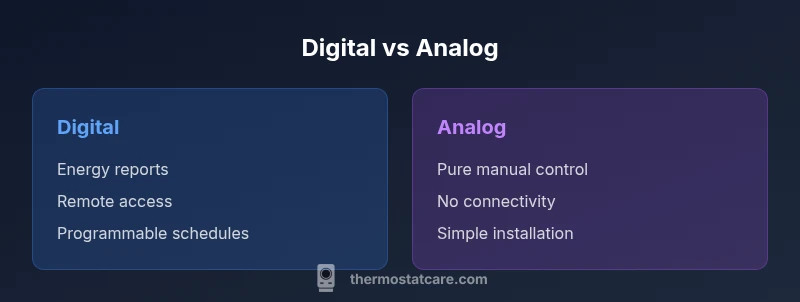
Digital Thermostat vs Analog: A Practical Home Guide
Compare digital thermostat vs analog options: programming, energy use, and reliability. Thermostat Care helps homeowners choose the right thermostat for comfort.


Digital thermostats generally win for customization and energy awareness, while analog models excel in simplicity and reliability. If you want programmable schedules, remote access, and detailed temperature tracking, a digital thermostat is the better choice. For homes needing simple, uninterrupted manual control during outages or when Wi-Fi is unreliable, analog may suffice.
Digital thermostat vs analog: A quick primer
In modern homes, the choice between a digital thermostat and an analog thermostat is about more than display type; it's about how you manage temperature, energy, and comfort. The digital option uses electronic sensors and a microcontroller to implement programmable schedules and sometimes connectivity for remote control or smart home integration. The analog unit relies on a bimetallic strip or simple sensor and a mechanical dial. According to Thermostat Care, understanding these differences helps homeowners decide which route fits their lifestyle and budget. When evaluating digital vs analog, consider your goals: ease of use, energy savings, system compatibility, and the reliability you expect during outages. This article lays out the practical implications of each approach, with a focus on real-world use cases and step-by-step guidance.
Core technologies: sensing, control, and power
Digital thermostats rely on electronic sensors, microcontrollers, and sometimes wireless modules. They require a steady power source, either from the HVAC system via a C-wire or from batteries in battery-powered models. Analog thermostats use mechanical sensing elements such as bimetallic strips and a purely mechanical control system, often powered directly by the HVAC wiring. This fundamental difference influences durability, maintenance, and how failures are diagnosed. Thermostat Care notes that digital devices can offer more diagnostic feedback, while analog units are prized for simplicity and long-term reliability with fewer electronic components.
Programming, scheduling, and user experience
One of the clearest advantages of digital thermostats is the ability to program complex schedules, set hold temperatures, and enable adaptive recovery modes. Some digital models even learn routines over time and provide energy-use analytics. Analog thermostats dispense with menus and apps, offering straightforward temperature control via a dial or slider. For households juggling varying occupancy, digital platforms can reduce energy waste, whereas analog controls shine when users demand immediate, tactile responses without navigation. Ther mostat Care emphasizes that the best choice aligns with the user’s comfort, tech affinity, and routine.
Energy efficiency and cost implications
Digital thermostats often enable energy savings through programmable schedules, occupancy sensing, and remote adjustments. The potential savings multiply when linked to energy dashboards and smarter HVAC equipment. However, initial costs, optional subscription features, and the need for a reliable power source can elevate total ownership costs. Analog thermostats, while cheaper upfront, typically offer limited ability to curb energy use and lack advanced analytics. Thermostat Care suggests calculating payback based on your local electricity rate, heating and cooling habits, and how often you adjust settings.
Reliability, maintenance, and durability
Analog thermostats are mechanically simple and tend to perform consistently with minimal maintenance, especially in environments where power stability is a concern. Digital thermostats introduce electronics that can be more sensitive to power surges and moisture but often provide built-in diagnostics and fail-safes. Battery-powered digital models may require occasional battery replacements, while 24V-powered units rely on clean wiring and proper C-wire integrity. In environments with frequent outages, an analog unit can offer robust operation, but digital units with a reliable power source can maintain comfort even when settings would otherwise be disrupted.
Installation considerations and compatibility
Installation realities matter more with digital devices. You must confirm compatibility with your HVAC system (24V vs. line voltage), the presence of a C-wire, and the thermostat’s wiring requirements. Analog thermostats typically install in a matter of minutes for straightforward two-wire setups, whereas digital models may require additional terminals or a common wire. Thermostat Care highlights the importance of choosing a model rated for your system type and verifying compatibility with any existing zone controls or multi-stage equipment.
Connectivity and smart features
Many digital thermostats bring Wi-Fi, Bluetooth, or Zigbee/Z-Wave connectivity, enabling remote control, voice assistant compatibility, and energy reports. Digital models can act as smart home hubs, but they introduce exposure to cybersecurity risks and potential privacy concerns. Analog thermostats have no connectivity, offering offline reliability but missing convenience features. Homeowners should weigh convenience against potential vulnerabilities and ensure network security when opting for a connected thermostat.
Practical buying guide and scenarios
If you value comprehensive control, energy analytics, and remote management, a digital thermostat is usually the better fit. For renters or homeowners on a tight budget who prefer mechanical simplicity and tactile feedback, an analog model may be the pragmatic choice. Consider your HVAC system type, wiring, budget, and how aggressively you want to pursue energy savings. A staged approach—start with a basic digital model and upgrade to a fully connected system later—can balance upfront costs with future-proofing.
Common myths and misconceptions
A common myth is that all digital thermostats automatically save energy; the truth depends on usage patterns and programming discipline. Another misconception is that analog units cannot be remotely controlled; in older setups, some analogs offer a simple digital display but no remote features. Finally, some assume that digital thermostats are unreliable in power outages; many modern models include battery backups or robust power management. Thermostat Care recommends evaluating both the features and your daily routines before choosing.
Outages, backup strategies, and fault tolerance
During power outages, analog thermostats typically retain manual control through the device’s mechanical interface, while digital thermostats may lose stored settings. A battery-backed digital model or a device with a robust hold setting can preserve preferences, but a fallback plan—like a tested manual override—helps ensure comfort restoration once power returns. If you live in an area with frequent outages, ensure the chosen thermostat supports a reliable default state and easy reset procedures.
Case studies: typical home scenarios
Consider a small apartment with predictable occupancy. A digital thermostat with a programmable schedule can significantly reduce heat loss while you’re away, while still returning to comfort before you return home. For a family with fluctuating routines and Wi-Fi access, a connected digital thermostat offers remote adjustments and energy insights that simplify life and optimize comfort. A single-family home with an older HVAC system may benefit from a hybrid approach, upgrading certain zones to digital controls while preserving simple analog controls in less-used areas.
How to upgrade from analog to digital: a step-by-step guide
- Check your HVAC compatibility and wiring, ensuring a C-wire is present or acceptable power options exist.
- Choose a digital thermostat rated for your system (single-stage, multi-stage, heat pump, etc.).
- Turn off power, remove the old unit, and label wires clearly.
- Install the new thermostat according to the manufacturer’s wiring diagram, then power up and run a system test.
- Program a basic schedule, verify temperature readings, and connect to Wi-Fi if desired. If you encounter issues, consult Thermostat Care’s troubleshooting guide or hire a qualified technician.
Comparison
| Feature | digital thermostat | analog thermostat |
|---|---|---|
| Control method | programmable, digital interface, remote access | manual dial, mechanical control |
| Power source | requires C-wire or battery power | direct line voltage, no wireless power |
| Energy management | advanced scheduling, energy reports, dynamic setpoints | basic on/off control without analytics |
| Ease of installation | slightly more complex due to wiring and network setup | simpler to install for straightforward setups |
| Connectivity | Wi‑Fi/Bluetooth/Smart home compatibility | no connectivity |
| Reliability in outages | depends on power source and battery backups | often robust in outages due to mechanical design |
| Cost range | $25-$150 for basic to mid-tier models | $10-$60 for basic analogs |
| Best for | tech-savvy households seeking energy savings | simple, low-maintenance setups |
Upsides
- Enables energy savings through schedules and analytics
- Offers remote control and integration with smart home systems
- Improved temperature precision and reporting
- Flexible programming for variable routines
The Bad
- Higher upfront cost and potential maintenance needs
- Requires reliable power and Wi-Fi for full functionality
- More complexity can overwhelm casual users
- Possible cybersecurity considerations with connected models
Digital thermostats win for most homes, but analog remains viable where simplicity and robustness are paramount
Choose digital if you want energy insights and remote control. Opt for analog if you prioritize straightforward, offline operation and lower upfront costs.
Questions & Answers
What is the main difference between digital thermostat and analog thermostat?
The digital model uses electronic sensors and a microcontroller for programmable schedules and remote control, while the analog version relies on a mechanical dial and simple sensing elements. Digital devices offer more features but require power and connectivity; analog units emphasize simplicity and reliability.
Digital thermostats use electronics for programming and smart features; analog thermostats rely on a mechanical dial for simple control.
Are digital thermostats more energy-efficient?
Often yes, because they enable precise schedules and responsive adjustments. Actual savings depend on how you program and use the thermostat, as well as the efficiency of your HVAC system.
Digital models can save energy when you program them and use smart features effectively.
Do digital thermostats require Wi‑Fi?
Many digital models rely on Wi‑Fi for remote control and data reporting, but some offer offline modes. If connectivity is a concern, choose a model with offline functions or keep a basic digital unit without network features.
Most digital thermostats can work without Wi‑Fi for basic functions, but full features need connectivity.
Can I install a digital thermostat myself?
Yes, if you have basic electrical wiring knowledge and follow the manufacturer’s instructions. Some configurations require a professional, especially for complex multi-stage systems or heat pumps.
Simple digital thermostats are DIY-friendly; complex setups may need a pro.
Is upgrading from analog to digital expensive?
Upfront costs vary with model features, but digital thermostats can pay back via energy savings over time. Include installation costs if you hire a technician and consider potential wiring upgrades.
Digital upgrades can pay off through energy savings, especially with learning features and remote control.
Which is better for systems with heat pumps?
Many digital thermostats support heat-pump controls and auxiliary heat intelligently. Analog options often require careful wiring; check compatibility before buying.
For heat pumps, a digital thermostat with proper settings is usually the better choice.
What to Remember
- Assess your daily routine to decide between digital and analog.
- Digital thermostats excel with scheduling and energy insights.
- Analog thermostats offer simplicity and reliability in outages.
- Ensure HVAC compatibility and wiring before upgrading.
- Consider future-proofing with a digital model if you plan smart-home integration.