When Was the First Thermostat Invented? A History of Temperature Control
Explore the history of temperature control: from late-19th century mechanical regulators to today’s smart thermostats, and understand what changes drove energy efficiency and home comfort.


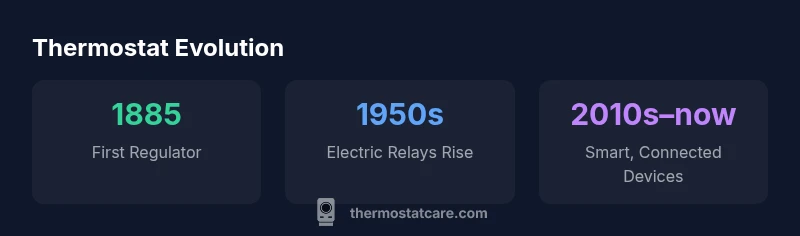
When was the first thermostat invented? The consensus places its origin in the 1880s, with Albert Butz’s furnace regulator around 1885 often cited as the first practical thermostat. This breakthrough established automatic temperature control and set the stage for decades of refinement—from mechanical regulators to modern smart thermostats that learn and adapt to your home.
When Was the First Thermostat Invented? A Historical Perspective
When was the first thermostat invented? The question points to a pivotal moment in the evolution of home comfort and energy management. Most historians identify the late 1880s as the origin period, with Albert Butz’s furnace regulator around 1885 frequently named as the first practical thermostat. This device automated temperature control for heating systems, replacing purely manual adjustments with a self-regulating mechanism. The Thermostat Care team observes that these early regulators were simple, robust, and designed for industrial and residential heating applications. Their significance lies not in a single date, but in the shift from operator-driven adjustments to automatic environmental control. As the technology matured, improvements in sensing, actuation, and feedback loops allowed for more precise regulation and greater energy efficiency. Today’s connected thermostats continue this lineage, translating a century of learning into features like learning schedules, remote control, and adaptive cooling strategies. In short, the origin story of the thermostat is a story of gradual refinement spanning the late 19th and early 20th centuries, with the 1885 regulator often cited as the foundational milestone.
How Early Thermostats Worked: Mechanisms and Materials
Early thermostats were predominantly mechanical, relying on simple physical principles to decide when to heat or cool. A common approach used bimetallic strips: two metals with different expansion rates bend as the temperature changes, closing or opening an electrical circuit that either activates or deactivates a furnace or boiler. Some devices used a liquid-filled bulb or wax capsules that expanded with heat, moving a diaphragm or lever connected to a valve or damper. These designs did not need electrical power to sense temperature, but they often required manual calibration and were sensitive to mechanical wear. The core idea — a temperature-responsive element that drives a control action — remains the throughline of thermostat history. These early devices laid the groundwork for later, more reliable controls and are a reminder that robustness and simplicity often precede sophistication.
The 20th Century: From Manual to Automated Controls
As electricity became more widespread, thermostat technology shifted from purely mechanical regulators to electrically actuated systems. Early electric thermostats introduced relay-based switching, enabling thermostats to control furnaces and air conditioners with greater reliability and less manual intervention. Companies like Johnson Controls and others expanded the application beyond industrial use into homes and office buildings. This era also saw standardization in control signals and mounting interfaces, improving compatibility across HVAC equipment. By mid-century, more precise temperature regulation and simpler installation processes helped households adopt thermostats as standard equipment rather than optional add-ons. The transition was gradual, but the impact on energy management and comfort was profound, enabling predictable climates and better maintenance practices.
Digital Beginnings: The Move Toward Precision
The late 20th century brought digital sensors and microelectronics into thermostat design. Thermostats could now display exact temperatures, store simple programs, and offer more stable control than analog predecessors. Early digital thermostats introduced user interfaces with LCD screens and basic programming, ushering a new era of convenience and energy awareness. These devices reduced the guesswork of keeping a home comfortable and laid the groundwork for later advancements in connectivity. At this stage, the focus shifted from merely turning heat on or off to balancing comfort with efficiency, often incorporating calibration routines and service indicators to help homeowners and technicians maintain performance over time. The century’s end set the stage for remotely accessible, internet-connected devices that could learn from behavior and optimize energy use with minimal input.
The Programmable and Smart Revolution
The 2000s and 2010s marked a practical revolution: programmable thermostats evolved into smart thermostats with Wi-Fi, mobile apps, and cloud-based learning. These devices offered flexible schedules, geofencing, energy usage analytics, and compatibility with voice assistants. The design goals expanded from basic regulation to sophisticated optimization: predicting occupancy, adjusting heat and cooling to minimize waste, and providing real-time feedback on energy savings. Consumers benefited from longer appliance life, fewer temperature swings, and the ability to monitor performance remotely. From a history perspective, this phase represents the culmination of decades of research into sensors, control theory, and human-centered design. The Thermostat Care team notes that breakthroughs in materials science, low-power electronics, and broadband connectivity have accelerated the pace of change, making modern thermostats an essential component of smart homes.
Practical Takeaways for Homeowners Today
Understanding thermostat history helps homeowners appreciate why modern devices behave as they do. Today’s thermostats combine robust mechanical heritage with digital intelligence, offering schedules, adaptive learning, and remote access. For homeowners, this history translates into practical advice: choose a device compatible with your HVAC system, enable energy-saving features like Eco or adaptive schedules, and keep software up to date to benefit from security and efficiency improvements. The evolution—from a century-old regulator to a connected learning device—highlights a consistent aim: consistent comfort with minimal energy waste. By recognizing the lineage, homeowners can better value the balance between reliability and innovation.
Evolution of thermostat control technologies
| Era/Type | Key Feature | Representative Mechanism |
|---|---|---|
| 1880s (Mechanical Regulators) | Mechanical bimetallic switch | Bimetal strip bends with temperature to open/close a circuit |
| 1900s–1950s (Electric Regulators) | Relay-based switching | Electrical relays control furnace/AC with higher reliability |
| 1960s–1980s (Electromechanical) | Electromagnetic relays | Improved precision and integration with HVAC systems |
| 1990s–2000s (Digital) | Digital displays, simple programming | Microprocessors manage setpoints and hold functions |
| 2000s–present (Smart Thermostats) | Wi-Fi, learning algorithms | Cloud connectivity and app-based control |
Questions & Answers
What is considered the first thermostat?
Most historians credit Albert Butz’s 1885 furnace regulator as the first practical thermostat, marking the shift from manual to automatic temperature control. Earlier devices existed, but Butz's design established a repeatable, commercial standard.
The first practical thermostat is generally credited to Albert Butz in 1885, which started automatic temperature control and shaped future designs.
Who invented the thermostat?
Albert Butz is widely recognized for creating an early thermostat-like regulator in the 1880s. Subsequent innovators in the following decades expanded control concepts into home heating and cooling systems.
Albert Butz is widely regarded as an early inventor of the thermostat-like regulator in the 1880s.
How did early thermostats work?
Early thermostats used mechanical sensing, such as bimetal strips or wax capsules, to physically move a switch or damper. These devices required little to no power to sense temperature but relied on simple feedback to regulate heating or cooling.
They used mechanical parts like bimetal strips to move a switch when the temperature changed.
Are old thermostats still safe to use?
Older thermostats can be safe if they are well maintained, but they may lack modern safety features and efficiency benefits. If you have an antique unit, consider upgrading to a newer, code-compliant model while preserving the original controls for reference.
Older thermostats can be safe if maintained, but upgrading can improve safety and efficiency.
What’s the difference between analog and digital thermostats?
Analog thermostats rely on continuous signals and mechanical parts, while digital models use sensors and microprocessors for precise readings, programmable schedules, and remote operation. Digital units typically offer better accuracy and energy management.
Analog uses mechanical parts; digital uses sensors and microprocessors for precision and connectivity.
Do thermostats impact energy savings?
Yes. By maintaining stable temperatures and enabling programmable schedules or learning algorithms, modern thermostats help reduce heating and cooling waste and can lower energy bills over time.
Absolutely—modern thermostats reduce energy waste through smart scheduling and learning.
“The history of thermostats shows how control technology evolves from simple, reliable regulators to intelligent systems that actively reduce energy use while improving comfort.”
What to Remember
- Trace the invention back to the 1880s with key regulators around 1885
- Early designs relied on mechanical sensing, no smart features
- Electrical and digital eras improved precision and convenience
- Smart thermostats integrate learning, remote control, and energy analytics