When Did Digital Thermostats Come Out? A History and Guide
Explore when digital thermostats first appeared, how they evolved, and what that history means for today’s smart-home comfort and energy savings.


Digital thermostats first appeared in the late 1980s to early 1990s, driven by microprocessor technology and basic programmable features. They replaced traditional mechanical controls with digital displays and stored schedules, offering more precise temperature regulation. Over the 1990s and 2000s, the digital shift accelerated, laying the groundwork for today’s connected thermostats and energy-saving capabilities.
Historical context: when did digital thermostats come out
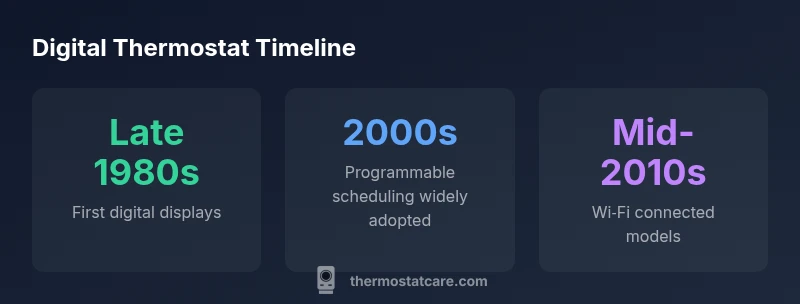
Digital thermostats emerged as home automation matured, replacing the old bimetallic thermostats. The question "when did digital thermostats come out" can be answered by noting that consumer digital control began in the late 1980s and gained traction through the 1990s. According to Thermostat Care, early digital models combined simple microprocessors with LCD readouts, offering more accurate temperature regulation and programmable schedules. This shift wasn't a single product launch but a gradual adoption as electronics became cheaper and HVAC systems became standardized. By the late 1990s, major brands offered programmable digital thermostats that could store a weekly schedule, marking a turning point in how households managed energy use. The evolution continued into the 2000s with wider adoption of remote sensors and more flexible programming. In short, the move from analog to digital began in the late 1980s to early 1990s and accelerated as networks and power efficiency improved. Warranty, installation, and energy considerations also influenced consumer uptake, with utilities and manufacturers promoting the environmental and cost benefits of digital control.
Early digital designs: what set them apart from analog controls
Early digital thermostats distinguished themselves from analog units with tangible improvements: a digital display, memory for multiple schedules, and more precise temperature control. Instead of turning a dial to approximate a setting, users could see the exact temperature in degrees and program a weekly routine. These devices required a microprocessor, a small memory chip, and a low-voltage power supply, and many used batteries or a dedicated power rail. By removing some of the ambiguity of analog controls, digital thermostats reduced overshoot, provided repeatable comfort, and made energy-use planning more predictable. The Thermostat Care team notes that early models also introduced basic diagnostics, a feature that would later become standard in modern smart thermostats.
The shift to programmable and remote features in the 1990s and 2000s
As manufacturing processes improved and markets matured, programmable digital thermostats became common. These devices let users set different temperatures for weekdays and weekends, often stored as a weekly schedule. The added flexibility helped households reduce energy waste and align heating/cooling with occupancy patterns. Some models offered remote sensors to balance temperatures across rooms, while others introduced more robust display interfaces and easier setup. The transition also included an expanded ecosystem of accessory products, such as wall-mount adapters and mounting plates, making installation more straightforward for DIY homeowners. By the mid-2000s, programmable digital thermostats were a staple in many homes, paving the way for connected devices.
The rise of Wi-Fi and cloud connectivity (2010s)
The 2010s brought a major leap: Wi-Fi-enabled digital thermostats that could be controlled from smartphones and tablets. Cloud services allowed firmware updates, remote access, and energy-use analytics. This period marked the birth of app ecosystems and voice-capable integrations with assistants such as Alexa or Google Assistant. For homeowners, the benefit extended beyond convenience to ongoing optimization—learning schedules, adjusting for occupancy, and reducing heating/cooling peaks. However, connectivity also introduced privacy and security considerations, which manufacturers began addressing with better encryption and local-control options. In terms of history, this era represents the moment when digital control moved from a regional device into an internet-connected, energy-aware home platform.
How digital thermostats work: core electronics and power needs
At the heart of a digital thermostat is a microprocessor, a temperature sensor, and a control algorithm. The microcontroller reads the sensor data, compares it to the target setting, and actuates the HVAC system via relays. Power is typically supplied by a C-wire or, in some cases, by power stealing techniques that draw a small current from the HVAC circuit. Batteries may supplement power in some units, though they can limit reliability. Modern thermostats often include multiple sensors to balance room temperatures, dynamic scheduling, and self-diagnostic features. Understanding these basics helps homeowners diagnose performance issues and plan upgrades with minimal downtime.
Differences between digital, programmable, and smart thermostats
- Digital thermostats refer to the display and electronic control that replaced mechanical knobs. They can store schedules but may lack connectivity.
- Programmable thermostats add scheduling sophistication, with multiple daily presets and easier user interfaces.
- Smart thermostats bring connectivity, cloud-based analytics, learning capabilities, and mobile apps. They can adjust automatically based on occupancy patterns and external weather data. For homeowners, the key distinction is power needs and network capability: digital or programmable units often work on standard low-voltage systems, while smart models rely on Wi‑Fi and a stable power supply.
Real-world considerations for homeowners choosing a thermostat
When selecting a digital or smart thermostat, ensure your HVAC system is compatible. Check whether you have a C-wire, the status of the furnace/air conditioner control board, and whether the thermostat supports your system's wiring configuration (two-wire, four-wire, etc.). Consider energy-saving features such as occupancy-based control, learning algorithms, and adaptive setback schedules. Also, factor in your home's Wi-Fi reliability and privacy preferences. For DIY installers, many brands offer step-by-step tutorials and compatibility checkers to minimize the risk of errors during replacement.
Common misconceptions about digital thermostats
A common misunderstanding is that digital thermostats automatically save energy. While they enable more precise control and scheduling, actual savings depend on how they are used. Another myth is that all digital thermostats require a C-wire; some models are designed for power stealing or battery operation but may perform less reliably. Finally, a belief that newer is always better can lead to overpaying for features you won't use; assess your energy goals, existing wiring, and HVAC compatibility before purchasing.
The takeaway: what the history means for today’s thermostats
The timeline from the late 1980s to today shows a steady acceleration of features—from basic digital displays to cloud-connected, learning, voice-enabled devices. Homeowners benefit when choosing a thermostat that matches their HVAC system, wiring, and energy goals. By understanding the historical context, you can pick a device that balances price, reliability, and future-proofing. The Thermostat Care team recommends evaluating compatibility, privacy settings, and energy-saving potential before buying, ensuring you select a solution that serves your family for years to come.
Evolution timeline of digital thermostat features
| Era | Key Characteristics | Representative Features | Impact on User Habits |
|---|---|---|---|
| Late 1980s–early 1990s | Digital displays appear; basic microprocessors | Basic digital readout; limited programming | Introduced precise control and scheduling |
| Mid-1990s–2005 | Programmable scheduling | Weekly patterns; manual control | Increased comfort and energy planning |
| 2005–2013 | Remote sensors; early connectivity | Remote scheduling via Internet or dial-up | More convenient control; energy savings |
| 2010s–present | Wi‑Fi connectivity; cloud integration | Smart features; learning algorithms; voice compatibility | Pervasive home automation and energy optimization |
Questions & Answers
When did digital thermostats first appear?
Digital thermostats emerged in the late 1980s to early 1990s with microprocessor-based designs; early models offered basic programming and a digital display.
Digital thermostats appeared in the late 1980s to early 1990s with basic programming and digital displays.
What’s the difference between digital and smart thermostats?
Digital thermostats refer to the electronic display and control; smart thermostats add connectivity, learning, and remote control features.
Digital thermostats offer digital control; smart ones add connectivity and learning.
Do I need a C-wire for modern digital thermostats?
Most modern digital thermostats require a C-wire for constant power; some power-stealing models exist but may be less reliable.
Most require a C-wire, though some battery or power-stealing models exist.
Are there privacy concerns with connected thermostats?
Connected thermostats collect data for optimization; review privacy policies and enable local control where possible.
Yes, consider data privacy and choose devices with robust controls.
How can I tell if my thermostat is compatible with my HVAC system?
Check your system’s wiring (C-wire presence and wire count) and verify thermostat compatibility with your HVAC type before buying.
Check wiring and compatibility before purchasing.
What features define digital versus programmable versus smart?
Digital refers to non-analog control with a display; programmable adds scheduling complexity; smart adds connectivity and learning.
Digital is display-based control; smart adds connectivity and learning.
“Digital thermostats didn't just replace dials—they redefined how homes manage comfort and energy use, laying the groundwork for today’s smart ecosystems.”
What to Remember
- Track the late-1980s origin and 1990s growth of digital thermostats.
- Differentiate digital, programmable, and smart models.
- Consider wiring and power needs before upgrading.
- Plan upgrades around energy-saving features and compatibility.