What is the Difference Between a Thermostat and a Sensor? A Practical Guide
Explore the key differences between a thermostat and a sensor, how they interact in home HVAC, and practical guidance for homeowners troubleshooting thermostats and optimizing comfort. Learn when to use each device and how to pair them for efficiency.


The thermostat's primary job is to regulate home climate by turning heating or cooling on/off to reach a setpoint. A sensor simply detects temperature and other conditions and feeds data to control systems or appliances. In many homes, the thermostat includes sensors; standalone sensors can't regulate. Understanding the distinction helps homeowners troubleshoot effectively and pick the right devices.
What each device does in your HVAC system
According to Thermostat Care, a thermostat is a control device that actively manages your heating and cooling by turning equipment on and off to reach a desired temperature setpoint. A sensor, by contrast, measures ambient conditions—most commonly temperature, but sometimes humidity or air quality—and reports that data to the control system. In many modern setups, the thermostat contains built‑in sensors, while standalone sensors monitor specific zones or remote spaces. The practical difference is clear: a thermostat executes decisions; a sensor provides the information that informs those decisions. This distinction matters for troubleshooting, compatibility, and selecting devices that match your home’s layout and insulation. When both components work well together, you experience steadier comfort and fewer energy spikes. The Thermostat Care team emphasizes that recognizing who does what helps you avoid replacing the wrong part and speeds up effective fixes.
sourceUrl”:null,
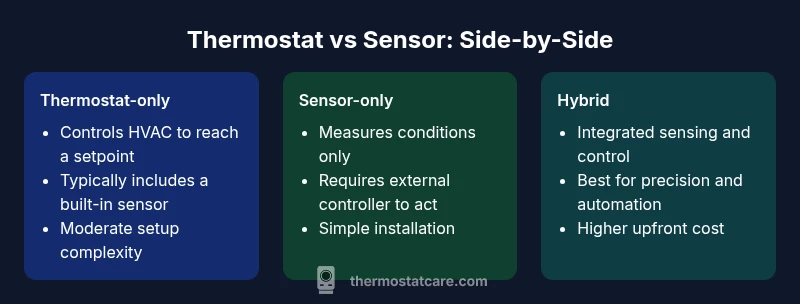
Feature Comparison
| Feature | Thermostat‑only System | Sensor‑only System | Hybrid System (Thermostat + Integrated Sensor) |
|---|---|---|---|
| Control capability | Active HVAC control to reach setpoint | No control capability (data only) | Integrated control with sensing for proactive adjustments |
| Sensing & data | Reads ambient temperature to drive control | Measures ambient conditions and reports data | Combines measurement with control logic for proactive regulation |
| Installation & wiring | Requires thermostat wiring and HVAC compatibility | Typically battery-powered or wired sensor modules | Requires compatible thermostat and sensor placement; may involve wiring or wireless setup |
| Energy impact | Optimizes energy use by maintaining setpoint | Energy savings depend on external control; data-only impact is indirect | Efficient when sensing and control are aligned for regulation |
| Best use case | Direct HVAC control for precise climate management | Monitoring and data collection without direct regulation | Best for precise control plus enhanced situational awareness |
Upsides
- Direct, predictable climate control improves comfort consistency
- Possible energy savings when paired with compatible HVAC systems
- Supports smart-home integration and automation
- Clear responsibility for maintenance and troubleshooting
The Bad
- Standalone sensors cannot regulate; a separate controller is required
- Hybrid systems can be more expensive and complex to install
- Wireless sensors rely on network reliability and battery changes
- Overly many sensors can complicate setup without proportional benefits
Thermostat-based control generally offers the most reliable climate management, while sensors provide essential data and zone awareness.
For most homes, a thermostat (ideally a model with reliable sensors or a compatible integrated sensor) provides stable regulation and energy efficiency. Sensors alone are valuable for monitoring and analytics, but they don’t regulate HVAC. The best setups often combine a thermostat with well-placed sensors to balance control, data, and comfort.
Questions & Answers
What is the main difference between a thermostat and a sensor?
A thermostat actively controls HVAC equipment to reach a desired temperature, while a sensor only detects conditions and reports data. Many modern thermostats include sensors, but standalone sensors do not regulate heat or cooling.
A thermostat controls the system; a sensor only measures. If you need regulation, you need a thermostat or a thermostat with sensing built in.
Can a thermostat operate without sensors?
Yes. Many thermostats have built‑in sensors to measure the room temperature. Some devices rely on external sensors or standard HVAC sensors; the controller still makes decisions based on the data it receives.
Yes, most thermostats include a built‑in sensor, but the thermostat is still the controller.
Is a standalone sensor better for energy savings?
Not by itself. A sensor provides data; energy savings come from a control strategy that uses that data effectively. Without a controller to act on the data, savings are limited.
Sensors alone don’t save energy unless there’s a controller acting on the data.
What is a smart thermostat and how does it relate to sensors?
A smart thermostat combines control with connectivity and often includes one or more built‑in sensors. It can learn behavior, communicate with apps, and adjust based on occupancy and data from sensors.
Smart thermostats add connectivity and learning, and they usually include sensors for smarter decisions.
Where should sensors be placed for accuracy?
Place sensors away from direct sun, drafts, or heat sources like ovens or lamps. For multi‑zone homes, consider zone sensors tied to a central controller to reflect each area’s needs.
Keep sensors out of direct heat or drafts to get accurate readings.
Do I need both a thermostat and sensors in my home?
Not always, but most homes benefit from both: the thermostat provides control, and sensors give detailed data for zoning and optimization. Assess your HVAC layout and comfort goals.
Usually you’ll want both for best comfort and efficiency.
What to Remember
- Identify whether you need active climate control or monitoring only
- Choose devices with proven integration with your HVAC system
- Place sensors away from heat sources to avoid skewed readings
- Prefer a combined thermostat + sensor setup for energy efficiency
- Plan for future upgrades to smart home ecosystems