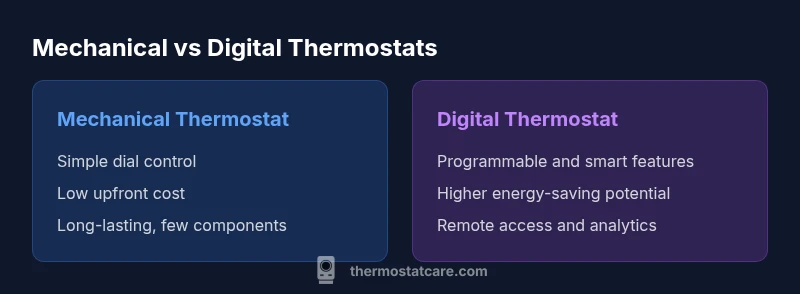
Mechanical vs Digital Thermostats: A Practical Comparison
Explore mechanical vs digital thermostats: how they work, key differences, energy use, and which is best for your home. Practical guidance from Thermostat Care.


Mechanical thermostat vs digital: in most homes, digital controls win for precision, programmability, and remote access, delivering clearer temperature control and energy insights. Mechanical units deliver ultra-simple, rugged reliability where power stability is a concern and where homeowners prefer minimal features. This quick comparison should guide whether you need basic, maintenance-free operation or a feature-rich upgrade.
Overview: mechanical vs digital thermostats
In the debate of mechanical thermostat vs digital, homeowners weigh simplicity against precision, reliability against flexibility. The traditional mechanical model relies on a bimetallic strip and a simple switch to trigger the HVAC system, while a digital thermostat uses electronics, sensors, and a microcontroller to control temperatures. According to Thermostat Care, most households today benefit from digital controls due to their precision, programmability, and remote capabilities, yet a mechanical unit can still shine in very simple setups or in areas with power instability. This section lays the foundation for the practical distinctions between the two types, helping readers understand the basic mechanisms, typical use cases, and the trade-offs involved. Whether you are replacing an aging unit or evaluating an upgrade, recognizing mechanical thermostat vs digital differences helps set expectations about performance, ease of use, and long-term value.
How a mechanical thermostat works
A mechanical thermostat operates with a simple, robust principle: a dial or lever adjusts a setpoint that is read by a physical sensor, typically a bimetallic strip or mercury switch. When the room temperature reaches the dialed value, the switch changes state and the HVAC equipment turns on or off. There are no digital displays or microprocessors involved, which reduces potential points of failure. Because the control is direct and passive, these thermostats tend to be extremely reliable in stable electrical environments. However, the lack of electronic sensors means drift and slower recovery can occur if the house cools or heats unevenly. Maintenance is minimal, and replacement parts are widely available, making them popular in older homes or in areas where residents prefer a hands-on, no-frills approach. Thermostat Care observations emphasize that the simplicity of mechanical thermostats can translate into predictable behavior during power outages or voltage fluctuations, where digital devices may struggle if they lose memory or programming settings.
How a digital thermostat works
Digital thermostats replace the old dial with an electronic interface. Inside, a microcontroller reads temperature sensors, executes firmware, and drives the heating or cooling system through a relay or contactor. Users interact via a digital display, buttons, or a touchscreen, and optional Wi‑Fi connectivity enables remote control, scheduling, and energy insights. The digital approach generally delivers higher precision (within a fraction of a degree in many models), faster adaptation to changes, and the ability to learn routines over time. Thermostat Care notes that sensor placement and calibration still matter, but the digital system can compensate with more frequent feedback and adaptive algorithms. This clarity of control is particularly valuable in homes with variable occupancy or complex heating patterns, where a digital thermostat can be tuned to match actual behavior and energy use.
User experience and interface
The user experience diverges sharply between the two families. Mechanical thermostats rely on a tactile dial or slider with a simple on/off readout, which many users find intuitive after a short learning curve. Digital models, by contrast, offer clear temperature readouts, multiple presets, and often a menu with settings for hold, fan operation, and recovery. For households with children, elderly residents, or frequent guests, the digital interface can reduce misreads and accidental changes through password protection, lockouts, or presets. In stress tests, digital interfaces also resist user error better by guiding users through recommended settings. Thermostat Care emphasizes that readability and ease of use are key factors in long-term satisfaction, especially when upgrades coincide with other smart-home devices.
Accuracy, calibration, and response time
Accuracy matters in both types, but digital thermostats generally deliver more consistent control because sensors and firmware communicate with high fidelity. Mechanical devices are susceptible to drift over years of use, especially if installation was marginal or if the environment has unusual heat sources. Response time—how quickly the system reacts to a setpoint change—tends to be faster with digital units due to electronic sensing and control. However, in a well-insulated home with a stable HVAC load, the difference may be subtle to the average user. Thermostat Care notes that proper placement of sensors and regular calibration checks can minimize discrepancies for both types, ensuring that the realized comfort aligns with displayed temperatures.
Energy efficiency, hold modes, and optimization
Digital thermostats can actively save energy through programmable schedules, adaptive recovery, and energy-use insights. Hold modes allow you to maintain a desired temperature for a set period, preventing wasteful overnight heating or cooling. In practice, digital systems excel when occupants follow a consistent routine or adjust settings seasonally. Mechanical thermostats rely entirely on the user’s discipline and do not offer built-in optimization or remote scheduling. The energy savings difference between the two depends on your behavior, home insulation, and system efficiency. Thermostat Care highlights that upgrading to a programmable digital model can unlock meaningful savings, particularly in homes with fluctuating occupancy.
Installation, compatibility, and maintenance
Installing a mechanical thermostat is often simpler, with fewer wires and no need for programming. Digital models may require wiring checks, compatibility with 24VAC HVAC systems, and, in many cases, a power source or battery. If you’re upgrading from mechanical to digital, ensure that your wiring harness and HVAC control board can support the new thermostat. Maintenance for mechanical thermostats is minimal but ongoing; digital thermostats demand occasional battery changes, firmware updates, and sensor cleaning to maintain accuracy. Thermostat Care suggests verifying compatibility with your specific HVAC brand and model, especially if you have an older system requiring adapters or additional wiring.
Costs, value, and long-term considerations
Upfront costs for mechanical thermostats are typically lower than for digital models, making them attractive for budget-conscious projects. Digital thermostats can pay for themselves over time through energy savings and enhanced comfort, especially in homes with variable schedules or where energy costs are a concern. Consider total cost of ownership, including potential wiring upgrades, firmware updates, and battery replacements. In most scenarios, the digital option offers greater value for households seeking flexibility, remote control, and data-driven optimization. Thermostat Care encourages homeowners to weigh initial expenditure against long-term energy use and convenience when deciding which path to take.
Smart features and integrations
Digital thermostats often integrate with Wi‑Fi, voice assistants, and other smart-home ecosystems, enabling remote control, occupancy-based adjustments, and energy reports. Some models support geofencing, weather-based adjustments, and learning algorithms that adapt to your routines. Mechanical thermostats do not offer built-in network connectivity, which can be a limitation for households pursuing a connected home strategy. If future-proofing matters, digital models can be upgraded with new features through firmware updates, a pathway not available for most mechanical units.
Which setup is best for you? Practical decision guide
The best choice depends on your priorities. If you want simplicity, durability, and a low upfront cost, a mechanical thermostat is a solid option—especially in a power-stable environment or for an aging system that does not support digital control. If you prioritize precise temperature control, energy savings, remote access, and future-proofing, a digital thermostat is the smarter bet for most homes. Use a decision framework that considers your daily routine, occupancy patterns, and whether you plan to expand your smart-home setup. Thermostat Care’s practical guidance suggests starting with a digital model in modern homes and reserving mechanical options for very basic configurations or where power reliability is a dominant concern.
Common myths and misperceptions
A common myth is that digital thermostats always save more energy than mechanical ones. In reality, savings depend on usage patterns and proper programming. Another belief is that mechanical thermostats are obsolete. While digital options offer more features, mechanical units can still outperform digital setups in simple, stable environments where features aren’t needed. Finally, some homeowners assume all digital thermostats require Wi‑Fi; many models operate offline with local control and battery power, though remote features will require connectivity.
Comparison
| Feature | Mechanical Thermostat | Digital Thermostat |
|---|---|---|
| User Interface | Dial or slider with basic on/off readout | Digital display with buttons or touchscreen |
| Power Source | Usually 24V powered, no battery | 24V powered or battery-backed depending on model |
| Programming & Scheduling | Manual adjustments only | Programmable, with schedules and adaptive options |
| Accuracy / Consistency | Moderate, potential drift over time | High precision with calibrated sensors |
| Energy Efficiency & Hold Options | No hold feature; relies on user discipline | Advanced hold modes and energy-saving features |
| Maintenance & Durability | Fewer electronic parts; very durable | Electronic components; potential for failures |
| Cost & Installation | Lower upfront cost; simpler install | Higher upfront; may require wiring adjustments |
| Smart Features Compatibility | Not smart-enabled | Wide range of smart integrations (Wi‑Fi, voice) |
Upsides
- Low upfront cost for basic mechanical units
- Fewer electronic components mean fewer failure points
- Very reliable in power-stable, simple environments
- No dependency on Wi‑Fi or cloud services
- Broad compatibility with older HVAC systems
The Bad
- Limited temperature precision and fewer control features
- No remote access or smart integrations
- Manual programming can be tedious and error-prone
- Less potential for energy savings without disciplined usage
Digital thermostats are the recommended choice for most homes.
Digital models offer precise control, scheduling, and smart integrations that typically lead to energy savings and greater convenience. Mechanical units remain viable in ultra-simple setups or where power stability is a primary concern, but for everyday comfort and efficiency, digital is the preferred path.
Questions & Answers
Which is easier to use for beginners: mechanical or digital?
For most beginners, digital thermostats are easier to use due to the clear display, presets, and guided menus. Mechanical units rely on familiarity with dials, which can be intuitive but slower to learn for new users.
Digital thermostats are typically easier for beginners because of the clear display and guided menus.
Can a mechanical thermostat save energy as well as a digital one?
Energy savings depend on usage patterns. Digital models offer programmable schedules and insights that help reduce usage, but careful operation of a mechanical unit can still yield savings in simple setups.
Digital models tend to save more energy due to scheduling and insights, but good habits with a mechanical unit can also save energy.
Are digital thermostats compatible with existing wiring and HVAC systems?
Most digital thermostats work with standard 24V HVAC systems, but some older setups may need adapters or professional installation. Always check the compatibility with your specific unit.
Most digital thermostats work with standard 24V systems, but check compatibility for older setups.
What maintenance is required for each type?
Mechanical thermostats require minimal maintenance and seldom fail due to moving parts. Digital thermostats may need occasional battery changes, firmware updates, and sensor cleaning to maintain accuracy.
Mechanical units are low maintenance; digital ones need occasional firmware updates and battery checks.
Do digital thermostats require Wi-Fi?
Many digital thermostats offer advanced features over Wi-Fi, but offline models exist that work without internet access. Remote control and smart features typically require a network connection.
Most digital models need Wi-Fi for full features, but offline options exist.
Is a digital thermostat more prone to power outages?
Digital thermostats can lose non-volatile memory after outages if not battery-backed. With proper design, many retain settings, but some advanced features may require reconfiguration after a power interruption.
Power outages can affect digital units unless they’re battery-backed.
What to Remember
- Digital thermostats generally deliver better control and energy savings.
- Mechanical thermostats excel in simplicity and reliability with minimal setup.
- Choose digital for modern homes with smart-home goals; choose mechanical for basic needs.
- Assess wiring compatibility and power stability before upgrading.
- Consider long-term value: upfront cost vs. ongoing energy and convenience.