Difference Between Thermostat and Aquastat: What Homeowners Need to Know
A careful comparison of thermostat vs aquastat, clarifying roles, systems, and how to pair them for reliable, efficient home heating.


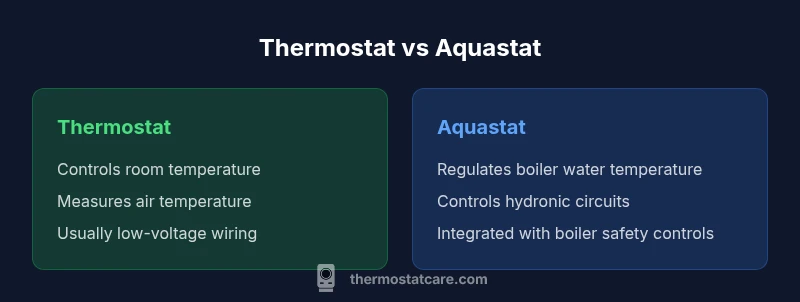
According to Thermostat Care, the thermostat and aquastat serve different roles in heating systems and are not interchangeable. A thermostat controls air temperature in living spaces, while an aquastat regulates boiler water temperature in hydronic systems. For most homes, install a compatible thermostat to manage comfort, and ensure the boiler’s aquastat is set correctly; together they optimize efficiency and reliability.
What is a thermostat and what is an aquastat?
A thermostat is the wall-mounted device you interact with to set a comfortable room temperature. It senses room air and communicates with your HVAC system to call for heat or cooling until the desired setpoint is reached. An aquastat, on the other hand, is a sensor and switch mounted on a boiler or water heater. It controls the temperature of the circulating water that feeds radiators, radiant floors, or hot-water coils. In practical terms, the thermostat manages the space you live in, while the aquastat manages the boiler's water temperature. This difference between thermostat and aquastat matters for system design, safety, and energy efficiency. According to Thermostat Care, recognizing this distinction helps homeowners avoid ill-suited replacements. In many homes, both devices coexist: the thermostat handles comfort, the aquastat ensures safe boiler operation.
Core differences in control philosophy
The core distinction rests in what each device regulates. A thermostat steers air temperature to influence how quickly the space heats up or cools down, often using a feedback loop tied to room sensors and occupancy patterns. An aquastat sets a target water temperature and can trigger the boiler to fire or modulate as needed to maintain that heat level in the hydronic circuit. This is not a matter of one device being better; it is about aligning control with the intended medium—air for space heating vs water temperature for boilers. When evaluating the difference between thermostat and aquastat, think about the control objective, the sensor type, and the system response time. Thermostat Care emphasizes matching control strategy to the heating goal for efficiency and comfort.
Air temperature vs water temperature: how each sensor works
Sensors and feedback play different roles. A room-facing thermostat measures ambient air to decide when to call for heat or cooling. Its setpoint is the comfort target. An aquastat measures the boiler's water temperature and turns the boiler on or off, or modulates it, to keep the circulating water within a safe and efficient range. Because water dynamics are slower to respond than air in most systems, aquastats tend to rely on different control logic (such as outdoor reset or boiler-dedicated limits) to prevent overheating or excessive cycling. Understanding these distinctions clarifies why the difference between thermostat and aquastat matters for performance and reliability.
System architectures: where each device lives
In many homes, a thermostat is installed in the living space, wired to the HVAC control board or furnace. The aquastat is physically attached to the boiler or water heater and wired into the boiler’s control circuit. In forced-air systems, the thermostat exercises broad control over fans and air delivery, while the aquastat focuses on water temperature within the boiler loop. In radiant or hydronic setups, an aquastat is essential to protect piping temperatures and maintain comfort. The two devices form a two-part control strategy: space comfort from the thermostat and boiler safety and efficiency from the aquastat.
Hydronic vs forced-air systems: implications for aquastats
Hydronic (radiant or hot-water) systems rely on the aquastat to regulate boiler water temperature, since the heating medium is water, not air. In contrast, forced-air systems use a thermostat to trigger the furnace and to control air mixing, dampers, and fan operation. Some homes combine both approaches—for example, a boiler-based hydronic system paired with a forced-air heat source. In such cases, the aquastat is still needed to manage boiler heat, while the thermostat coordinates air temperature and distribution. This interplay highlights why you cannot substitute one device for the other without risking comfort gaps or boiler inefficiency.
Wiring, power, and installation considerations
Thermostats typically operate on low-voltage power or batteries and connect to the HVAC control board. Aquastats connect to boiler circuitry and may run on boiler power or special control wiring. Installation requires careful attention to voltage compatibility, wiring diagrams, and safety codes. Incorrect wiring can lead to short cycling, heat fluctuations, or equipment damage. If you are replacing an old device, verify whether your boiler supports an updated aquastat or whether an external control relay is needed. For many homeowners, professional installation ensures safe and correct integration with the existing heating system.
How integration works with boilers and radiators
The thermostat signals a heat call when room temperature falls below the setpoint. The aquastat then influences boiler firing to raise water temperature, meeting the load demanded by radiators or radiant floors. In advanced setups, an outdoor reset strategy optimizes boiler water temperature based on outdoor conditions, improving efficiency. The difference between thermostat and aquastat becomes critical here: misconfiguring the aquastat can lead to inadequate boiler response, while a miscalibrated thermostat can create comfort swings. Both devices need proper calibration for optimal performance.
Smart thermostats and boiler compatibility
Modern smart thermostats can enhance both comfort and energy savings when paired with compatible boilers and aquastats. They offer remote scheduling, learning capabilities, and integration with home automation. However, not every boiler supports every smart thermostat, and some aquastats may limit compatibility with certain controls. When selecting a smart thermostat, check the boiler's documentation or consult a professional to ensure seamless integration and to avoid conflicts in control logic. The right pairing can improve efficiency without sacrificing reliability.
Practical steps to identify which device you have
Begin by inspecting the device labels and its physical location. If you see a wall-mounted control with room sensors, you are looking at a thermostat. If a device is bolted to the boiler itself and wired into the boiler's electrical circuit, you are likely dealing with an aquastat. Review the wiring diagram on the boiler or its manual to confirm. If you are unsure, photograph the control panel and consult a licensed HVAC technician. Remember: the difference between thermostat and aquastat is not merely terminology—it determines how service, maintenance, and upgrades should be planned.
Troubleshooting common issues with thermostats and aquastats
If heat is inconsistent, begin by checking the thermostat settings and battery level, then inspect wiring connections to ensure no loose terminals exist. For aquastats, verify setpoints and safety limits, and look for signs of improper control such as either overheating or insufficient heat. If the boiler cycles too frequently, the aquastat may be miscalibrated or the thermostat may be asking for heat more often than necessary. When in doubt, consult a technician to validate protection limits, wiring integrity, and that there is no safety risk to the boiler or plumbing.
Safety, maintenance, and professional upkeep
Routine maintenance includes testing both devices for proper operation, updating any outdated controls, and ensuring wiring is intact and protected from moisture and dust. Never bypass safety features on an aquastat or a boiler; these controls are essential to prevent overheating and potential damage. Regular service by a licensed professional helps detect wear and corrosion, calibrates controls, and guards against energy waste. A well-maintained thermostat and aquastat partnership supports consistent comfort and safe operation.
Choosing replacement parts: when to upgrade
When replacing controls, assess compatibility with your existing boiler and heating distribution: radiators, underfloor, or hydronic loops. Upgrading to a modern programmable thermostat or a smart thermostat can offer better energy management, but ensure the aquastat or boiler controls are still appropriate and within warranty guidance. If the system is aging, replacing both controls in concert can simplify wiring and improve response times, reducing the risk of mismatches between room temperature requests and boiler temperature output.
Real-world scenarios: case studies (fictional)
A single-family home with a boiler-based hydronic system uses a traditional aquastat and a wall thermostat. The thermostat manages room comfort, while the aquastat maintains boiler water setpoints. In a two-zone system, separate thermostats control different living areas, while the aquastat coordinates boiler temperature for all radiators. A hybrid system pairs a smart thermostat with an aquastat that supports outdoor reset; the homeowner enjoys improved energy efficiency and consistent comfort. These scenarios highlight why understanding the difference between thermostat and aquastat matters for design and upgrades.
Quick-start guide to pairing thermostat and aquastat
- Identify your system type (air-based vs hydronic). 2) Confirm compatibility between the thermostat and boiler/ aquastat. 3) Install the thermostat on a suitable wall and connect to the HVAC control board. 4) Verify the aquastat is properly set to boiler temperature and safety limits. 5) Run a test cycle to observe response times and comfort outcomes. 6) Consider advanced options like outdoor reset or smart integration only after confirming basic functionality.
Comparison
| Feature | Thermostat | Aquastat |
|---|---|---|
| Primary role | Controls air temperature to match room setpoint | Controls boiler water temperature for hydronic circuits |
| System scope | Air-based comfort and HVAC operation | Boiler operation and heating water management |
| Wiring/Power | Typically low-voltage or battery-powered | Connected to boiler circuitry; may use boiler power |
| Compatibility | Works with a wide range of HVAC systems and smart controls | Boiler-specific; compatibility depends on boiler model |
| Smart features | Many support smart thermostat integrations | Usually non-smart; some digital models exist for boiler control |
| Safety/limits | Setpoints influence comfort and energy use | Safety limits and boiler protection are built-in |
Upsides
- Enables energy-efficient temperature control for spaces
- Supports smart-home integration and scheduling
- Clarifies control domains (air vs water) for easier maintenance
- Improves diagnostics by separating system functions
The Bad
- Requires compatible HVAC and boiler hardware
- Not interchangeable; misapplication can reduce comfort
- Some older systems have limited feature sets on aquastats
Thermostat handles air temperature; aquastat handles boiler water temperature—use both when your system requires hydronic heating.
In most homes with boilers, a thermostat controls room comfort while an aquastat regulates boiler water. Properly configuring both ensures reliable heat and energy efficiency. If you’re upgrading, verify compatibility and installation with a qualified professional.
Questions & Answers
What is an aquastat and what does it do?
An aquastat is a device on a boiler or water heater that senses and regulates the temperature of the circulating water. It helps protect the boiler from overheating and ensures efficient operation by maintaining a set water temperature.
An aquastat controls boiler water temperature to keep the system safe and efficient.
How do thermostat and aquastat interact in a hydronic system?
The thermostat requests heat when room temperature falls below the setpoint, and the aquastat responds by adjusting the boiler to meet the required water temperature. Together they balance comfort and boiler efficiency.
Thermostat asks for heat, aquastat delivers boiler temperature.
Can I replace an aquastat with a thermostat?
No. A thermostat controls air temperature, while an aquastat controls boiler water. Some integration exists, but you generally need both for proper operation.
They serve different roles; you typically need both.
Do modern thermostats work with boilers?
Many thermostats can work with boilers, but compatibility depends on the boiler and wiring. Check the boiler’s documentation and use a compatible control relay if needed.
Many thermostats can control boilers with proper wiring.
What are common signs of aquarium/thermostat issues?
Look for uneven heating, thermostat not responding to setpoints, boiler short-cycling, or inconsistent water temperatures. If in doubt, have a professional inspect wiring and control settings.
Watch for temperature swings and unresponsive controls.
Is an aquastat part of a thermostat replacement?
Not typically. Replacing a thermostat updates air-temperature control, whereas an aquastat is boiler-specific; you may need to address both components in hydronic systems.
Aquastats stay boiler-focused; thermostats update room comfort.
What to Remember
- Identify whether your system is air-based or hydronic first.
- Choose a thermostat for room comfort and an aquastat for boiler control.
- Verify wiring and compatibility before upgrading or replacing parts.
- Consider smart thermostat options only after confirming boiler integration.
- Consult a professional to ensure safe, efficient operation.