Thermostat Says Aux Heat On: Urgent Troubleshooting Guide
Urgent guide to diagnose and fix when your thermostat shows aux heat on. Learn common causes, quick checks, step-by-step fixes, and safety tips to restore efficient heating.


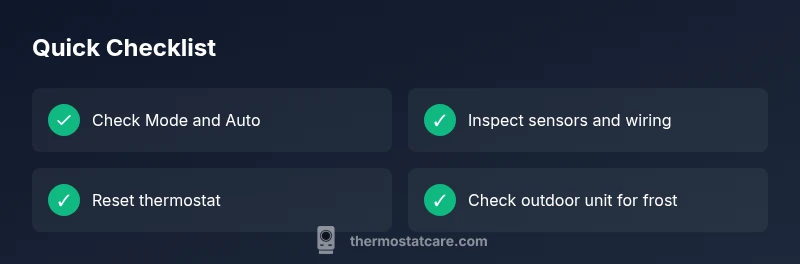
The most likely cause is the heat pump running in emergency/aux heat due to a misread sensor or thermostat misconfiguration. Start by confirming the thermostat mode is set to auto, check sensor placement and wiring, and perform a reset. If the message persists, power-cycle the thermostat and contact a pro.
Understanding AUX Heat and Why It Displays on Your Thermostat
When a home uses a heat pump, the system switches between the primary heat source and auxiliary or emergency heat to meet comfort demands. The message thermostat says aux heat on typically means the secondary heat source is active. This can happen in very cold outdoor temperatures, during defrost cycles, or if the thermostat misreads a sensor. According to Thermostat Care, aux heat is a planned function of many heat pump systems, but it should only run when needed. The Thermostat Care team also notes that misconfigurations or sensor wiring issues are a frequent cause of extended aux-heat use. Understanding the difference between outdoor temperature, sensor input, and mode settings helps you diagnose quickly.
In most homes, aux heat should kick in briefly during cold snaps or when the heat pump cannot meet the setpoint with its primary source. If aux heat remains ON longer than expected, it can waste energy and raise utility costs. This guide prioritizes fast, safe checks and a path to a lasting fix. Keep in mind that local climate and equipment type influence how often aux heat runs.
Common Triggers for a Stuck AUX Heat
There are several typical reasons the thermostat says aux heat on and stays active longer than necessary. The most common include a misconfigured thermostat mode, a faulty outdoor temperature sensor, or wiring issues that cause the control board to signal auxiliary heat repeatedly. Cold outdoor temperatures can legitimately trigger aux heat, but if you notice it during milder weather, it’s a red flag. A defrost cycle in a heat pump can occasionally mimic aux heat behavior, especially if the system cannot distinguish between frost buildup and chill outside. Thermostat batteries or power supply problems can also cause communication glitches that lead to unintended aux heat.
From a troubleshooting standpoint, you want to separate normal behavior (acute cold) from a likely fault (persistent aux activation). The Thermostat Care analysis shows that many households experience prolonged aux heat when sensors misread or when a thermostat is not communicating correctly with the outdoor unit. This is why systematic checks beat guesswork.
- Cold snaps that legitimately trigger aux heat
- Thermostat mode left on Emergency/Aux
- Faulty outdoor sensor misreporting outdoor temperature
- Wiring issues or poor power supply
- Defrost cycle confusion and timing issues
Quick Pre-Checks You Can Do Safely
Before you touch electrical components, power down the thermostat and any associated equipment following the manufacturer’s safety instructions. Start with simple, low-risk checks. Ensure the thermostat is in Heating and that the mode is Auto rather than Emergency Heat. Inspect the display for sensor warnings or fault codes. If you have a two-stage system, verify that Stage 1 is engaged first and not stuck on Stage 2. Check the outdoor unit for obvious icing or debris that could trigger a defrost sequence, then observe whether aux heat deactivates as outdoor conditions improve.
If you see low battery indicators on the thermostat, replace them and recheck operation. Confirm that the C-wire is securely connected at both the thermostat and the furnace control board, as a loose connection can cause intermittent signals. These quick checks often resolve the issue without tools. Thermostat Care recommends documenting what you tried and the results to avoid repeating steps.
- Confirm Heating mode is Auto
- Check for fault codes or warnings on the display
- Inspect C-wire connections and battery status
- Look for ice/debris on outdoor unit and defrost timing
- Note if aux heat turns off when temps rise
Diagnostic Flow: Symptom → Diagnosis → Solution
If you notice the symptom “thermostat says aux heat on” persistently, follow this diagnostic flow to pinpoint the cause and implement a fix efficiently. Start with the simplest explanation: is the thermostat set to Auto, not Emergency? If yes, check whether an outdoor sensor is reporting abnormally low temperatures or if the system is stuck in a defrost cycle. If the problem remains, examine wiring and power supply to the thermostat and heat pump control board. When a mismatch between outdoor temperature and sensor input exists, the control may default to aux heat. In this sequence, the diagnosis progresses from user-controlled settings to sensor accuracy, then to wiring integrity, and finally to professional service if needed. Thermostat Care’s experience confirms that most issues end up being mode misconfiguration or sensor/wiring problems rather than a complete heat-pump failure.
- Symptom: Aux heat stays on beyond expected
- Diagnosis: Check mode, sensor input, and wiring
- Solution: Correct mode, replace faulty sensor, or repair wiring as needed
Step-by-Step Fix: Most Common Root Cause (Thermostat Mode or Wiring)
Safety, Warnings, and When to Call a Pro
Prevention and Maintenance to Avoid Future AUX Heat Issues
Steps
Estimated time: 60-90 minutes
- 1
Confirm thermostat mode and settings
Ensure the thermostat is in Heating mode and set to Auto, not Emergency or Aux. Review any recent changes or schedules that could trigger a temporary shift.
Tip: Take a quick photo of current wiring before making changes. - 2
Inspect outdoor sensor and defrost status
Check if the outdoor temperature sensor reads plausibly; look for ice on the outdoor unit or erratic sensor readings that could prompt aux heat.
Tip: If you see frost, allow the defrost cycle to complete and monitor changes. - 3
Check thermostat wiring and power
Power down the system and inspect thermostat wires at both ends. Look for loose C-wire or damaged insulation that could cause communication faults.
Tip: Securely re-seat all connectors; avoid moving wires while powered. - 4
Reset and re-power the system
Perform a soft reset on the thermostat and a power cycle on the furnace/air handler to clear transient faults.
Tip: After reset, recheck that aux heat does not immediately re-engage. - 5
Test after adjustments
Set a comfortable setpoint and observe whether aux heat engages only during cold conditions, not during normal operation.
Tip: Monitor for at least two cycles to confirm stability. - 6
Call a pro if unresolved
If aux heat remains on abnormally, a licensed HVAC technician should test the heat pump, defrost controller, and wiring to prevent further energy waste.
Tip: Provide service with the steps you have already performed to speed up diagnosis.
Diagnosis: Thermostat says aux heat on and the system runs in emergency heat
Possible Causes
- highThermostat set to Emergency/Aux mode
- mediumFaulty outdoor temperature sensor misreporting conditions
- mediumWiring issues or loose connections at thermostat or control board
- lowDefrost cycle confusing the thermostat due to timing or sensor error
- lowThermostat or control board malfunction
Fixes
- easyVerify thermostat mode is set to Auto and not Emergency/Aux; switch to Auto if needed
- easyInspect outdoor temperature sensor and replace if reading abnormally low/high
- mediumCheck all thermostat and furnace/wire connections; re-seat wires and verify power; replace damaged wires
- easyPower cycle the thermostat and, if needed, restart the heat pump to clear faults
- hardIf issues persist, contact a licensed HVAC technician for a full diagnostic and possible component replacement
Questions & Answers
What does aux heat mean on a heat pump thermostat?
Auxiliary heat is a secondary heat source used by heat pumps when the outdoor temperature is too low for efficient operation. It can be triggered temporarily during cold weather or due to sensor or control issues.
Aux heat is the backup heat your heat pump uses when it can't keep up with the cold, sometimes due to sensor or wiring problems.
Why would aux heat stay on even when it’s not cold outside?
If aux heat remains on, it often points to a misconfigured thermostat mode, a faulty outdoor temperature sensor, or wiring issues that keep signaling auxiliary heat.
If aux heat won’t turn off, check the mode, sensor readings, and wiring, then reset the thermostat.
How can I disable aux heat without harming the system?
Disabling aux heat should be done by setting the thermostat to Auto and ensuring the heat pump can meet the setpoint. If it continues, inspect sensors and wiring or consult a professional.
Set the thermostat to Auto and check the sensors; if it won’t disable, call a pro.
Is aux heat expensive to run?
Aux heat uses more energy than the primary heat source, so prolonged use can raise energy costs. If it’s needed only during cold snaps, impact is typically manageable with a well-insulated home.
Yes, aux heat costs more to run, especially during extended use, so address the root cause when possible.
When should I replace my thermostat or heat pump due to aux heat problems?
Replace or service only if persistent faults remain after troubleshooting, or if the thermostat or heat pump shows repeated error codes that a professional can’t clear.
If faults recur after fixes, consider professional assessment for replacement options.
How can I test if the outdoor sensor is faulty?
Compare outdoor sensor readings against a known thermometer or use the thermostat’s diagnostic tests if available. If readings don’t align, the sensor may be faulty.
Check sensor readings; if they don’t match real outdoor temps, you might need a sensor replacement.
Watch Video
What to Remember
- Verify Auto mode first
- Check sensors and wiring for faults
- Power-cycle to reset faults
- Address defrost vs. sensor mixups promptly
- Call a pro for persistent issues