RH vs RC Thermostat: Power Terminals Explained for HVAC
Explore the differences between RH and RC thermostat terminals, when to use each, and how to wire safely. Learn how single- vs dual-transformer setups affect jumper usage and compatibility. Thermostat Care provides practical troubleshooting guidance for homeowners and DIY enthusiasts.


RH and RC are 24V power terminals for heating and cooling. In single-transformer systems they’re often jumped; in dual-transformer setups they stay separate. Use a single R with a jumper when appropriate. Get the full wiring guide in our detailed comparison from Thermostat Care.
Overview of RH vs RC Thermostat Terminals
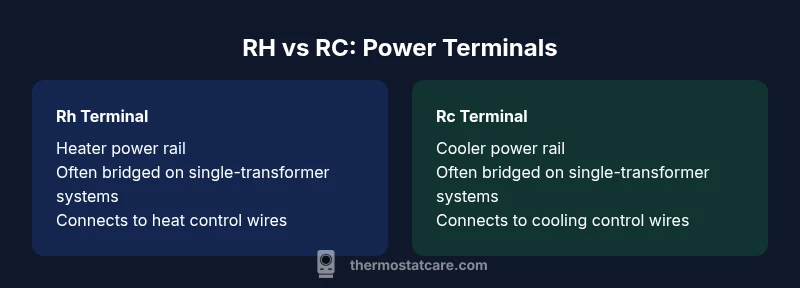
RH and RC are the two standard 24-volt power terminals found on many thermostats. RH powers the heating circuit, while RC powers the cooling circuit. The naming convention comes from older HVAC systems where heat and cool used separate transformers. In many modern homes, a single 24-volt transformer feeds both heating and cooling circuits, and RH and RC are tied together through a jumper. The Thermostat Care team notes that understanding these distinctions is essential for safe wiring and for ensuring your thermostat can control both heat and cool functions properly. If you’re replacing a thermostat, identify what kind of transformer your system uses before deciding whether to jumper RC and RH or wire them separately. This initial check prevents backfeed, misreading of temperature signals, and potential damage to the control board. When diagnosing issues, start by confirming which transformer powers heat, which powers cooling, and whether your thermostat supports dual transformer configurations. This rh vs rc thermostat distinction is particularly important for DIY wiring accuracy and safety.
When to Use RH and RC: System Configurations
RH and RC designation matters most when your HVAC system uses separate transformers for heat and cool versus a single transformer that serves both. If your furnace and air conditioner share a single 24-volt supply, you’ll typically see a jumper between RH and RC on the thermostat base, or a single power terminal labeled R. In dual-transformer setups, RH powers the heat circuit and RC powers the cooling circuit without a jumper. This separation helps prevent cross-feed and allows independent control signals. Thermostat Care emphasizes verifying your system’s transformer arrangement before wiring, because misconfigurations can lead to thermostat confusion or equipment strain. For the rh vs rc thermostat decision, the transformer configuration is the deciding factor. If you’re unsure, start with a single R and a jumper and adjust only after confirming your equipment wiring schematic.
Wiring Scenarios: Step-by-Step Examples
Scenario A – Single-transformer system with jumper:
- Turn off power at the breaker and the furnace control board. 2) Attach the thermostat R terminal to the existing single power line and place a jumper between RH and RC as per the thermostat’s labeling. 3) Connect W (heat) and Y (cool) as directed by your system. 4) Restore power and test heat and cool functions. Scenario B – Dual-transformer system:
- Identify heat-transformer and cool-transformer leads. 2) Connect heat transformer to RH and cool transformer to RC. 3) Leave the jumper disconnected, and wire W and Y accordingly. 4) Power on and test. In rh vs rc thermostat wiring, the exact steps depend on the transformer's count and plate labeling. Thermostat Care recommends confirming the wiring diagram before applying power to avoid miswiring.
Common Mistakes and Quick Fixes
- Mistake: Leaving a jumper on a dual-transformer system. Fix: Remove the jumper; connect RH and RC to their respective transformers. - Mistake: Ignoring the thermostat label. Fix: Read the base plate; follow manufacturer wiring guides. - Mistake: Reusing an old, non-compatible thermostat. Fix: Confirm that the new unit supports RH/RC wiring or single-R setups. In the rh vs rc thermostat context, mismatched transformer counts are a frequent source of error.
Impact on Thermostat Features and Hold Settings
Modern thermostats often blend the RH and RC paths into a single power source for simplicity, especially in single-transformer homes. If you rely on hold functions, fan control, or advanced scheduling, ensure the thermostat wiring matches your system topology. An incorrectly configured RH/RC can affect temperature sensing, battery life, and the reliability of smart features. Thermostat Care recommends reviewing your manual and testing both heat and cool modes after wiring changes. In rh vs rc thermostat setups, the decision guides how these features are wired and tested.
Safety Considerations and Tools You’ll Need
Before touching any wiring, power down at the breaker and power switch. Use a non-contact voltage tester to verify that control wires are de-energized. Gather these tools: a labeled wire stripper, a small screwdriver, a multimeter (for verifying transformer outputs), and the thermostat’s wiring diagram. If you’re unsure, consult a licensed HVAC technician. Working with live 24V circuits risks shock, equipment damage, or fire when signals cross or short. In rh vs rc thermostat scenarios, safety is the top priority because small mistakes can affect the entire HVAC system.
How to Verify Transformer Configuration in Your System
Start with the outdoor condensing unit and furnace—look for a transformer label near the control board that states Primary/Secondary voltages. If you see a single secondary labeled ‘24VAC’ feeding both heat and cool, you likely have a single-transformer setup and may bridge RH/RC or use a combined R terminal. If you see two separate transformers, note which leads feed the heat and which feed the cool. Your thermostat should be wired to RH and RC accordingly. Always double-check with the unit’s manual and Thermostat Care’s guidance. The rh vs rc thermostat decision hinges on identifying these transformer counts first.
Real-World Wiring Scenarios: Quick Case Studies
Case 1: A small apartment with a single furnace and AC unit uses one 24V transformer. The thermostat base shows an R with a jumper to RC and RH. Replacing with a smart thermostat that uses a single R input, the jumper remains, and RH/RC are bridged internally. Case 2: A two-transformer split-system in a home with separate heat pump and auxiliary heat uses RH for heat and RC for cooling; jumper is removed, and the thermostat wires W/Aux and Y connect normally to the unit. These practical examples illustrate common configurations and typical wiring steps, emphasizing caution in rh vs rc thermostat wiring decisions.
AUTHORITY SOURCES
- https://www.energy.gov/eere/buildings/articles/thermostats
- https://www.energy.gov/eere/buildings/articles/how-thermostats-work
- https://www.nist.gov/topics/hvac
Practical Quick Reference: Wiring Snapshot
- Single-transformer system: R (with jumper to RH/RC) – W – Y – G – C if present. - Dual-transformer system: RH (heat) on heat-transformer lead; RC (cool) on cool-transformer lead; connect W and Y as required; remove any jumper.
How Thermostat Care Approaches This Topic
Thermostat Care prioritizes safety, accuracy, and actionable steps. Our guidance focuses on distinguishing heat and cool power rails, verifying system configurations, and following manufacturer wiring diagrams to avoid cross-wiring. We also emphasize testing all functions after wiring changes and knowing when to call a pro. In rh vs rc thermostat discussions, clear wiring boundaries reduce troubleshooting time and improve reliable operation.
RH vs RC in Modern Smart Thermostats
Smart thermostats commonly use a single power feed (R) with internal circuitry to switch between heat and cool signals. Some models retain separate RC/RH terminals but often the device bridges them internally. Always consult the device’s installation guide for the exact wiring method and any jumper requirements. Thermostat Care notes that opting for a model with clear labeling and robust safety protections reduces the risk of miswiring and improves reliability. In the rh vs rc thermostat landscape, many smart devices simplify wiring while preserving compatibility with dual-transformer configurations when needed.
Comparison
| Feature | Rh Terminal | Rc Terminal |
|---|---|---|
| Power source | Heat transformer (if separate) | Cool transformer (if separate) |
| Common usage | Powers heating path | Powers cooling path |
| Typical jumper requirement | Often bridged on single-transformer setups | Usually not bridged on dual-transformer setups |
| Best for | Heat-focused systems | Cool-focused systems |
Upsides
- Clear separation of heat and cool power rails when dual transformers are present
- Easier troubleshooting of power-related thermostat issues
- Flexibility for complex HVAC layouts
The Bad
- More wiring steps for dual-transformer systems
- Risk of backfeed if jumpers are misconfigured
- Not all thermostats support separate RH and RC terminals
In most homes with a single transformer, use a single R with a jumper; reserve RH and RC for dual-transformer configurations.
Single-transformer systems benefit from a bridged RH/RC or single R. Dual-transformer setups require separate RH and RC wiring to prevent cross-feed and misoperation.
Questions & Answers
What is the difference between RH and RC thermostat terminals?
RH powers the heating circuit, RC powers the cooling circuit. In single-transformer setups they’re often jumped; in dual-transformer setups they are separate. Verify your system’s transformer configuration before wiring.
RH powers heat, RC powers cooling. In a single-transformer setup they’re usually jumped; in dual-transformer setups they stay separate. Check your system’s transformer configuration before wiring.
Can I remove the jumper between RH and RC?
Only if your system uses separate heat and cool transformers. If you’re unsure, follow the thermostat’s wiring guide and avoid leaving a jumper where it could cause backfeed.
Only remove the jumper if you truly have separate transformers. If unsure, follow the guide to avoid backfeed.
My thermostat shows R only; how do I wire RH/RC?
Many thermostats have a single R input with internal bridging. If your unit uses separate RH and RC, you’ll need dedicated heat (W) and cool (Y) wiring and may require bridging on the base. Check the installation guide.
R may be a single input with internal bridging. If RH/RC are separate, wire heat and cool accordingly and consult the manual.
Do smart thermostats require RC/RH terminals?
Most smart thermostats use a single R input and handle heat/cool switching internally. Some models still expose RC/RH, but wiring instructions will specify whether a jumper is needed.
Most smart thermostats use a single R input; wiring RC/RH is model-dependent.
How do I know if my system is single- or dual-transformer?
Check the control board or transformer labels. If there’s one 24VAC supply for both heat and cool, it’s single-transformer. If there are two separate transformers, it’s dual-transformer.
Look for one or two transformers to determine single vs dual-transformer. The control board will show 24VAC on one transformer or two.
What to Remember
- Identify your transformer configuration before wiring
- Bridge RH and RC only on single-transformer systems
- Keep RH and RC separate on dual-transformer systems
- Modern thermostats often use a single R input
- Always power off and test heat/cool after wiring