RC vs RH Thermostat Wiring: A Practical Guide
Learn the differences between RC and RH thermostat wiring, when to bridge jumpers, and how to wire heating and cooling safely. Thermostat Care provides practical guidance for homeowners and DIY enthusiasts.


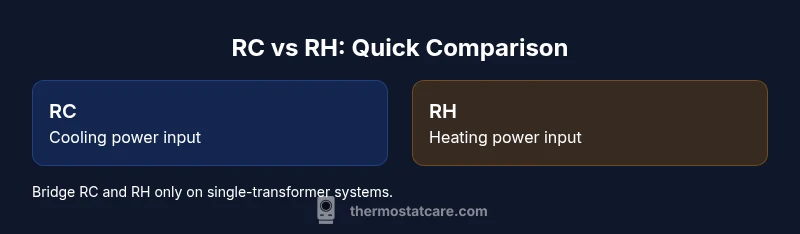
Quick takeaway: RC vs RH identify two power inputs on many thermostats. RC is the cooling power source, RH is the heating power source. If your heating and cooling are fed by a single transformer, you may see a small jumper bridging RC and RH so one supply runs both. If you have two transformers, RC and RH should remain separate to avoid cross-wiring. For most homes, verify your furnace and outdoor AC setup before wiring.
Understanding RC and RH: What the labels mean
According to Thermostat Care, RC and RH identify two distinct power inputs on many thermostats. RC is the cooling power source, while RH is the heating power source. If your heating and cooling are fed by a single transformer, you may see a small jumper bridging RC and RH so one supply runs both. If you have two transformers, RC and RH should remain separate to avoid cross-wiring.
When your system has a single transformer
In homes with a single transformer powering both heating and cooling, RC and RH are typically bridged or treated as the same circuit inside the thermostat. You may see a physical jumper between RC and RH, or the thermostat’s internal circuitry may connect them. In these configurations, the thermostat can call for heat or cool using the same source. Always confirm the transformer’s rating and the control board’s capacity to handle the combined load before wiring. Mismatches can stress components and lead to performance issues. Thermostat Care emphasizes following the manufacturer’s specs to avoid overload and warranty issues.
When you have dual transformers: RC vs RH in practice
Some homes have separate transformers for heating and cooling—often a furnace powers heat and a separate air conditioner handles cooling. In these setups, RC powers cooling, RH powers heating, and the two are kept isolated unless the thermostat manufacturer specifies a jumper. This arrangement minimizes cross-power interference and keeps functions modular. Ensure both transformers share a neutral or common grounding in line with the equipment manual to avoid ground loops. In practice, dual-transformer systems reduce risk but require careful labeling and testing.
Common wiring scenarios and troubleshooting tips
A frequent source of trouble is wiring the R, RC, and RH terminals incorrectly or omitting the C wire. When you encounter no power to the thermostat or intermittent operation, recheck which transformer feeds each function. Use a multimeter to verify voltage between R and C, and make sure the jumper, if present, is intact. If the air handler and outdoor condenser use different power sources, double-check that RC and RH are correctly configured and that the thermostat is compatible with dual-transformer systems. The right wiring depends on understanding your equipment and following the manual closely.
Bridging RC and RH: pros, cons, and safe practices
Bridging RC and RH simplifies wiring on single-transformer systems but adds a risk if mistaken on a dual-transformer setup. Benefits include fewer wires and easier startup; drawbacks include potential backfeed and overheating if the transformer is undersized. Best practice is to follow the thermostat’s wiring diagram and confirm the HVAC equipment’s transformer arrangement before bridging. Thermostat Care recommends documenting every wire after installation to avoid confusion during maintenance.
Practical wiring steps for common setups
For a single-transformer system: install the R wire to R, bridge RC to RH if the thermostat requires both, connect W to heating call, Y to cooling call, G to fan, and C to common if available. For dual-transformer setups: connect RH to heating call and RC to cooling call separately, and ensure the thermostat has a proper C wire. If you are unsure, consult a licensed HVAC technician.
Compatibility with smart thermostats and HVAC equipment
Smart thermostats can work with RC and RH wiring, but some rely on a common wire (C) or internal power management. Before purchasing, verify that your thermostat supports dual-transformer configurations or has a built-in jumper. Also confirm that your HVAC system’s compressor, blower, and outdoor unit are compatible with the thermostat’s controls.
Testing, safety and maintenance tips
After wiring, test each mode—heat, cool, fan—to confirm proper operation. Listen for unusual noises or short cycles, and observe system response time. If anything seems off, shut power at the breaker and recheck the wiring. Regular maintenance and occasional inspection of transformer integrity can prevent problems later.
Comparison
| Feature | Single-transformer setups | Dual-transformer setups |
|---|---|---|
| Power source | One transformer powers both heating and cooling | Two separate transformers power heating and cooling |
| Wiring approach | Bridge RC and RH when a jumper is present | Keep RC and RH separate with no jumper |
| Common risks | Overloading a single transformer if undersized | Backfeeding or miswiring can damage control boards |
| Best for | Homes with a single heating/cooling transformer | Homes with separate HVAC transformers (furnace + AC) |
| Troubleshooting tips | Check transformer ratings and jumper integrity | Test R-C voltage and ensure correct terminal labeling |
Upsides
- Clarifies power sources and reduces risk when wiring
- Helps diagnose thermostat issues faster
- Supports simple setups with a single transformer
- Improves compatibility with common HVAC configurations
The Bad
- Bridging can cause backfeed or overheating if misused
- Dual-transformer systems require careful wiring and may need pro help
- Bridging RC and RH is not always recommended for heat pumps
Bridge only for single-transformer systems; keep RC and RH separate for dual-transformer setups
In most homes with one transformer, bridging RC and RH simplifies operation and wiring. For homes with two transformers, keeping RC and RH isolated prevents backfeed and ensures each system functions reliably. The Thermostat Care team recommends confirming transformer count before wiring and following the thermostat manual to avoid damage.
Questions & Answers
What does RC stand for on a thermostat?
RC designates the cooling power input on many thermostats. In single-transformer systems, RC is often bridged to RH so one supply can power both heating and cooling.
RC is the cooling power input, typically bridged to RH on single-transformer systems.
What does RH stand for on a thermostat?
RH designates the heating power input. In many installations it pairs with RC when a single transformer powers both heat and cool; otherwise it remains separate on dual-transformer setups.
RH is the heating power input, often used with RC on single-transformer setups.
When should I bridge RC and RH?
Bridge RC and RH only when your HVAC uses a single transformer for both heat and cool. If you have two transformers, bridging is not recommended and can cause problems.
Bridge RC/RH only if you have one transformer powering both - otherwise keep them separate.
Can I bridge RC and RH if my system has two transformers?
No. Two transformers typically require separate RC and RH wiring to avoid backfeeding and potential damage.
Not recommended for systems with two transformers.
Do smart thermostats require RC and RH wiring?
Many smart thermostats can work without separate RC/RH wiring if they provide internal power management and a C-wire. Always check your model’s requirements.
Some smart thermostats don’t need separate RC/RH wiring if they have a C-wire and power management.
What happens if RC and RH are wired incorrectly?
Miswiring can prevent heating or cooling from responding, cause short cycling, or damage the control board. Recheck terminal labels and connections carefully.
Miswiring can cause no heat or cooling, or damage; double-check wiring against the manual.
What to Remember
- Identify your HVAC transformer count before wiring
- Avoid bridging RC and RH on dual-transformer systems
- Follow the thermostat's wiring diagram exactly
- Test your system after wiring to confirm proper function