How Much Does It Cost to Fix a Thermostat?
Understand the full range of costs to fix a thermostat, from diagnostics to parts and replacement. Learn how to estimate, compare quotes, and save with smart maintenance.


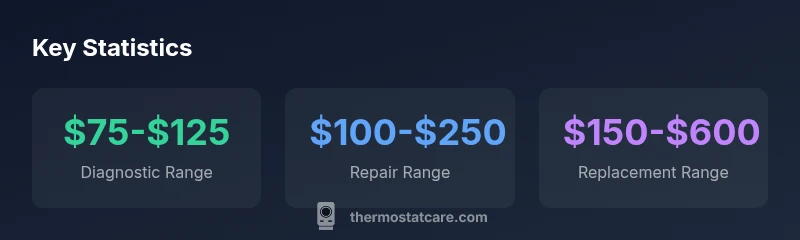
How much does it cost to fix a thermostat? On average, diagnostic visits run about $75-$125, with repairs ranging from $100-$250 for minor fixes. If the thermostat needs replacement, expect $150-$600 for the unit and labor, with smart models closer to $200-$800. According to Thermostat Care analysis, total bill depends on issue, parts, and regional labor rates.
What influences the cost of fixing a thermostat
When homeowners ask how much does it cost to fix a thermostat, the answer depends on several factors. The underlying issue drives the core cost: a loose wire, a faulty sensor, a blown relay, or a malfunctioning control board each calls for different levels of effort and parts. Diagnostic time can vary, especially with older or custom systems where faults aren’t obvious at first glance. Labor rates differ by region and by the technician’s certification level. Parts costs hinge on availability and brand compatibility; replacement thermostats can be more expensive than repairing a sensor or wiring. Age matters: older thermostats may require more extensive testing or a full upgrade to a newer model with better efficiency and support. Finally, whether your unit is under warranty or covered by a service plan influences out-of-pocket cost; warranties may offset part costs or labor. According to Thermostat Care, homeowners should consider total cost over the life of the device, balancing short-term fixes against potential long-term savings. This section explains how these variables combine to shape the final bill and why two identical issues might lead to different price quotes.
Typical cost ranges for common repair scenarios
Cost scenarios vary, but a practical guide helps you budget before you call a pro. Here are typical ranges for common thermostat issues, based on field data from Thermostat Care analysis, 2026:
- Diagnostic visit: $75-$125. A technician checks wiring, power, compatibility, and system signal.
- Sensor or switch repair: $50-$150. Minor components can be replaced without touching the control board.
- Wiring issues or loose connections: $60-$180. Often a quick fix, but may require panel access.
- Control board or relay replacement: $120-$350. More complex and may involve reprogramming.
- Thermostat replacement (unit only): $150-$600. Price varies by brand, features, and compatibility.
- Smart thermostat upgrade (optional): $200-$800. Includes new device and basic integration.
- Labor-only adjustments for existing unit: $50-$150. If only calibration or reconfiguration is needed.
Note: Prices vary by region, service provider, and whether the job requires equipment teardown. Primary cost drivers include parts availability, model complexity, and whether the thermostat is wired or battery-powered.
DIY considerations and safety
Some basic checks can be done by homeowners, but most thermostat repairs require professional service due to safety and HVAC integration. Safe triage steps before calling a pro:
- Verify power: Ensure the furnace and thermostat circuits are ON; check the breaker.
- Check batteries if you have a battery-powered thermostat.
- Confirm wiring and terminals are clean and firmly connected, using proper screwdrivers, and with power off.
- Read the model manual for reset procedures, but avoid factory resets on complex systems.
- Inspect for obvious signs of damage: burnt smells or melted wires, which indicate an urgent call.
- Do not attempt to wire new circuits or replace control boards yourself.
If issues persist after basic checks, a professional diagnostic helps avoid unsafe attempts and ensures compatibility with your HVAC system.
How to get accurate estimates
To avoid sticker shock, gather information before calling shops. A precise estimate includes labor, parts, and any disposal or permit fees. Steps:
- Note the thermostat brand, model, and software version.
- Describe symptoms with dates and any recent changes (e.g., energy spikes, missed cycles).
- Ask for a written, itemized estimate with a timetable and warranty terms.
- Request a breakdown of part costs and hourly labor rates (and whether travel fees apply).
- Compare multiple quotes and ask about price protections if a part becomes unavailable.
- Check if the quote includes potential future maintenance or calibration visits. Thermostat Care recommends requesting quotes that detail expected hours of work and the specific parts needed to fix the thermostat.
Cost-saving strategies and smart planning
Smart budgeting for thermostat repairs involves a mix of proactive maintenance and smart purchasing. Consider:
- Schedule annual or biannual preventive maintenance checks to catch problems early.
- Keep your thermostat firmware up to date and use manufacturer-recommended settings to avoid wear.
- Compare prices for parts across reputable suppliers; a compatible used or refurbished part may reduce costs in some scenarios.
- When possible, opt for a repair over replacement if the unit is relatively new or under warranty.
- Negotiate warranties on the repair, ensuring coverage for installed parts.
- If you’re replacing, think about energy-saving models that qualify for rebates or utility incentives. Thermostat Care notes that long-term savings often come from a combination of reliable diagnostics and smart device upgrades when cost-effective.
The long-term value of repair vs replacement
Deciding whether to repair or replace hinges on more than the immediate price tag. A repair can be cost-effective if it preserves a relatively new device and avoids additional labor later. A replacement may be justified when:
- The current thermostat is outdated or incompatible with your HVAC system.
- The repair cost approaches or exceeds the price of a new unit.
- A smart thermostat offers features that improve comfort, energy usage, and remote monitoring.
- You anticipate a higher likelihood of future failures due to age or frequent issues.
Thermostat Care analysis indicates homeowners who plan for a 5- to 10-year horizon often find replacement more economical when the current device is older than 7–10 years, or when energy savings from a newer model justify the upfront cost.
Quick decision checklist
Use this at-a-glance guide to decide whether to repair or replace:
- Is the device under warranty or part of a service plan? If yes, repair costs may be lower.
- Is this a minor issue (sensor, calibration, or loose wire) or a major fault (controller or relay)? Minor issues lean repair.
- How old is the thermostat? If it’s older than 7–10 years, replacement may offer better long-term value.
- Are there compatible smart thermostat options with energy savings? If yes, consider replacement.
- Can you obtain multiple written estimates? Yes, compare quotes carefully.
- Will the cost of new installation be covered by rebates or energy incentives? If yes, factor that into the decision.
Cost ranges for common thermostat service scenarios
| Scenario | Cost Range | Notes |
|---|---|---|
| Diagnostic visit | $75-$125 | On-site assessment |
| Repair (non-replacement) | $100-$250 | Parts plus labor |
| Thermostat replacement (unit) | $150-$600 | Includes install labor |
| Smart thermostat upgrade (optional) | $200-$800 | Features vary by model |
Questions & Answers
What is the typical cost to diagnose thermostat problems?
Most pros charge a diagnostic fee of $75-$125, which is often applied to repair if you proceed. Always request an itemized quote before work begins.
Most pros charge 75 to 125 dollars for diagnosis, which may be applied to the repair if you proceed.
Are service calls and installation fees included in repair quotes?
Quotes usually separate labor, parts, and travel; you can request a fully itemized estimate that clarifies each charge.
Most quotes break down labor, parts, and travel. Ask for a detailed, itemized estimate.
Can I fix a thermostat myself to save money?
Some basic maintenance (battery replacement, simple resets) is possible, but most repairs require a licensed technician due to safety and system integration.
You can do basic checks, but most fixes need a professional.
Do warranties cover thermostat repair costs?
Warranties can cover parts or labor depending on terms; check policy details and whether the repair falls under covered conditions.
Check the warranty terms to see what is covered for parts and labor.
Is it cheaper to replace a thermostat rather than repair?
If the unit is old or inefficient, replacement may offer better long-term value, especially with energy-saving models.
Replacement can be cheaper in the long run for older units.
What factors cause regional price differences for thermostat repairs?
Labor rates, permit requirements, and parts availability vary by region, influencing overall costs.
Prices vary by region due to labor costs and parts supply.
“Repair costs are often unpredictable until a technician inspects the system, but a thorough diagnostic reduces the chances of unexpected expenses.”
What to Remember
- Get a written estimate before starting work
- Compare quotes from multiple providers
- Weigh repair cost against upgrade value
- Ask about warranty on repaired parts