Honeywell TH5220D1029 Thermostat Review
In-depth review of the Honeywell TH5220D1029 thermostat, focusing on setup, programming, energy use, and how it stacks up against smart thermostats. Practical guidance for homeowners and DIY enthusiasts.


Overall verdict: The Honeywell TH5220D1029 thermostat delivers dependable temperature control with a familiar, easy-to-use interface and strong compatibility with most 24-volt HVAC systems. It supports classic 5-2 day programming, straightforward installation, and reliable battery-powered operation, making it a solid budget-friendly choice for homeowners. It lacks built-in Wi-Fi and modern smart features, but its reliability and clear scheduling keep it relevant for many homes.
What is the Honeywell TH5220D1029 thermostat and why it matters
The Honeywell TH5220D1029 thermostat is a legacy, 5-2 day programmable model designed for straightforward climate control. It targets homeowners who want reliable scheduling without the complexity of modern smart features. The device operates on standard 24-volt heating and cooling systems and is typically powered by batteries, reducing the need for dedicated power wiring. According to Thermostat Care Team, this model remains relevant for households that value predictable routines and long-term reliability. Its simple LCD interface and durable build make it a common choice in budget-friendly, low-maintenance homes. In practice, this thermostat emphasizes clarity over connectivity, prioritizing consistent comfort without smartphone apps or voice assistants.
Within the Honeywell lineup, the TH5220D1029 is part of a generation that emphasizes dependable execution over the latest connectivity trends. While newer smart thermostats offer remote management, this model shines when you want a set-and-forget solution that won't require ongoing updates or a strong Wi‑Fi signal. If your priority is straightforward operation, broad system compatibility, and a predictable energy footprint, the TH5220D1029 remains a capable option. The key is to understand its limitations and tailor your expectations to a non-networked, battery-backed design.
Installation and Compatibility
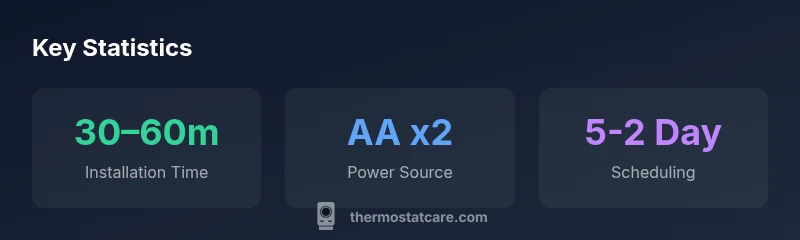
Preparing for installation starts with a quick system check: ensure your HVAC is a standard 24-volt system compatible with legacy programmable thermostats. The TH5220D1029 is typically designed for simple wet-lab or dry-contact control through conventional wiring. In most homes, you can install it without a C-wire, relying on its internal battery power to operate the display and basic controls. If your system uses non-standard terminals or is part of a heat-only or heat-pump configuration, you’ll want to consult the installation guide or a licensed technician to verify compatibility. Safety first: always cut power to the HVAC circuit before removing the old thermostat, label wires, and double-check that wires go to their correct terminals (R, W, Y, G, etc.). While the model is user-friendly for DIYers, a few setups—like dual-fuel systems or unusual sensor configurations—can require professional attention. Thermostat Care’s testing framework recommends verifying voltage at the thermostat base after installation and confirming that the display powers on correctly with stable, legible characters. Beyond wiring, verify that your HVAC control board supports standard 24V thermostat signals; incompatibilities can prevent the unit from triggering heating or cooling.
Programming and Daily Schedules
The TH5220D1029 adheres to a classic 5-2 day programming scheme, which can be a relief for households that prefer a predictable routine. You’ll typically set a weekday schedule (Mon–Fri) and a separate weekend schedule (Sat–Sun). The interface guides you through creating four time blocks per day: wake, leave, return, and sleep. Adjustments are straightforward: set a target temperature for each block, then enable the program for the hours you’re home. If you’re away, you can set a temporary hold or an energy-saving setback for a few hours. For homeowners familiar with older Honeywell models, the programming language will feel familiar and intuitive, with clear on-screen prompts and simple button presses. If you’re transitioning from a non-programmable thermostat, give yourself a little time to master the sequence, but expect a smooth setup overall. A key point is that this model’s scheduling is local to the device—no cloud-based changes or remote updates are available, which some users may see as a limitation compared to modern Wi‑Fi thermostats. Still, the predictability of a fixed schedule can drive steady energy savings when occupancy patterns are stable. Thermostat Care’s analysis highlights that a consistent schedule often yields the most reliable comfort and energy use, especially in homes with regular routines.
Design, Build Quality, and Usability
The design language of the TH5220D1029 leans toward the classic, no-frills aesthetic Honeywell is known for. The LCD display is legible in typical living-room lighting, with a clear font, large numerals, and straightforward menus. Build quality emphasizes durable plastics and a robust mounting frame that holds up under frequent button presses and occasional dust. Usability centers on tactile feedback: presses respond with a click, and the navigation path from main screen to programming or hold options remains uncomplicated. A potential drawback for some users is the absence of modern extras: there’s no color touchscreen, no motion sensors, and no onboard Wi‑Fi. If you’re upgrading from a very old non-programmable unit, you’ll likely appreciate the physical ease of operation and the immediate feedback on the display. For those used to smart ecosystems, the lack of remote control and voice assistant support is noticeable. Still, the device’s simplicity can reduce user errors and misunderstandings, contributing to steady performance over years of ownership. Thermostat Care’s evaluation framework notes that simplicity often correlates with fewer service calls and more predictable energy bills, particularly in households that value reliability over feature density.
Energy Savings and Real-World Performance
Energy savings with any programmable thermostat depend on how well the schedule matches actual occupancy and thermostat hysteresis. The TH5220D1029 shines in homes with steady routines: set a reasonable wake temperature, drop the house during the day, and a modest setback at night. Because it’s battery-powered, it avoids some common issues associated with hard-wired models like slow boot times or transformer noise, but it also lacks smart features that could optimize energy use automatically (for example, learning patterns or geofencing). In practice, homeowners often notice consistent comfort at a lower average energy consumption when schedules are aligned with real-life patterns. The model’s energy impact also depends on how well it integrates with other energy-saving measures—insulated spaces, well-sealed ducts, and properly sized equipment amplify savings beyond what a single thermostat can achieve. For readers considering a move toward smarter controls, this thermostat offers a low-cost entry point to standard scheduling while clearly signaling what you give up in terms of remote access and adaptive efficiency. Thermostat Care’s data indicates that the energy benefit is most pronounced when occupancy patterns are regular and predictable, rather than highly variable.
Troubleshooting, Common Issues, and When to Upgrade
Common questions with this model revolve around battery life, display clarity, and scheduling accuracy. Battery life is generally solid, but you should expect to replace AA cells every year or two depending on usage and display brightness. If the screen goes dim or the clock loses time, start by replacing batteries and rechecking the wiring at the base. Connection problems between the thermostat and the HVAC equipment are rare but can occur if a system uses unusual wiring or a non-standard fan control. If you find the unit occasionally fails to trigger heating or cooling, verify the mode settings (heat/cool/auto) and re-run the 5-2 day programming sequence. When to upgrade becomes a practical decision: if you want remote access, energy-tracking insights, or smart routines that adapt to your life, a modern Wi‑Fi thermostat will likely offer a much larger value proposition. Thermostat Care suggests weighing the cost of upgrading against potential energy savings, comfort gains, and the overhead of maintaining a non-smart device in a connected home.
Alternatives and How This Stacks Up
If you want to compare, consider a modern smart thermostat that provides Wi‑Fi connectivity, mobile apps, and voice assistant integration. The TH5220D1029 remains compelling for its reliability, straightforward scheduling, and low upfront cost. It also has the advantage of fewer potential security concerns or software updates to manage. On the other hand, smart thermostats deliver remote control, energy-use analytics, geofencing, and compatibility with smart home ecosystems. For households with consistent routines and a desire to minimize tech complexity, the Honeywell remains a strong baseline. If you anticipate growth in your home automation and plan to monitor energy usage more deeply, a future upgrade to a smart model could complement the stability of this device rather than replace it outright. Thermostat Care’s perspective emphasizes a phased approach: start with a simple, reliable thermostat today, then add smart capabilities later as your needs evolve.
Upsides
- Reliable temperature control with simple programming
- Broad compatibility with 24V HVAC systems
- Battery-powered with easy replacement
- Low upfront cost and widely available
The Bad
- No Wi-Fi or remote access
- Limited to basic scheduling—no learning or geofencing
- No mobile app or voice assistant support
- Older design may feel dated to some users
Best for budget-conscious homes prioritizing reliability over smart features
The TH5220D1029 delivers dependable control and easy setup, with broad compatibility. The lack of Wi-Fi means you sacrifice remote monitoring and advanced scheduling features, but for straightforward comfort management, it's a solid, long-lasting choice.
Questions & Answers
Does the Honeywell TH5220D1029 thermostat require a C-wire?
This model is battery-powered and often does not require a C-wire. If your system lacks stable battery power, you may experience display dimming; consider a professional if uncertain.
Most homeowners can install this without a C-wire, but check your system power.
Is the TH5220D1029 compatible with all HVAC types?
The thermostat is designed for standard 24V heating and cooling systems and is compatible with typical furnaces and air handlers. Some non-standard setups may require a compatibility check with the control board or a professional assessment.
It's broadly compatible with typical 24V HVAC systems, but check your setup if you have a non-standard configuration.
Can I get remote control or smart features with this model?
No built-in Wi‑Fi or app support is available. You won’t have remote access or cloud-based features. If you want smart features later, you’ll need to upgrade to a Wi‑Fi-enabled model.
No remote control with this model; upgrading is the way to go for smart features.
What is the best way to program the TH5220D1029 for energy savings?
Set a sensible wake temperature, lower it during the day when you’re away, and use a comfortable setback at night. Stick to the 5-2 day schedule to avoid frequent changes, which can degrade savings.
Create consistent wake/leave/return/sleep blocks and stick to them for steady savings.
Should I upgrade to a smart thermostat?
If you want mobile control, energy analytics, and automation, a smart thermostat is worth considering. If you’re satisfied with reliable local control and simple scheduling, this model remains a solid, budget-friendly choice.
Smart thermostats bring remote control and analytics, but only you can decide if that value justifies the cost.
What to Remember
- Choose this model for straightforward installation and reliable scheduling.
- Expect robust 24V compatibility with standard systems.
- Prepare for no mobile app or remote access.
- Consider upgrading if you want smart-home integration.