How to Tell If Your Thermostat Has a C Wire
Learn how to determine if your thermostat has a C wire with step-by-step checks at the thermostat and furnace. Clear, homeowner-friendly guidance from Thermostat Care to power smart thermostats reliably.


According to Thermostat Care, the quickest check is to look for a dedicated C terminal on the thermostat base with a wire connected. If you see a C labeled terminal and a wire attached (often blue or brown), you have a C wire. If there is no C terminal or the wire isn’t present, your thermostat likely lacks a C wire and may require wiring work or an alternative power option.
How to tell if thermostat has c wire: What the C wire does
The C wire, short for common wire, provides a continuous return path for 24-volt power in most modern heating and cooling systems. It powers smart thermostats and keeps sensors reliably on line. For homeowners, the central question remains: how to tell if thermostat has c wire. As Thermostat Care notes, the simplest starting point is a visual inspection of the thermostat base. Look for a terminal labeled C with a wire connected. If you find a C terminal and a wire on it (blue, brown, or another color common to your system), you likely have a C wire. If the terminal isn’t present or there’s no wire on C, you probably don’t have a C wire and will need to pursue alternate wiring options or consult a professional.
Why a C wire matters for reliability and features
Many older thermostats relied on power stealing or alternate methods to charge their circuits, but modern thermostats, especially Wi‑Fi or smart models, require a stable 24V reference. The C wire completes the circuit and prevents dim displays, incorrect readings, or unresponsive schedules. For homes with heat pumps or multi-stage systems, a C wire becomes even more important to ensure consistent operation across all modes. Thermostat Care analysis shows that understanding whether your system has a C wire helps you avoid troubleshooting bottlenecks later on.
Quick-check rules to keep in mind
- If your thermostat base has a C terminal with a connected wire, you likely have a C wire. - If there is no C terminal or the wire lacks a path back to the furnace, you don’t have a C wire. - Some systems use a power extender kit or a transformer-based setup instead of a direct C wire; these require careful wiring to avoid safety risks.
Always power down the system before handling wiring to avoid shocks or damage.
Tools & Materials
- Non-contact voltage tester (optional)(Helpful for quick live-checks but not strictly necessary for visual verification)
- Multimeter (AC voltage capable)(Used for confirming 24V AC between R and C at the furnace control board)
- Screwdriver set (flathead and Phillips)(To remove the thermostat cover and access terminals safely)
- Flashlight(Better visibility inside the furnace/air handler compartment)
- Owner’s manual for thermostat/model(Model-specific wire colors and terminal labeling can vary)
Steps
Estimated time: 50-75 minutes
- 1
Power off the system
Turn off the thermostat at the thermostat or the circuit breaker feeding the HVAC system. This prevents shocks to your components while you inspect the wiring.
Tip: If you’re unsure which breaker controls the HVAC, switch off the main at the panel and verify no lights or fan run on the unit. - 2
Remove the thermostat cover
Carefully unscrew and lift the cover to expose the terminal strip. Keep screws in a safe place and avoid tugging on wires.
Tip: Take a photo of the existing wiring before moving anything so you can reference the original layout. - 3
Inspect the terminal strip for C
Look for a terminal labeled C. If a wire is connected to C, note its color and whether it appears to lead toward the furnace wiring.
Tip: If you don’t see a C terminal, you may have an older thermostat or a proprietary wiring setup. - 4
Trace the common wire
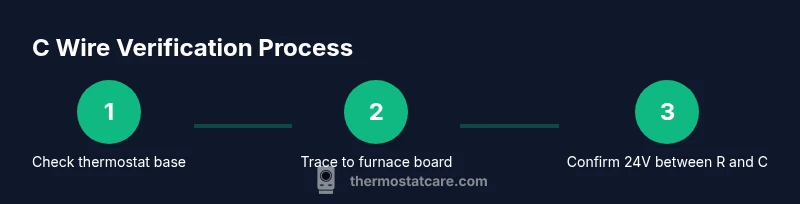
If there is a wire on C, trace, as far as safely possible, whether the other end travels to the furnace control board. This confirms a complete path.
Tip: Avoid forcing wires through cramped spaces; if you can’t trace safely, proceed to Step 6 instead. - 5
Check at the furnace control board
Open the furnace cabinet and locate the control board. Identify the C terminal and ensure the same conductor found at the thermostat terminates here.
Tip: Some boards label terminals with letters and color keys—use the manual to confirm C’s location. - 6
Test for 24V between R and C
With power restored (or with the system off and a controlled test method), measure between R and C terminals. A steady 24V reading confirms a live C path.
Tip: If you’re not confident using a multimeter, contact a professional instead of guessing voltages. - 7
Decide on next steps if C is absent
If no C wire is found, you can run a new conductor, use a power extender kit, or explore a C-wire adapter option from the thermostat manufacturer.
Tip: Running a new wire may require opening walls and floor coverings; weigh safety and cost before proceeding. - 8
Document and test the setup
Reconnect all covers, restore power, and check the thermostat for power-on behavior and status lights. Confirm the thermostat’s settings recognize a C wire.
Tip: Keep a record of changes for future maintenance or when calling a technician.
Questions & Answers
Can a thermostat work without a C wire?
Some thermostats can operate without a C wire by stealing power from other circuits, but this can lead to unreliable operation and erratic readings. A dedicated C wire improves stability and performance.
Some thermostats can run without a C wire, but it may cause unreliable performance. A dedicated C wire improves stability.
How do I know which wire is the C wire?
The C wire is typically connected to the C terminal on the thermostat and the furnace control board. Color is not guaranteed, so verify by tracing the wire path or consulting the manual.
The C wire usually goes to the C terminal on both the thermostat and the furnace control board; color alone isn’t reliable.
Is it safe to test with a multimeter?
Yes, but only after powering down and following proper safety steps. Use a multimeter to verify 24V between R and C when power is restored for testing.
Yes, with power off, use a multimeter to check voltage when you restore power carefully.
Should I hire a professional to install a C wire?
If you’re uncomfortable with electrical work or navigating furnace wiring, hiring an HVAC technician or electrician is the safest option.
If you’re not comfortable with electrical work, it’s wise to hire a pro.
What if my thermostat is battery powered?
Some battery-powered thermostats can operate without a C wire, but many models still benefit from a dedicated C. Check your model’s installation guide.
Battery-powered thermostats can work without C, but many need C for optimal performance.
Watch Video
What to Remember
- Identify the C terminal to confirm a C wire presence.
- Verify continuity from thermostat to furnace control board for a complete path.
- If C is missing, options include running a new wire or using an adapter kit.
- Always power down before inspecting electrical components.
- Document changes for future maintenance.