How Much Is a Nest Thermostat in 2026? Price Guide and Practical Tips
Learn the current price ranges for Nest Thermostat models, what drives cost, and how to maximize value with bundles, promos, and installation options in 2026.


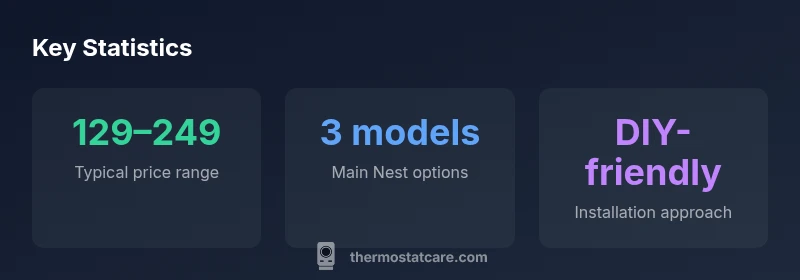
How much is a Nest Thermostat? In 2026, the standard Nest Thermostat typically costs between $129 and $249 USD depending on model and retailer. Promotions, bundles, and retailer sales can move the price, and installation (DIY or professional) adds additional costs to factor in. Overall, expect higher price for Learning or E variants and consider bundled accessories to maximize value.
What determines the price of a Nest Thermostat in 2026
The price you pay for a Nest Thermostat isn't set by one fixed number. It depends on the model you choose, where you buy it, and whether you grab a bundle or promotion. Brand and retailer pricing can shift due to stock, holiday sales, or retailer exclusives. In practical terms, you should budget for the base device, plus any accessories (like temperature sensors) and potential installation costs. According to Thermostat Care analysis, the biggest price levers are model tier, bundled accessories, and any professional installation service. When you plan, separate the device cost from these add-ons to avoid sticker shock and to compare apples to apples across retailers.
Nest Thermostat models and their price impressions
There are several Nest options commonly available in 2026. The standard Nest Thermostat (the newer model) typically falls in the mid-range for smart thermostats, while the older Nest Thermostat E is positioned as a lower-cost alternative. The Nest Learning Thermostat sits at the premium end with advanced learning features and occupancy sensing. In general, you’ll see price ranges that reflect feature sets: the more automation and learning intelligence you want, the higher the upfront price. For budgeting purposes, expect variations by model and region. Thermostat Care analysis notes that model choice is the primary driver of price, followed by retailer promotions and any bundles you select.
The role of bundles and promotions in overall cost
Smart-home retailers frequently offer bundles that pair the thermostat with sensors, extra thermostats, or installation credits. Bundles can drastically alter the “out-the-door” price, sometimes reducing the effective cost per feature. Promotions around holidays, back-to-school, or big shopping days also shift the price briefly. If you’re buying for multiple zones or upgrading an entire system, bundles can deliver noticeable value. Thermostat Care recommends evaluating the price per feature (on-device controls, energy insights, and compatibility) rather than chasing the lowest sticker price alone.
Installation costs: DIY vs professional
Installation costs are a common source of confusion. A DIY install can save money but requires comfort with wiring and basic HVAC terminology. A professional installation adds a separate fee and is often advised for more complex systems (heat pumps, multi-stage setups, or homes with non-standard wiring). The final bill will reflect labor time, travel, and any additional wiring or adapters needed. Thermostat Care notes that in many cases, homeowners recoup some of the extra cost through improved energy efficiency and better thermostat performance over time.
Where to buy and how to compare prices
Major retailers and Google's official Nest store are the typical sources for Nest Thermostats. When comparing prices, check the model name, included accessories, and whether the price applies to a bare device or a bundled option. Don’t forget to verify return policies, warranty terms, and any promotional expiration dates. In addition to price, consider compatibility with your HVAC system and the ease of installation when choosing a source. Thermostat Care emphasizes looking for transparent total-cost information (device price + any add-ons + installation) to avoid hidden costs.
Cost of ownership: energy savings vs upfront price
The total cost of ownership depends on how efficiently your home uses heating and cooling. A higher upfront price on a more capable model can pay off if your energy bills drop meaningfully over time. While exact energy savings vary by climate, home insulation, and HVAC setup, homeowners should model potential annual savings and compare them to the upfront price (plus installation). Thermostat Care suggests a simple approach: estimate annual energy savings and divide the upfront cost to approximate payback time. This helps ensure the price aligns with the value you’ll receive.
Buying tips to maximize value
- Compare model features against your needs (basic scheduling vs learning capabilities)
- Look for official bundles that include sensors or installation credits
- Check for retailer promotions and seasonal sales
- If your wiring is unfamiliar, opt for professional installation to avoid future issues
- Verify compatibility with your HVAC system before purchase
- Consider a test period: many retailers offer a return window if it doesn’t meet expectations
Nest thermostat model price ranges and core features
| Model | Typical Price Range | Core Features |
|---|---|---|
| Nest Thermostat (2020s) | $129–$199 | Energy-saving features, Google Home compatibility |
| Nest Thermostat E | $99–$149 | Simplified design, essential features |
| Nest Learning Thermostat | $199–$249 | Advanced learning, occupancy sensing |
Questions & Answers
Is the Nest Thermostat cheaper than the Nest Learning Thermostat?
Yes, the Nest Learning Thermostat generally costs more due to its advanced learning and sensing capabilities. The standard Nest Thermostat is typically the more affordable option.
Yes, the Learning model costs more because of extra features.
Do I need a professional to install a Nest Thermostat?
Most standard installations can be done DIY if you’re comfortable with basic wiring. Complex systems or heat pumps may benefit from professional installation.
DIY is usually fine for simple setups, but call a pro for complex wiring.
Are there rebates or incentives for Nest thermostats?
Some utility programs offer rebates or incentives for smart thermostats. Availability varies by location and program terms.
Check local utility programs for rebates.
How long does installation take?
DIY installations typically take 20–60 minutes, depending on your wiring and HVAC setup. Professional installs can take longer if additional wiring is required.
Most installs take under an hour.
Will a Nest Thermostat work with my existing HVAC system?
Nest Thermostat works with most 24V HVAC systems. Some setups may require a compatibility check or a C-wire adapter.
It works with most 24V systems, but verify compatibility.
“Price is driven by model complexity and bundled features, not the brand alone. For most homeowners, a careful price-to-value assessment pays off when you factor energy savings and convenience.”
What to Remember
- Expect price variation by model and retailer
- Bundles and seasonal promos can change the total cost
- DIY installation reduces upfront costs for simple setups
- Factor in potential energy savings when budgeting