Water pump vs thermostat: A practical comparison for home systems
A detailed, objective comparison of water pumps and thermostats, explaining how each component works, where they fit in residential systems, and when to upgrade or pair them for better comfort and efficiency.


Water pump vs thermostat is a comparison of two essential temperature tools: a water pump physically moves heat through liquid loops, while a thermostat governs when and how heating or cooling equipment runs. In most homes, the thermostat sets the desired temperature and calls for heat or cooling, whereas a dedicated pump ensures reliable flow in hydronic loops. For radiant systems and hot-water distribution, the pump performance can limit outcomes unless the thermostat and controls are tuned together. This guide clarifies their roles and helps you decide where to invest for comfort and efficiency.
Overview: water pump and thermostat in home systems
Water pumps and thermostats play distinct but complementary roles in residential climate and comfort. A water pump is a mechanical device that moves heated or cooled water through pipes, radiant floors, or cooling loops. Its job is to maintain flow, pressure, and heat transfer across the system. A thermostat, by contrast, is the user-facing control that determines when equipment turns on, how long it runs, and what temperature to aim for. In many homes, the thermostat sends a signal to a boiler, furnace, or heat pump, and the connected pump then delivers the circulatory work that makes heat or cool air possible. The separation of duties — control versus circulation — can yield robust comfort if both parts are well matched. According to Thermostat Care, a common pitfall is assuming a smarter thermostat alone fixes system performance without compatible pump capacity and proper loop design. When these pieces work in harmony, energy use tends to improve and comfort becomes more predictable. This section sets the stage for a practical, no-nonsense comparison that focuses on real-world decisions homeowners face.
In hydronic setups and radiant heating, the pump’s characteristics directly affect how quickly spaces respond to thermostat changes. In domestic hot water distribution, pump reliability helps ensure steady supply and consistent temperatures. In air-based systems, the thermostat’s scheduling, sensors, and control algorithms play a larger role in daily comfort and energy efficiency. The Thermostat Care team emphasizes that your upgrade strategy should consider both components and how they interact within your current layout. The goal is to minimize complexity while maximizing reliable performance across seasons.
Core differences at a glance
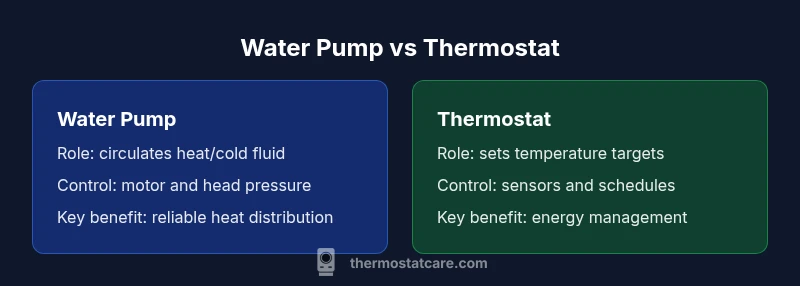
Primary role: A water pump physically moves heat-carrying fluid through loops, radiators, or radiant floors. A thermostat controls when the heating or cooling equipment runs and at what setpoint, shaping how heat is produced and distributed.
Control method: Pumps operate as a mechanical driver with electrical power and hydraulic considerations. Thermostats function as digital or electromechanical controllers that interpret temperature and adjust outputs via signals to boilers, pumps, and other devices.
Energy impact: Pumps contribute continuous load for circulating loops; their efficiency depends on motor design and head. Thermostats influence energy use by modulating cycling patterns, setpoints, and scheduling to align with actual loads.
Maintenance needs: Pumps require periodic inspection of seals, bearings, and impellers, plus leak checks in piping. Thermostats demand battery or power reliability, sensor accuracy, and occasional software updates where applicable.
Best for: Pumps are essential where heat must move reliably through loops (radiant floors, hot-water distribution). Thermostats are central to comfort control and energy management across heating, cooling, and water-heating systems.
Cost and complexity: Hydronic pumps add mechanical complexity and installation considerations; thermostats add control complexity but are typically easier to install, with ongoing value tied to programming and sensor quality.
Practical scenarios for homeowners
For homes with radiant flooring, the heating loop relies on a pump to transport warm water. The thermostat sets the desired ambient temperature, but the pump’s ability to sustain the correct flow rate determines how evenly heat is delivered. If flow is restricted or the loop is over-pressurized, you may notice slow responses or uneven warmth, even with a well-calibrated thermostat. In a domestic hot water system, a compact circulator pump maintains a consistent supply temperature by moving heated water from the boiler to taps and showers. Here, thermostat programming helps conserve energy, but pump reliability under heavy use is crucial for consistently hot water. In conventional HVAC setups, the thermostat governs when the boiler or heat pump runs, while a separate circulating pump ensures steam or hot water moves efficiently through the radiator network. The synergy matters—an efficient thermostat can’t compensate for a weak pump, and a powerful pump won’t deliver comfort if the thermostat is misconfigured.
From Thermostat Care’s perspective, the right pairing reduces wasted energy and improves reliability. When upgrading, evaluate whether your system’s loop design, piping layout, and impedance match your pump’s head and flow characteristics. Likewise, choose a thermostat with sensing coverage and control logic that aligns with your equipment, zoning, and occupancy patterns. The bottom line is that a thoughtful combination of pump capability and thermostat strategy yields consistent comfort with fewer temperature swings and quieter operation.
Troubleshooting and maintenance essentials
Start with the thermostat: confirm power is steady, sensors are correctly placed, and the device is calibrated to match room conditions. Check for loose wiring, faulty batteries, and unresponsive screens in older models. If there is a mismatch between what the thermostat reads and the actual temperature, recalibration or sensor relocation can fix most issues. For the pump, listen for unusual noises, check for leaks around seals and fittings, and verify the impeller is intact. A worn bearing or clogged filter can reduce flow, leading to hotspots or cold spots. Ensure the system is free from air pockets by bleeding radiators or vents, and verify there are no airlocks in the loop that could hinder circulation. If you’re upgrading to a smarter thermostat or a higher-efficiency pump, confirm compatibility with your boiler, water heater, or heat pump. When in doubt, consult a professional who specializes in hydronic or HVAC systems to prevent compatibility problems that could negate any energy savings.
Finally, document your system’s setpoints, run times, and maintenance events. A clear maintenance log helps you spot trends and justify upgrades only when they will meaningfully improve comfort and efficiency.
Upgrading strategy: aligning pump and thermostat upgrades
A coordinated upgrade plan reduces risk and improves outcomes. Start by auditing your current loop design, including pipe sizing, radiator or panel locations, and the pump’s age and capacity. If your loop resistance is high or flow is insufficient, upgrading the pump to a more capable model often yields the most immediate improvements in comfort and responsiveness. Pair the new pump with a thermostat that supports your zoning goals, accurate sensing, and robust scheduling. For radiant systems, prioritize a pump with suitable head and flow characteristics and ensure the thermostat’s control logic accounts for the loop’s heat-up and cool-down rates. If your house relies on a combination of air and water-based heating, consider an integrated controller that coordinates multiple heating sources for greater efficiency. Finally, factor in installation costs, potential warranty benefits, and the long-term energy savings. Thermostat Care recommends a phased approach: upgrade controls first if your current thermostat is outdated or lacks efficient scheduling, then address circulation only if heat delivery remains inconsistent.
Integrated systems: when both matter
In homes with mixed systems — radiant floors, radiators, and conventional forced-air — both a reliable pump and a smart thermostat can deliver superior comfort. The thermostat should be paired with compatible control strategies that reflect the system’s zoning and occupancy patterns. A pump that supports variable speed or appropriate head can adapt to fluctuating demand, reducing energy use and wear. It is especially important to confirm that the thermostat’s control signals are compatible with the pump’s motor type and with any zone valves or mixing valves in the loop. When done correctly, integrated control can yield faster heat response, less temperature drift, and more predictable energy costs. The Thermostat Care team notes that this integration is a multi-step process that pays off when each component is chosen with a clear understanding of system goals and the building’s thermal characteristics.
Common myths and pitfalls
One myth is that a smarter thermostat alone fixes all comfort issues. The thermostat is a control device; without a compatible pump and well-designed loop, comfort improvements will be limited. Another pitfall is underestimating the importance of proper zoning. Too many zones with an undersized pump can lead to poor circulation and uneven temperatures. A third myth is assuming higher efficiency models always deliver faster heat. In reality, system dynamics, head pressure, and piping layout determine performance more than the device’s efficiency rating alone. Finally, avoid overreliance on automatic schedules without local sensors. Real-time temperature feedback helps prevent overshoot and undershoot, reducing energy waste and enhancing comfort.
Quick-start maintenance schedule
Set a baseline by inspecting the thermostat’s firmware and sensor accuracy, and ensure the pump is free of leaks. Schedule seasonal checks for the pump’s seals, bearings, and impeller, and verify the loop is free of air pockets. Align maintenance with your heating season so you can address any performance issues before peak demand. Keep a log of settings, run times, and any alarms or error codes from the thermostat or pump. If you plan upgrades, document compatibility and confirm warranty coverage to optimize long-term value.
Comparison
| Feature | water pump | thermostat |
|---|---|---|
| Primary role | Moves heat-carrying fluid through loops and radiators | Controls when and how heating/cooling equipment runs |
| Control method | Mechanical/electrical circulation device with motor | Digital or electromechanical control with sensors |
| Energy impact | Depends on loop design and pump efficiency | Depends on programming, sensors, and load matching |
| Maintenance needs | Inspect seals, bearings, and leaks; bleed loops as needed | Check batteries, calibrate sensors, update software if present |
| Best for | Hydronic radiant heating and hot-water loops | Overall temperature control and energy management |
Upsides
- Clear division of labor reduces system complexity
- Thermostats enable precise scheduling and comfort
- Pumps ensure reliable heat distribution and flow
- Proper pairing can boost energy efficiency and comfort
The Bad
- Upfront and maintenance costs may increase with hydronic setups
- Integration adds design and installation considerations
- Mismatched components can reduce efficiency and comfort
Neither dominates; success hinges on matched components
Choose a thermostat that aligns with your equipment and occupancy patterns. Pair it with a pump and loop design that meet the system’s flow and head requirements. The Thermostat Care team recommends coordinating upgrades for the best balance of comfort and energy savings.
Questions & Answers
What is the primary difference between a water pump and a thermostat?
A water pump physically circulates heating or cooling fluid, while a thermostat controls when and how equipment runs to achieve a target temperature. They are complementary components in many homes.
A water pump moves the fluid that carries heat; a thermostat tells the system when to heat or cool. They work together, not in competition.
Can I upgrade one without affecting the other?
Yes, you can upgrade a thermostat for smarter control or a pump for better circulation, but the best results usually come from coordinating both so that control logic and flow are aligned with system demands.
Yes, but for real gains, coordinate upgrades so controls and circulation match.
Which should I upgrade first for energy savings?
If you have an old thermostat, upgrading to a smarter model with zoning and occupancy sensing can yield immediate savings. If circulation is weak, a pump upgrade may deliver larger comfort improvements first.
Start with the thermostat if it’s old; if heat delivery is slow, upgrade the pump too.
Are there common compatibility issues to watch for?
Yes. Check that the thermostat supports your boiler or heat pump and that the pump’s flow and head meet loop requirements. Mismatches can reduce efficiency and cause comfort issues.
Yes—make sure the thermostat works with your equipment and that the pump fits the loop.
What maintenance schedule is recommended?
Perform seasonal checks on both thermostat function and pump operation. Bleed air from loops, inspect seals, and verify sensor accuracy and power reliability.
Do a seasonal check on both devices, bleed air, and verify sensors.
What to Remember
- Assess system goals before upgrades
- Prioritize compatibility between pump and thermostat
- Design for zoning and real-world loads
- Plan maintenance to prevent performance dips
- Consider phased upgrades for biggest impact