Honeywell Thermostat vs Google Nest: An Analytical Comparison
Analytical compare Honeywell thermostat vs Google Nest, focusing on features, compatibility, privacy, energy savings, and long-term value for homeowners.


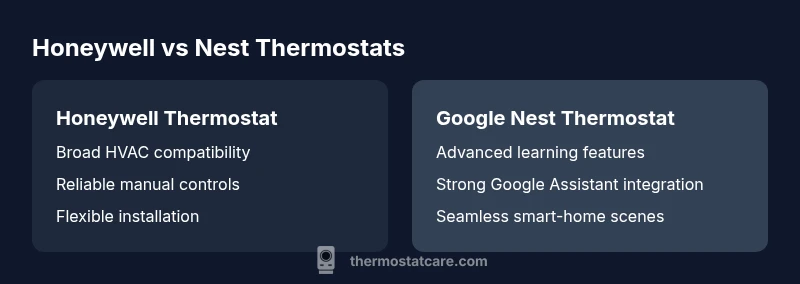
According to Thermostat Care, the honeywell thermostat vs google nest matchup reveals distinct strengths. Nest excels in learning routines and seamless Google ecosystem integration, while Honeywell emphasizes broad HVAC compatibility and reliable manual controls. The best choice depends on whether you prioritize smart automation or broad system compatibility, and this analysis helps homeowners weigh the trade-offs. Consider installation realities, privacy expectations, and total cost of ownership to finalize your decision.
Overview: honeywell thermostat vs google nest in 2026
The debate between a honeywell thermostat vs google nest centers on how you use a smart thermostat day to day. Both brands offer reliable temperature control and mobile apps, but they target different homeowner priorities. According to Thermostat Care, Nest tends to shine when you want adaptive learning, strong voice assistant integration, and seamless operation within a Google-centric smart home. In contrast, Honeywell places emphasis on broad HVAC compatibility, predictable performance across diverse systems, and more granular manual controls. This section sets the stage for a deeper dive into ecosystem fit, installation realities, privacy considerations, and future-proofing. Throughout this article, we reference practical homeowner scenarios so you can see how each option performs in real homes, not just on spec sheets. The aim is to help you choose the solution that minimizes surprises and maximizes comfort without overpaying for features you won’t use.
For homeowners who value a straightforward upgrade path, this honeywell thermostat vs google nest comparison will map out when one option clearly outperforms the other, and when either choice remains a solid fit depending on your living situation and budgeting. Thermostat Care’s analysis emphasizes context over hype, focusing on how each thermostat behaves in everyday cycles rather than isolated specs.
Ecosystem and Compatibility
Compatibility is often the single biggest deciding factor in the honeywell thermostat vs google nest decision. Google Nest thermostats tend to work best in homes already using Google Assistant, Google Home, or other Google ecosystem devices. If you rely on voice control, smart speakers, and a dashboard that includes Google services, Nest can feel like a natural extension of your existing setup. Nest also tends to deliver smoother integration with other Nest devices, providing cohesive scenes and routines across lighting, cameras, and thermostats. However, Nest’s advantages in ecosystem alignment can come with a caveat: some users encounter smoother operation when their other devices are also part of the Google ecosystem, which could limit flexibility if you prefer Alexa or Apple HomeKit-centric setups.
Honeywell, by contrast, often offers broader HVAC compatibility across a wider range of systems and brands. This means older furnaces, heat pumps, or non-standard installations might be easier to support with a Honeywell model. Many Honeywell thermostats provide robust manual controls and clear on-device interfaces, which can be a boon in households that prioritize visibility and direct adjustment without relying on cloud services. In practice, if you live in a house with older or complex HVAC wiring, Honeywell’s approach can reduce headaches and post-install surprises. Thermostat Care’s observations suggest that the best choice depends on whether your home leans toward a multi-brand, cross-platform environment or you want a more tightly integrated, Google-aligned experience.
For DIYers, a simple install with clear labeling reduces confusion. Nest’s wiring detection is often strong, but cross-brand compatibility can require additional adapters or bridges in some configurations. Honeywell’s broad compatibility means more upfront feasibility checks are needed to ensure the chosen model supports your specific gas, oil, or heat pump setup. In either path, review the compatibility list supplied by the manufacturer and cross-check against your HVAC equipment’s model, age, and wiring bundle.
Learning and Automation Capabilities
Automation and learning capabilities are central to the honeywell thermostat vs google nest comparison. Google Nest has built-in learning algorithms that study your temperature adjustments, occupancy patterns, and preferred schedules to optimize cooling and heating automatically over time. Many users appreciate a sense of “set it and forget it” comfort, with the thermostat gradually refining routines to align with real-life habits. This learning ability is one of Nest’s defining advantages for the average homeowner who wants hands-off efficiency and smooth automation. Nest also shines in smart-home scenes, where you can tie the thermostat to routines triggered by door sensors, cameras, or third-party automation services. Thermostat Care's analysis notes that these features tend to improve user satisfaction for people who are comfortable with cloud-based learning and ongoing data collection.
Honeywell models typically balance automation with explicit control options. While some Honeywell thermostats include adaptive schedules and energy-saving modes, the emphasis is often on reliability and predictability rather than deep learning. This can be preferable for households that value deterministic behavior and dislike surprises from automated learning. For homeowners who manage multifaceted comfort strategies—like humidification, dehumidification, or multi-stage systems—Honeywell can provide more nuanced controls without automatically adjusting settings in ways you don’t anticipate. Thermostat Care’s team observes that the best fit depends on whether you want a thermostat that adapts behind the scenes (Nest) or one that you adjust with confidence (Honeywell).
Additionally, privacy considerations may shape your view of learning features. Nest’s learning relies on cloud processing and data analytics, while Honeywell offers configurations that can minimize data sharing or enable more on-device processing in certain models. If you are concerned about data flow, review the privacy settings and consider whether cloud-based learning aligns with your preferences. Thermostat Care’s stance is that both brands provide meaningful value, but only one will feel truly invisible in daily life if you prefer minimal interaction with AI-driven adjustments.
Nest’s learning is particularly appealing for busy households or tech-forward homes seeking seamless automation. Honeywell’s approach is attractive for users who want reliable, stable performance with robust manual overrides and less reliance on cloud-based inference. In practical terms, choose Nest if you want a thermostat that learns your routine and speaks fluently with your smart home. Choose Honeywell if you want robust compatibility with diverse equipment and greater on-device control.
Installation and Setup Considerations
Installation and setup are practical realities that homeowners must confront when choosing between honeywell thermostat vs google nest. Nest devices tend to walk you through wiring checks and can often identify nonstandard setups during initial configuration. The goal is to minimize guesswork and ensure that the thermostat can access the common wire (C-wire) for stable, full-feature operation. In homes with unusual wiring or non-standard HVAC configurations, Nest may prompt you to upgrade wiring or use a power-extender kit. While this adds a potential upfront step, it often results in smoother operation once installed. Thermostat Care notes that home projects of this type are very feasible for confident DIYers, but if you’re unsure, professional installation is a safe route.
Honeywell models typically emphasize compatibility with a wide range of systems and can be forgiving for mixed configurations. Some Honeywell models are designed to work with older control boards and legacy wiring, which can simplify installation in homes that have not been updated recently. The downside is that, depending on the model, you might face limitations if you want the fastest possible feature set or the latest communication protocols. When planning installation, check the exact model’s wiring diagram, confirm whether a C-wire is required, and verify whether any optional accessories or adapters are recommended for your HVAC system. Thermostat Care’s practical guidance highlights that preparation reduces the risk of mismatches, callbacks, and frustration after the install. If you have a complex system, consider professional help to ensure the thermostat integrates properly with heat pumps, multi-stage furnaces, or radiant heating components.
Finally, assess your home’s Wi-Fi stability and device placement. A strong home network helps both Nest and Honeywell deliver reliable remote control and timely software updates. Place the thermostat where it can sense ambient temperature accurately, away from direct sunlight or heat sources. For Nest users, ensure that the thermostat remains connected to the Google ecosystem to maximize features, while Honeywell users should consider how app connectivity will be used for schedule updates and climate control across devices.
Privacy, Security and Data Practices
Privacy and data practices are increasingly central in the honeywell thermostat vs google nest decision. Google’s Nest devices are part of the broader Google ecosystem, which means some data is processed in the cloud to enable features like learning, remote access, and cloud-based updates. If you have privacy concerns, you’ll want to review the Nest privacy settings, disable unnecessary data-sharing options, and consider whether you’re comfortable with cloud-based processing. Nest does provide dashboards that show data usage and allow you to manage privacy preferences, but the default configuration often emphasizes data collection to improve service and personalization. Thermostat Care notes that many homeowners value the convenience and performance of a cloud-connected device, while others prefer clear controls and more on-device processing options.
Honeywell’s approach varies by model, as some Honeywell thermostats emphasize local control and offline capabilities more than cloud-driven features. This can be attractive if you’re wary of constant data exchange. However, even in models with strong offline options, firmware updates typically require internet connectivity. A balanced approach to privacy is to disable features you don’t use, regularly audit device permissions, and keep firmware up to date. Thermostat Care’s guidance is to treat privacy settings as a core part of the setup, similar to configuring energy-saving modes and schedules. In short, both brands offer meaningful privacy controls, but your comfort with cloud-based learning versus on-device processing will guide your choice. Consumers who value minimal data sharing may lean toward Honeywell, while those who want the full breadth of smart features may tolerate Nest’s data practices.
For households with shared accounts or guest access, review user permissions in the respective apps. Regularly audit linked services and third-party integrations. With both brands, configure account security (strong passwords, two-factor authentication where available) to protect your climate data. Thermostat Care recommends reading the privacy policy and the terms of service for your chosen model and adjusting settings to match your comfort level.
Energy Savings, Reliability, and Costs
Energy savings and cost considerations are central to the honeywell thermostat vs google nest decision. Nest’s adaptive learning and eco modes can yield meaningful energy savings over time, particularly in households with fluctuating schedules or occupancy patterns. The Nest ecosystem’s precise scheduling and occupancy-aware features allow the thermostat to pre-cool or pre-heat spaces so that comfort is maintained without excessive runtime. In practice, users often report that Nest’s data-driven insights help optimize energy usage for moderate-to-high efficiency gains, especially in homes that embrace automation and remote control. Thermostat Care analyses suggest that the level of savings will depend on your daily patterns, local climate, and how aggressively you implement eco settings. Nest’s energy history feature can help you identify wasteful periods and adjust accordingly.
Honeywell thermostats offer strong energy-management capabilities, including efficient scheduling, setback periods, and adaptive recovery that minimizes overheating or overcooling during transitions. They also tend to provide reliable performance across a wider range of HVAC types, including non-standard systems. The budget implications vary by model, but Honeywell often comes in at a broader price spectrum, with entry-level models available for relatively low cost and premium models offering advanced features at higher price points. Thermostat Care emphasizes evaluating total cost of ownership, including installation, potential wiring upgrades, app subscriptions, and required accessories. In many cases, the Honeywell option can deliver lower upfront cost with solid long-term reliability, while Nest offers premium features that may justify a higher initial investment if you fully leverage the smart ecosystem and learning capabilities.
When making a long-term decision, compare price ranges and energy savings estimates for your climate. A practical approach is to estimate a year’s worth of cooling and heating cost reductions based on your typical usage and the device’s eco modes. Remember to factor in the cost of installation, potential professional service, and any ongoing subscription services tied to cloud-based features. Thermostat Care’s analysis cautions that outcomes vary by home specifics, and the most accurate assessment comes from monitoring your own energy usage after installation. In short, Nest is often favored by tech-forward homes seeking maximum automation, while Honeywell appeals to homeowners who want robust performance across diverse systems with predictable costs.
Best Use Scenarios and Takeaways
Choosing between honeywell thermostat vs google nest hinges on your household’s priorities. If you want a thermostat that disappears into your smart home and learns your routines, Nest is typically the better fit for tech-forward homes with strong Google integration. It offers sophisticated automation, voice control, and deep compatibility with Google-based devices. Thermostat Care’s evaluation indicates that Nest thrives in settings where automation and ecosystem synergy are the primary goals, as long as you’re comfortable with cloud-based processing and data sharing.
If you prefer broad HVAC compatibility, manual override options, and a device that works well with multiple ecosystems (including Alexa and Apple HomeKit in some cases), Honeywell delivers steady performance and flexibility. It is often the smarter choice for homes with complex or legacy HVAC configurations, where ensuring compatibility is the priority and cloud-based learning is a secondary concern. For homeowners who want to minimize surprises and have a straightforward user experience, Honeywell’s approach can be more predictable and easier to manage over time. Thermostat Care emphasizes that neither brand is universally “better”—each excels in different arenas. The key is aligning the thermostat’s strengths with your home’s wiring, preferred ecosystem, and energy goals.
To summarize, Nest is best for: seamless smart-home integration, learning features, and an optimized Google ecosystem experience. Honeywell is best for: broad HVAC compatibility, strong manual controls, reliability with complex systems, and flexible ecosystem options. In practice, most households will choose the option that aligns with their core priorities: automation and ecosystem or universal compatibility and control. Thermostat Care’s verdict is to select the option that minimizes friction in daily life while maximizing comfort and efficiency; the right choice will feel almost invisible once installed and configured.
Maintenance and Upgrades
Maintenance and ongoing upgrades are part of the lifecycle for honeywell thermostat vs google nest. Regular firmware updates are essential for both brands to address security, performance, and compatibility with new smart home devices. With Nest, updates are typically delivered over the air and can include new learning capabilities, faster response times, and enhanced compatibility with additional Google services. It is wise to enable automatic updates or set a reminder to review release notes after each update so you understand what changes are being applied to your system. For Honeywell, firmware updates improve security and reliability, and some models offer optional features that can be enabled or expanded through the app. Check if the model you choose supports local control modes in addition to cloud-based features, as this can extend the device’s usefulness in cases of internet outages.
Water, dust, and temperature exposure can impact the lifespan of any thermostat. To extend device life, keep the thermostat clean and ensure proper mounting on the wall, avoiding heat sources or direct sunlight. If you’re upgrading from an older thermostat, plan a quick-check of your HVAC wiring to avoid any miscommunications with a new unit. Thermostat Care recommends maintaining a documented record of installation steps, wiring diagrams, and any changes to the HVAC system as you upgrade. Regularly test basic functions—setpoints, heat/cool toggles, and remote access—to ensure continued reliability. Finally, revisit energy-saving settings every season and adjust as needed based on evolving home occupancy and climate conditions. Regular maintenance reduces the likelihood of call-backs and supports consistent performance over time.
Comparison
| Feature | Honeywell thermostat | Google Nest thermostat |
|---|---|---|
| System compatibility | Broad HVAC compatibility across many brands and legacy systems | Optimized for Google ecosystem devices; best with Nest-compatible setups |
| Learning & automation | Balanced automation with explicit user control | Advanced learning and auto-scheduling via Nest learning features |
| Voice assistants & ecosystem | Works with multiple assistants (Alexa, Google Assistant, Siri via hub) | Strong Google Assistant integration; best with Google devices |
| Energy savings | Efficient scheduling, eco modes, and adaptive recovery | Energy history, Eco mode, and learning-based optimization |
| Installation ease | Can accommodate a wide range of wiring; check compatibility | Often straightforward for Google ecosystem users; may require adapters |
| Pricing range | $60-$250 | $129-$249 |
| Privacy controls | Clear privacy settings with on-device options in some models | Cloud-based features with Google data practices; privacy controls available |
Upsides
- Broad compatibility with a wide range of HVAC systems
- Flexible installation options, with strong manual controls
- Clear energy-saving features and reliable performance
- Solid app experience and remote access across brands
The Bad
- Nest relies more on cloud processing, raising privacy considerations
- Nest ecosystem performance may vary if not using Google devices
- Honeywell can appear less feature-rich in AI learning aspects
- Prices vary by model; some premium Nest features require higher upfront cost
Nest for smart-home ease; Honeywell for broad compatibility
Choose Nest when you want deep learning, strong ecosystem integration, and seamless Google compatibility. Choose Honeywell when you need broad HVAC compatibility, robust manual controls, and flexible ecosystem options. Thermostat Care emphasizes aligning your choice with your HVAC setup, privacy preferences, and energy goals.
Questions & Answers
Which thermostat is easier to install for a DIY homeowner?
Both Honeywell and Nest are designed with DIY installation in mind, but Nest often provides more guided wiring checks. If you have straightforward HVAC wiring, either brand can be installed by a confident homeowner. If your system is older or complex, professional installation reduces the risk of wiring errors.
Both are DIY-friendly, but Nest may guide you better on wiring; for complex systems consider professional help.
Are Honeywell and Google Nest compatible with the same HVAC systems?
Honeywell generally supports a broader array of HVAC configurations, including older systems. Nest supports many modern setups and works best within the Google ecosystem. Always verify exact model compatibility with your HVAC equipment before buying.
Honeywell covers more legacy systems; Nest fits well with newer setups and Google devices.
Do Honeywell thermostats support voice assistants like Alexa or Google Assistant?
Yes, many Honeywell models work with major voice assistants, including Alexa and Google Assistant. Nest is tightly integrated with Google Assistant, offering deeper native control within that ecosystem. Your choice may depend on which voice assistant you use most.
Honeywell supports multiple assistants; Nest shines with Google Assistant.
Which offers better energy savings for a typical home?
Nest often enables deeper learning-driven optimization, which can improve energy efficiency in households with variable schedules. Honeywell provides solid energy-saving controls and reliable performance across diverse systems. Real savings depend on your climate, occupancy, and how you configure settings.
Nest can save more with learning; Honeywell is reliable with solid energy controls.
Is Nest always better for smart-home ecosystems than Honeywell?
Not always. Nest excels in Google-centric setups and scenes, but Honeywell offers broader ecosystem flexibility and compatibility with multiple platforms. If your home already uses multiple ecosystems, Honeywell might reduce friction.
Nest is best with Google homes; Honeywell works well across many ecosystems.
What to Remember
- Identify your ecosystem preference before choosing
- Check HVAC compatibility for reliability
- Weigh cloud-based learning against on-device control
- Consider total cost of ownership, including installation
- Review privacy settings and data practices carefully