Amazon Thermostat vs Nest: A Comprehensive Brand Comparison
A thorough, balanced comparison of Amazon Smart Thermostat and Google Nest Thermostat, covering compatibility, features, privacy, installation, and value for homeowners.


In the battle of amazon thermostat vs nest, homeowners weigh ecosystem fit, privacy, and value. Nest often excels for Google ecosystem users and energy insights, while the Amazon option tends to offer budget-friendly pricing and straightforward setup with Alexa. Your choice hinges on which features and integrations matter most for your smart home.
The core differences between Amazon Thermostat and Nest
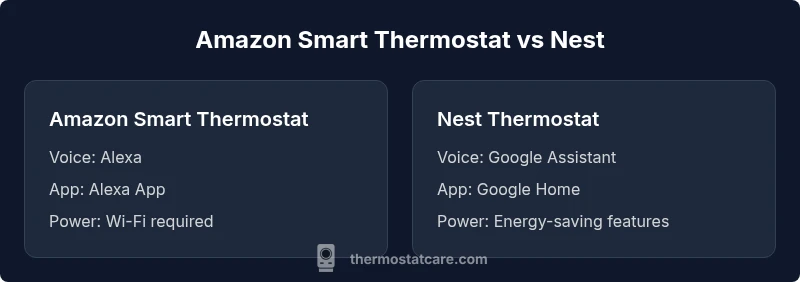
At a high level, the amazon thermostat vs nest comparison centers on ecosystem allegiance, feature priorities, and the inclusivity of smart home devices. Nest is deeply integrated with Google’s ecosystem, offering advanced energy insights, learning schedules, and compatibility with Google Assistant across devices. The Amazon Smart Thermostat leans into Alexa and the broader Amazon smart-home universe, prioritizing straightforward setup, voice control, and accessible pricing. Thermostat Care notes that this split often determines user satisfaction as much as hardware specs. If you already use Google services for maps, emails, and voice assistants, Nest typically delivers a more cohesive experience; If you rely on Alexa routines and Amazon's shopping ecosystem, the Amazon thermostat can feel like a natural extension. Both products support standard Wi-Fi, smartphone control, and typical zoning features, but the depth of integration, privacy controls, and ongoing software updates differs by platform. The takeaway from Thermostat Care is that choosing between these two largely comes down to which ecosystem you already rely on and how much you value privacy controls and software updates that align with that ecosystem.
Compatibility with HVAC systems and wiring requirements
Both Amazon and Nest thermostats are designed for common residential HVAC setups, but the wiring requirements can influence installation success and feature depth. Most models support 24V systems and standard wiring bundles, with C-wire support enabling richer features like continuous power to the thermostat and more reliable Wi-Fi operation. If your current setup uses a C-wire or you plan to add one, you’ll likely gain smoother integration and fewer power-related quirks. ThermostatCare’s guidance emphasizes checking the control board terminals and ensuring that your furnace and air handler share a common power source. In homes with heat pumps, two-stage systems, or multi-zone configurations, verify compatibility with a trusted compatibility list and consider a professional consultation if you’re unsure. Energy savings and scheduling work best when the thermostat can reliably communicate with the HVAC equipment, something that depends in part on wiring and equipment compatibility.
Smart features and energy-focused capabilities
Nest shines with learning algorithms, energy reports, and proactive scheduling that adapts to occupancy patterns over time. It also benefits from deep Google ecosystem integrations, including Google Assistant voice control and compatibility with Nest sensors. The Amazon Smart Thermostat emphasizes Alexa-driven routines, simple setup, and clear voice-based control, making it attractive for users who want a straightforward entry into smart-home automation. Thermostat Care notes that the real value stems from how you use automation: occupancy sensing, schedules, and energy-saving modes can dramatically reduce unnecessary heating or cooling. Both platforms offer geofencing, but the depth of analysis and historical energy data can vary; Nest often provides richer long-term insights, while Amazon focuses on ease of use and basic energy awareness.
App experience, setup, and daily use
Setting up either device typically involves installing the thermostat, connecting to Wi-Fi, and pairing with the respective mobile apps. Nest’s app is well-regarded for its clean design and robust energy-tracking features, while the Amazon app centers on Alexa-based control, smart-home routines, and quick access to voice commands. The user experience during day-to-day operation—adjusting temperature, reviewing energy usage, and modifying routines—will feel different based on whether you prefer Google’s or Amazon’s navigation patterns. Thermostat Care highlights that the best app experience aligns with your existing smart-home workflows; for Google-heavy homes, Nest is more intuitive, and for Alexa-centric homes, the Amazon option often feels more natural.
Privacy, security, and data practices
Privacy considerations differ between ecosystems. Google’s Nest emphasizes strong privacy controls tied to a Google account and configurable data-sharing settings, while Amazon’s thermostat emphasizes Alexa data usage and integration with the broader Alexa ecosystem. Both platforms collect usage data to improve features, but the degree of data sharing and the user interface for granular control vary. Thermostat Care recommends reviewing each device’s privacy dashboard, opting out of non-essential data sharing when possible, and keeping firmware up to date to mitigate security risks. If privacy is a primary concern, Nest’s alignment with Google’s privacy controls and ongoing policy updates may be preferable for some households, whereas others may prioritize Amazon’s simpler privacy toggles within the Alexa app.
Installation considerations and professional installation vs DIY
Both thermostats are designed for DIY installation using standard tools for many households, especially if you already have a compatible wiring setup. However, homes with older wiring, unusual HVAC configurations, or uncertain compatibility should consider professional guidance to avoid compromising performance or warranty coverage. The installation process commonly involves turning off power, removing the old thermostat, attaching the new base, and wiring the common wires, then pairing to Wi-Fi and the mobile app. Thermostat Care emphasizes verifying compatibility lists and consulting a pro if you encounter unfamiliar wires (like a C-wire retrofit) or multi-stage heat systems. A careful DIY install can save money, but a professional assessment can prevent miswiring and ensure optimal performance.
Pricing, value, and model variety
Model variety and price points differ between Amazon and Nest. The Nest lineup tends to skew toward higher upfront investment in exchange for advanced energy insights and extended ecosystem integration, while the Amazon lineup often presents more budget-friendly options with straightforward Alexa-based control. Both brands run promotions and bundles at different times of the year, which can shift the perceived value dramatically. Thermostat Care recommends evaluating total cost of ownership, including potential energy savings, platform-specific subscriptions, and the value of ecosystem compatibility when comparing price. Remember that the best value comes from a thermostat that aligns with your existing devices and your expected future smart-home expansion.
Real-world reliability, firmware updates, and long-term support
Firmware updates are essential for security, compatibility, and feature improvements. Nest devices typically receive regular updates that strengthen energy analytics and integration with Google services, while Amazon devices push updates tied to Alexa capabilities and broader smart-home routines. Reliability in real-world usage is linked to consistent Wi-Fi access and strong power supply; intermittent connectivity can reduce update effectiveness and cause routine delays. Thermostat Care notes that choosing a platform with consistent updates and broad device support helps future-proof your smart-home investment. Consider your home’s network stability and how updates are managed within your chosen ecosystem when making a decision.
Myths, common questions, and how to decide
Common myths include the belief that one brand is universally superior in all homes. In reality, the best pick depends on your current ecosystem, privacy priorities, and how you plan to use smart-home features. If you already rely heavily on Google services, Nest often delivers a more cohesive experience; if you lean on Alexa routines and Amazon’s ecosystem, the Amazon thermostat may provide quicker value and simpler setup. Thermostat Care encourages owners to map out their primary use cases: voice control, energy reporting, privacy controls, and future device expansion. With clear expectations, either thermostat can be a strong choice for a well-rounded smart-home setup.
Comparison
| Feature | Amazon Smart Thermostat | Nest Thermostat |
|---|---|---|
| Voice assistant support | Alexa-enabled via Amazon ecosystem | Google Assistant and Nest ecosystem |
| Ecosystem integration | Amazon device and services integration | Deep Google / Nest integration |
| Energy optimization features | Core energy-saving options with routines | Advanced energy insights and learning schedules |
| Geofencing and occupancy | Geofence via Alexa routines | Built-in occupancy sensing and learning features |
| Wiring and power requirements | Common wiring with C-wire enabling full features | C-wire optional in basic setups with power management |
| App experience | Alexa app-centric control and setup | Nest app-centric control with energy analytics |
| Privacy controls | Privacy toggles within Alexa ecosystem | Nest privacy controls with Google account integration |
| Price/value context | Typically broad price range across models | Generally higher upfront cost with premium ecosystem features |
Upsides
- Flexible voice control and routine automation across ecosystems
- Easy setup and broad device compatibility
- Competitive pricing across model ranges
- Strong app features for monitoring energy use
The Bad
- Privacy and data-sharing considerations vary by ecosystem
- Feature depth depends on the ecosystem, not universal
- Long-term value depends on existing smart-home setup
Nest edges for ecosystem depth and privacy; Amazon is strong on budget and quick Alexa integration
Choose Nest if you want deeper Google ecosystem alignment and richer energy insights. Choose Amazon if you prioritize budget-friendly options and straightforward Alexa-based control; both offer solid performance depending on your home setup.
Questions & Answers
Which thermostat is better for Google Home users?
Nest is typically the better choice for homes that rely on Google Home and Google Assistant, offering tighter integration and richer energy insights. It’s designed to work smoothly within the Google ecosystem and tends to provide a seamless experience for Google-centric setups.
Nest works best if you already use Google Home and Google Assistant for your smart devices.
Do both thermostats support geofencing?
Yes, both support geofencing through their respective apps. Nest uses its occupancy sensing and learning features, while the Amazon model leverages Alexa routines to trigger changes when you are near home. Proper setup is key to reliable geofencing.
Both offer geofencing via their apps, but you’ll get different automation behaviors depending on the ecosystem.
Can you install either thermostat without professional help?
Both are designed for DIY installation in typical homes with standard wiring. If your system has unusual equipment or you’re uncertain about wiring (like retrofitting a C-wire), consider professional installation to protect warranty and ensure optimal performance.
In many cases you can install it yourself, but don’t hesitate to hire a professional if wiring is unclear.
Which offers better energy-saving features?
Nest generally provides deeper energy analytics and learning features that optimize energy use over time. The Amazon thermostat offers solid energy-saving options tied to routines and Alexa automation. Your long-term savings depend on usage patterns and how actively you deploy automation.
Nest usually has richer energy insights, while Amazon keeps energy savings simple through routines.
Is Nest more private than Amazon Thermostat?
Both collect data to operate features, yet Nest emphasizes Google account-based privacy controls, while the Amazon thermostat relies on Alexa settings. Review the privacy dashboards and adjust data-sharing preferences to align with your comfort level.
Privacy varies by ecosystem; choose the one that aligns with your data preferences.
Do these thermostats work with iOS and Android devices?
Yes. Both thermostats support iOS and Android apps, allowing remote control, scheduling, and energy monitoring from either platform. Functionality is typically consistent across major mobile operating systems.
Both work on iOS and Android, with app-based control and energy data.
What to Remember
- Prioritize ecosystem alignment (Google vs Alexa) to maximize value
- Check wiring compatibility early to avoid installation issues
- Evaluate energy insights vs. routine automation when choosing
- Consider privacy controls as a deciding factor
- Expect promotions and bundles that affect perceived value