amazon thermostat vs google nest: Brand Comparison 2026
Compare amazon thermostat vs google nest to evaluate installation, ecosystem compatibility, energy reporting, and privacy. Learn which thermostat fits your home and budget in 2026.


amazon thermostat vs google nest: Nest edges ahead in ecosystem integration and energy analytics; Amazon's thermostat is simpler to install and excels with Alexa-centric control. For homeowners already invested in Google or Amazon ecosystems, the choice hinges on compatibility, privacy preferences, and long-term costs. This comparison clarifies which is best for different households.
What this comparison means for your home
Choosing between the Amazon Thermostat and Google Nest is not just about a single feature; it’s about how your home communicates with your smart devices, energy data, and daily routines. In the current market, the two leaders represent different philosophies: Amazon prioritizes seamless Alexa-powered control and broad third-party compatibility with home kits, while Google Nest emphasizes deep integration with Google’s ecosystem, richer energy insights, and more predictive scheduling. For homeowners evaluating amazon thermostat vs google nest, the decision often boils down to ecosystem alignment, privacy preferences, and long-term value. Thermostat Care analysis suggests that most households benefit from mapping their existing accounts and devices first—do you already rely on Google Assistant for calendars and routines, or is Alexa your main voice assistant? Your answer will shape not only which thermostat you buy, but how you configure automations, geofencing, and occupancy sensing.
Ecosystem and compatibility: who plays best with Alexa vs Google Assistant
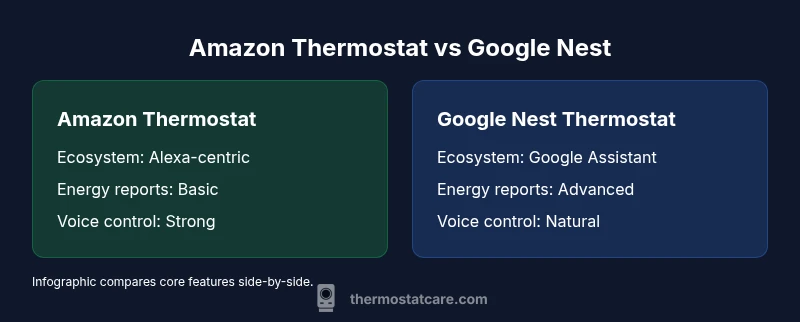
Nest and Google Home are designed to shine when you use Google’s apps and devices, offering native routines, app experiences, and voice commands that feel natural with a Nest thermostat. Amazon’s ecosystem, by contrast, is built around Alexa, shopping, and broad smart home integrations. If you have a Google Nest Hub, Pixel phone, and rely on Google routines, the Google Nest thermostat will feel more native, with fewer workarounds. If your home centers on Alexa-enabled devices, shopping budgets, and a wide array of third‑party smart devices, the Amazon thermostat can deliver tighter integration and voice control across rooms. The key difference for amazon thermostat vs google nest is whether your daily cues (lights, routines, weather, reminders) respond best to Google’s ecosystem or Amazon’s.
Installation and hardware requirements
Both thermostats are designed for straightforward installation, but the devil is in the wiring. Most homes can install either device by replacing a standard 24V thermostat, but there are caveats. The Nest thermostat often uses power from the HVAC's C-wire to maintain a longer learning window for energy reports; if you lack a C-wire, you may need a power adapter or professional help. The Amazon thermostat generally works with standard wiring and tends to be forgiving for single-stage systems. In both cases you’ll want to confirm compatibility with your HVAC system, confirm whether your home has a C-wire, and prepare for potential heat pump or multi-stage configurations. Thermostat Care notes that, regardless of brand, a secure Wi‑Fi connection and up-to-date firmware are essential to maintain features like occupancy sensing and geofencing.
Energy features and learning capabilities
Nest often leads with energy reporting and learning capabilities that translate into actionable insights, such as adaptive scheduling and savings tips. It can display long-term energy trends in the Google Home app and offers energy history per device, which helps identify waste. Amazon’s thermostat provides strong basics: straightforward energy usage summaries, simple schedules, and robust voice control to adjust thermostat settings on the fly. For households focused on data-rich energy analytics and proactive optimization, Nest tends to be the stronger option, while Amazon’s model suits users who want quick, practical control without heavy analytics. The running narrative amazon thermostat vs google nest centers on depth of energy intelligence and how you like to see that data presented.
Privacy, data usage, and security considerations
Data handling differs by platform. Google emphasizes privacy controls that tie to your Google account, with options to disable certain data sharing and to minimize personal data collection in energy features. Amazon ties thermostat data to your Amazon account, using it to personalize experiences and improve services; you can review privacy settings in the Alexa app and you can mute data collection where supported. Thermostat Care recommends auditing both accounts for data-sharing settings and choosing devices that align with your comfort level. If privacy is a primary concern, you may prefer Nest’s ecosystem when you already exercise strong Google privacy controls, or you may adjust Amazon’s settings to minimize data sharing.
UI, apps, and voice control experiences
The user interface for Google Nest prioritizes the Google Home app, with clean visuals and predictive energy insights. Voice control tends to feel natural with Google Assistant, and routines can be tied to calendar events, weather, and location. Amazon’s interface leans on the Alexa app, which offers broad compatibility and robust voice interactions across devices, including Echo speakers and Fire TV. Users who value cross-device routines and a wider array of skills may prefer Amazon’s thermostat; those who want deeply integrated energy guidance and a Google-centric experience may favor Nest. In amazon thermostat vs google nest, the perceived smoothness of the control experience often comes down to which app you use most frequently.
Price range and value proposition
Price is a factor, but the total cost of ownership matters more. Both devices tend to sit in the mid-range to premium tier, with price varying by retailer, model, and regional promotions. Expect to pay more for models that support advanced sensors, multi-room setups, and enhanced energy analytics. Note that third-party installation costs, if required, can alter total value. Over a typical 5-year horizon, Nest’s energy insights may justify a higher upfront price for energy-conscious households, whereas Amazon’s thermostat can deliver quicker returns for users who prioritize ease of setup and broad compatibility. The amazon thermostat vs google nest decision often hinges on whether you value deeper analytics or broader platform support.
Real-world scenarios: which to choose by home type
For a small apartment with a basic HVAC, the Amazon thermostat may deliver quick, reliable comfort with minimal setup and excellent voice control in a compact footprint. A family with a home office and a Google-centric smart home may find the Google Nest thermostat more suitable, thanks to richer energy insights and seamless routines across Google devices. In a tech-forward home with multiple Echo devices and a strong emphasis on shopping and automation, Amazon often provides the most convenient ecosystem cohesion. If your priority is privacy and data minimization, you should weigh both brands’ settings and defaults before purchasing.
Setup tips and common pitfalls
- Before buying, verify compatibility with your HVAC and confirm presence of a C-wire.
- Create baseline routines in your chosen ecosystem so you can compare apples-to-apples.
- Update firmware after installation and reconnect to Wi‑Fi to ensure features like occupancy sensing work.
- Avoid mixing ecosystems for core routines if you want the tightest integration; you may still use cross-compatibility for peripheral devices, but that can complicate automations.
- Be mindful of privacy and data-sharing settings; review them during setup and adjust as needed. The best path amazon thermostat vs google nest is to start simple and gradually expand.
Comparison
| Feature | Amazon Thermostat | Google Nest Thermostat |
|---|---|---|
| Ecosystem compatibility | Alexa-centric control across Amazon devices | Deep Google Home integration and Assistant control |
| Energy reporting | Basic energy usage summaries | Advanced energy insights and energy history in Google app |
| Routines and automations | Broad Alexa routines across devices | Google-inspired routines with Google services |
| Installation complexity | Good for standard setups | Good with standard setups; check wiring for optimization |
| Privacy controls | Amazon account data controls in Alexa app | Google account data controls in Google Home app |
| Price emphasis | Mid-to-premium depending on model | Mid-to-premium depending on model |
Upsides
- Clear ecosystem alignment for most users
- Reliable voice control via Alexa or Google Assistant
- Strong energy features and scheduling
- Solid installation with common wiring
The Bad
- Privacy concerns due to data collection
- Limited cross-ecosystem compatibility
- Some users may see slower feature rollouts in one ecosystem
- Energy analytics depth may vary by model
Nest is generally the stronger choice for Google ecosystem lovers; Amazon Thermostat is ideal for Alexa-first homes.
Nest offers deeper energy insights and native Google integration for most households. Amazon Thermostat shines when Alexa-driven control and broad device compatibility are priorities.
Questions & Answers
Which thermostat tends to have better energy reports?
Google Nest generally provides more advanced energy insights within the Google Home ecosystem, while the Amazon Thermostat offers solid energy summaries and basic scheduling. Your choice may depend on how deeply you want to analyze energy use.
Nest usually has the richer energy analytics, especially if you’re using Google Home. Amazon provides reliable energy basics.
Can I use Nest and Amazon devices in the same home?
Yes, you can use devices from both ecosystems, but core routines are typically easier when kept within a single ecosystem. You may rely on automation hubs or third-party apps for cross-ecosystem control.
You can use both, but expect some extra setup to run common routines across both ecosystems.
Do these thermostats require a C-wire?
Most modern thermostats rely on a C-wire for stable power, but some configurations can work without it using power-stealing methods or adapters. Check your HVAC wiring before purchasing.
A C-wire is usually needed for best performance, but some setups can work without one.
Is privacy a concern with either device?
Both devices collect data through your account, but you can adjust data-sharing settings in the respective apps. If privacy is critical, start with strict settings and review them after setup.
Privacy depends on settings; adjust controls in the app to minimize data sharing.
Which is easier for a first-time homeowner to install?
Both are designed for straightforward installation, but the Amazon Thermostat often feels more forgiving for beginners, especially if you have a standard single-stage system. Nest requires attention to energy reports configuration.
Amazon tends to be easier for first-timers, but both are doable with basic DIY skills.
Can I switch ecosystems later without losing my schedules?
You can switch, but you’ll usually need to recreate schedules and routines in the new app. A backup plan is to document configurations before moving devices.
Switching is possible, but you’ll want to redo automations in the new system.
What to Remember
- Prioritize your existing ecosystem when choosing between Nest and Amazon Thermostat
- Nest excels in energy analytics and Google integration
- Amazon favors quick setup and broad cross-device control
- Review privacy settings to align with your comfort level