Why is My Boiler Overriding the Thermostat: Urgent Troubleshooting Guide
Urgent troubleshooting guide to diagnose and fix boiler overriding thermostat issues. Learn causes, step-by-step fixes, safety tips, and prevention strategies from Thermostat Care.


The most likely cause is a control wiring issue or a malfunctioning relay causing the boiler to ignore the thermostat's setpoint. Quick fix: shut off power, inspect the thermostat and boiler wiring, ensure the C-wire is connected, and reset both devices. If it still overrides, contact a qualified technician. According to Thermostat Care, a failed aquastat or zone valve can also trigger override behavior.
Why is my boiler overriding the thermostat? (Core context)
In many homes, the boiler seems to respond to temperature requests, but at times it overrides the thermostat's setpoint. This behavior is not normal and often signals a fault in the wiring, a faulty relay or aquastat, or a misconfigured boiler timer. When the boiler won’t respect the thermostat, you may notice abrupt temperature swings, the boiler firing at odd intervals, or it running longer than needed. According to Thermostat Care, these symptoms are a warning sign that the control loop between device and boiler is compromised. Quick action can prevent energy waste and discomfort, but rushing to a DIY fix without care can cause safety issues or further damage. Stay calm, work methodically, and document each check so you know what to tell a professional if you need one.
The root cause is almost always in the 24-volt control circuit: thermostat wires, the boiler relay, or the aquastat. A healthy system should see clean, stable signals from the thermostat, prompting precise boiler operation. When overrides occur, you’re usually dealing with voltage drop, a loose terminal, a short, or a safety interlock that’s been triggered. Understanding these dynamics helps you diagnose effectively rather than guess at random fixes.
How the control loop works between the thermostat and boiler
The thermostat sends a low-voltage signal indicating a heating demand. The boiler’s control board receives this signal and decides whether to fire the burner and circulate water. If the signal is lost, stuck, or misinterpreted, the boiler may run on a pre-set schedule or at higher temperatures, effectively overriding the thermostat. Several components can disturb this loop: the C-wire (common) connection, the 24V power supply, zone valves, aquastats, and safety relays. Each part must present a clean, reliable signal when the thermostat calls for heat. Modern boilers often include a time-based control or outdoor reset that can conflict with an old thermostat if not wired or programmed correctly. Regular maintenance helps keep this loop healthy and reduces the risk of unexpected overrides.
Common causes you can check first
- Loose or corroded thermostat wiring at the thermostat or boiler terminals.
- Faulty relay or aquastat inside the boiler that fails to read the thermostat’s signal.
- Missing or loose C-wire, causing insufficient control voltage.
- Mismatched thermostat settings or a misconfigured boiler timer/boiler reset schedule.
- Zone valve or pump issues that keep the system circulating regardless of demand.
- Power surges or a tripped breaker that resets control logic without clearing faults.
These causes are the most frequent culprits in override behavior. Start with simple checks (tighten screws, inspect the C-wire) before moving to more involved diagnostics. If you notice burning smells, smoke, or buzzing relays, stop and call a professional immediately. Thermostat Care emphasizes safety first: never bypass safety interlocks to test a heating system.
Diagnostic flow: symptom → diagnosis → solutions
- Symptom: Boiler overrides thermostat during temperature requests.
- Possible diagnosis: Control wiring fault, relay/aquastat failure, or misconfigured timer.
- Likely solution: Tighten terminals, verify 24V continuity, and replace faulty components as needed. If the symptom persists after basic checks, you may be dealing with a deeper problem in the boiler’s control board or zone controls. In this situation, a professional inspection is advised to avoid electrical hazards and gas safety concerns. Thermostat Care recommends documenting observed symptoms, dates, and any error codes to guide the technician.
Step-by-Step Fixes for the Most Likely Cause
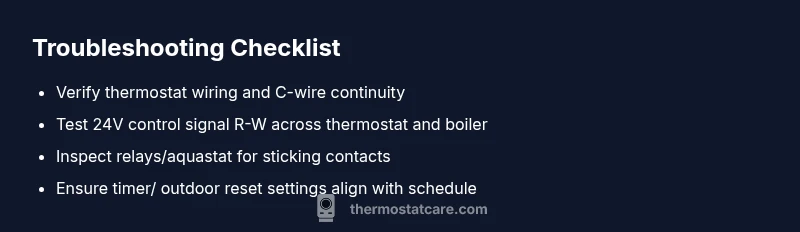
- Inspect the thermostat wiring at both ends and tighten all terminals.
- Power down the system, then back on to reset the control circuit.
- Verify the C-wire continuity and ensure it is connected securely.
- Check the boiler’s internal relay and aquastat for signs of wear or sticking contacts.
- Confirm the thermostat and boiler share compatible voltage and that the 24V signal is clean.
- If you use a timer or outdoor reset, ensure it isn’t forcing a different temperature profile than your thermostat.
- Test operation by setting a clear call for heat and observing if the boiler responds to the thermostat’s setpoint.
Tip: Always test after each step and avoid making multiple changes at once to isolate the cause quickly.
If this doesn’t resolve the issue, escalate to a licensed technician who can bench-test components and assess gas safety concerns. Thermostat Care reminds homeowners that some fixes require professional electrical inspection for safety and code compliance.
Safety, warnings, and prevention
Electrical and gas-powered systems carry real risks if misused. Always shut off power at the breaker before inspecting wiring, and never bypass a safety interlock to test whether the boiler will fire. If you smell gas or hear hissing, leave the area and call the utility emergency line. Use a non-contact voltage tester to check for live circuits before touching wires. Regular maintenance, including annual boiler service and thermostat checks, reduces the likelihood of overrides and improves efficiency. Thermostat Care notes that small wiring fixes performed safely can prevent bigger problems later.
Quick checks to prevent future overrides
- Schedule annual boiler service and thermostat calibration.
- Use compatible thermostat and boiler components; avoid cheap cross-compatibility patches.
- Keep wiring clean and free from corrosion; replace damaged cables.
- Record any error codes and monitor for recurring patterns after temperature calls.
- Verify that outdoor reset and timer settings align with your preferred schedule.
Proactive maintenance and careful configuration minimize the chance of overrides and keep your system running at peak efficiency.
When to call a professional and what to expect
If you don’t find a clear, safe fix after basic checks, call a licensed HVAC technician. A professional will verify gas pressure and venting, test 24V circuits with a multimeter, inspect zone valves, and check for air lock or pump issues. Expect a diagnostic visit to include a safety check, component testing, and a written estimate for any necessary parts or replacements. Thermostat Care underscores that complex electrical or gas work should not be attempted by untrained homeowners. A pro can prevent costly damage and ensure your system complies with local codes.
Steps
Estimated time: 45-90 minutes
- 1
Power down safely
Turn off the boiler and thermostat power at the circuit breaker. Wait a full minute to discharge residual voltages before touching wiring. This reduces the risk of short circuits or shock.
Tip: Never work on live electrical components. - 2
Inspect thermostat wiring
Remove the thermostat faceplate and check that all wires are firmly seated in their terminals. Look for loose strands that could cause a short. If you see any damaged wire, replace the section.
Tip: Use the wiring diagram for your model to confirm correct terminals. - 3
Check the C-wire connection at both ends
Ensure the C-wire is securely connected at the thermostat and the boiler control board. A loose C-wire can deprive the control circuit of power and cause unstable signals.
Tip: A continuity test with a multimeter can verify connectivity. - 4
Test the 24V signal
With power restored, set a heat call and measure the 24V signal between R and W at the thermostat. Confirm the same signal reaches the boiler control input.
Tip: If voltage is missing, suspect wiring or a faulty PCB. - 5
Inspect relay/aquastat for sticking
Listen for clicking sounds and visually inspect for signs of wear on the relay or aquastat. A sticking contact can keep the boiler energized or prevent proper off-commands from the thermostat.
Tip: Replace with an exact-match part per the boiler model. - 6
Review timers and outdoor reset
Check whether an internal timer or outdoor reset control is forcing a different temperature profile. Disable or reprogram if incompatible with your thermostat schedule.
Tip: Keep a backup of original settings before making changes.
Diagnosis: Boiler turns on or off inconsistently, ignoring thermostat setpoint
Possible Causes
- highPower issues or loose wiring between thermostat and boiler
- highFaulty relay or aquastat inside boiler
- mediumMismatched or miswired C-wire causing control voltage problems
Fixes
- easyCheck and tighten all terminal screws at both thermostat and boiler connections
- easyTest the 24V circuit and verify C-wire continuity; replace damaged wiring if needed
- mediumInspect and, if necessary, replace the boiler relay or aquastat with a compatible part
- hardReview timer/ outdoor reset settings to ensure no override is programmed
Questions & Answers
Why does my boiler ignore the thermostat sometimes but not others?
Inconsistent overrides are usually caused by flaky wiring, a failing relay, or a misconfigured timer. External factors like a loose C-wire or a bad thermostat can also create intermittent signals. Systematic checks help isolate the fault before a professional repair.
Intermittent overrides often come from wiring issues or a faulty relay. Check connections, then test signals to confirm the fault before calling a pro.
Can a bad C-wire cause boiler overrides?
Yes. A faulty or loose C-wire can deprive the control circuit of power and cause erratic boiler responses. Inspect both ends of the C-wire, replace damaged cable, and re-test the 24V circuit after reconnecting.
A bad C-wire can lead to control faults. Check the wiring at both ends and replace if damaged.
Is it safe to reset the boiler and thermostat to fix an override?
A reset can clear transient faults, but it won't fix a wiring or relay problem. Use resets after verifying connections, and only if you understand the timer and configuration implications.
Resetting can help with glitches, but you should verify wiring and settings first.
When should I replace the aquastat or relay?
Replace when testing shows the component is stuck, worn out, or failing to switch cleanly. A professional can confirm with measurements and may test the entire control circuit.
Replace a faulty aquastat or relay after professional testing confirms it’s the cause.
What quick checks can prevent overrides in the future?
Regular maintenance, secure wiring, correct thermostat compatibility, and alignment of timer settings with the thermostat schedule go a long way. Keep error codes documented and review settings after any service.
Keep up with regular maintenance and verify wiring and settings after any service.
Do I need a professional if I smell gas or hear unusual noises?
Yes. If you smell gas or hear loud noises, turn off the system and call emergency services or your gas supplier immediately. Do not attempt further repairs yourself.
If you smell gas or hear unusual noises, skip DIY and call a pro right away.
Watch Video
What to Remember
- Identify whether the override is electrical or control-related
- Check wiring, C-wire, and 24V signals first
- Test and reset only after securing all connections
- Do not bypass safety interlocks; call a pro if needed
- Maintain routine boiler and thermostat maintenance to prevent overrides