RC vs RH Thermostat: Wiring Differences Explained
A thorough, objective comparison of RC and RH thermostat wiring, including when to bridge RC and RH, how transformer layouts influence setup, and tips for smart thermostat compatibility.


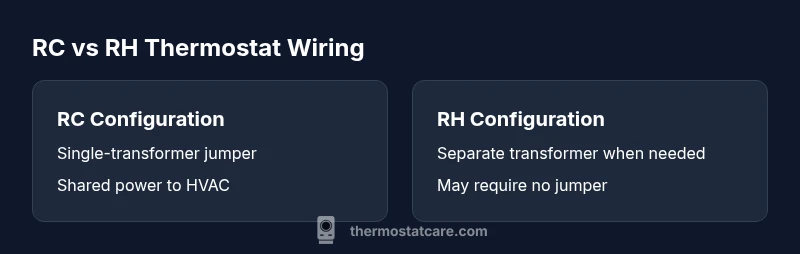
RC vs RH thermostat wiring centers on how heat and cooling circuits are powered. RC is the cooling power terminal, RH powers heating. In most single-transformer systems, a jumper links RC and RH so one transformer serves both. In two-transformer setups, RC and RH are kept separate. For smart thermostats, this distinction guides compatibility and wiring choices.
RC vs RH Thermostat Wiring: What They Do and Why It Matters
In modern homes, the thermostat wiring is more than just a bundle of colored wires; it determines whether your heating and cooling systems respond correctly. The term RC vs RH refers to separate power supply channels for cooling and heating circuits. According to Thermostat Care, understanding these letters helps you avoid dangerous cross-wiring that can damage furnaces or air conditioners. If you see RC and RH on your thermostat, you are looking at a power arrangement that either shares a transformer or uses two transformers. In most single-transformer systems, the thermostat relies on a jumper to bridge RC and RH so a single transformer powers both heat and cool. In systems with two dedicated transformers, RC and RH may be kept separate, with each feeder receiving its own supply. The implications affect not only safety but also compatibility with smart thermostats and energy efficiency. A wrong connection can lead to nuisance cycling, short circuits, or a blown fuse; thus, mapping the wiring before any upgrade is prudent.
Electrical Foundations: Transformers, Power, and Terminals
To truly grasp RC vs RH, homeowners need to understand the basics of how HVAC power is delivered to a thermostat. Most furnaces and air handlers rely on one or two low-voltage transformers that step down 120-volt house current to around 24-volt control voltage. The thermostat acts as the switchboard, routing 24V signals to the appropriate equipment. When a single transformer powers both heat and cool, RC and RH terminals are often connected through a jumper so that one source feeds both circuits. When two transformers exist—one for heating and one for cooling—the RC and RH circuits may be kept separate to preserve transformer isolation. This distinction matters because it affects how safety devices, such as fuses and circuit breakers, respond to faults, and it influences how smart thermostats interface with your system. Thermostat Care notes that incorrect bridging can confuse the control logic, causing heat or cooling to run unexpectedly or not at all.
Terminology and Real-World Wiring: What RC and RH Actually Mean
RC stands for the cooling power terminal (Red-Cooling) and RH stands for heating power (Red-Heating); not every installer or thermostat uses color designations literally, but many labels reflect the transformer sources inside the system. Some units provide a shared 24V supply with an internal bridge; others separate the power for heating and cooling entirely. In practice, you design the thermostat wiring around your system’s transformer layout: if there is a single transformer, RC and RH are bridged; if there are two, you keep them separate and configure the thermostat accordingly. Understanding this helps in selecting a compatible thermostat, planning upgrades, and diagnosing issues when a thermostat signals a fault or fails to respond to a command.
Single-Transformer Systems: Jumpers and What to Expect
Single-transformer configurations are common in older homes or in simplified HVAC setups. The thermostat can control both heating and cooling using a single 24V source. In these setups, a jumper is typically installed between RC and RH at the thermostat to feed the same transformer to both circuits. The advantage of this arrangement is simplicity and cost: fewer wires and no separate transformers to manage. The downside is that any fault in the shared transformer can affect both heating and cooling, and some modern smart thermostats may require a C-wire for power, which adds a separate consideration. When replacing or upgrading, verify whether your thermostat model expects a bridged RC-RH configuration or a direct RC/RH pairing. Thermostat Care’s guidance emphasizes confirming compatibility before final installation.
Two-Transformer Systems: Separate RC and RH Circuits
In a two-transformer arrangement, a distinct transformer powers the heating circuit (RH) and one transformer powers the cooling circuit (RC). This setup reduces cross-talk and provides more precise control in systems with separate heat and cooling equipment. In such cases, you usually do not bridge RC and RH; you feed each thermostat terminal from its respective transformer. The practical implication is that some thermostats require you to configure RC and RH as separate inputs; others provide an internal bridge or a jumper option. If you upgrade to a smart thermostat, check whether the model can handle two transformer inputs or if it requires a common wire (C) to power the device. The advantage here is clean separation and potentially improved reliability, but it can complicate wiring during installation and replacement.
How to Identify Your System Without Opening the Furnace
For many homeowners, locating the transformer inside the furnace is not convenient. A practical first step is to inspect the thermostat base: look for RC and RH terminals, and note whether a jumper is present. Next, consult the thermostat’s manual and the furnace’s wiring diagram; many manufacturers label transformer counts and terminal functions clearly. If you have access to the air handler or furnace panel, verify whether there is one 24V transformer or two separate units. When in doubt, take photos of the terminal strip and consult a qualified HVAC technician. Thermostat Care recommends documenting wire colors and the function of each conductor before disconnecting anything, to avoid reassembly errors.
Jumpers: Should You Bridge RC and RH? Best Practices
Jumpers bridge RC and RH to provide a common 24V supply when a single transformer powers heat and cool. The decision to bridge depends on the transformer layout and thermostat compatibility. If you operate a single-transformer system with a jumper, ensure the jumper is intact and the thermostat’s internal wiring supports bridging. If your system uses two transformers, do not bridge RC and RH; instead, configure the thermostat to treat the two terminals as separate power sources. Some modern thermostats offer automatic bridging logic, but you should always cross-check with the installation manual and your furnace diagram. The risk of bridging in a two-transformer setup includes feeding the wrong transformer back into the other circuit, which can trip breakers or damage components. In short: bridging is safe and common in single-transformer setups, while dual-transformer systems require deliberate configuration.
Smart Thermostats and RC/RH: What Changes with Modern Controls
Smart thermostats bring new flexibility but also new wiring considerations for RC and RH. Many models support common power (C-wire) and can internally bridge RC and RH when appropriate. If you are upgrading to a smart thermostat, verify whether your system will power correctly with either a bridged RC-RH configuration or separate RC and RH inputs. Some models require a C-wire to prevent power issues and ensure consistent operation, especially in homes with longer wire runs or multiple zones. Always check the thermostat’s compatibility guide, and consider upgrading the furnace control board or wiring to ensure a reliable power supply. A well-planned upgrade preserves comfort, avoids ghost readings, and reduces the chance of nuisance trips.
Troubleshooting Wiring Mistakes and Symptoms
Common mistakes in RC/RH wiring include leaving a jumper in a two-transformer setup, bridging RC and RH without a need, or mislabeling wires during replacement. Symptoms include heat or cooling cycling on without a command, the thermostat displaying error codes, or the HVAC system failing to respond to settings. To diagnose, verify the transformer count with the furnace label or service panel, confirm that RC and RH are configured correctly in the thermostat, and test the system with a simple on/off command while observing which unit responds. If a fuse trips or a breaker trips, stop and recheck the wiring, as a short circuit may have occurred. When in doubt, consult the installation manual or contact a licensed HVAC professional.
Step-by-Step Safe Wiring Check for RC/RH
Power down the system at the circuit breaker, then remove the thermostat cover and photograph the terminal strip. Confirm whether there is a single or dual transformer by inspecting the furnace label or service panel. If only one transformer powers both heat and cool, a jumper between RC and RH is expected; if there are two transformers, do not bridge the terminals. Label every conductor for easy reassembly and consult the thermostat’s installation guide for any model-specific requirements. Do not force connections that the diagram does not show. If you encounter resistance or uncertainty, pause and reach out to a licensed HVAC technician. This approach reduces the risk of electrical shock and equipment damage.
Authority Sources for RC vs RH Wiring
When evaluating RC vs RH wiring, rely on authoritative sources to confirm best practices. For general guidance on thermostat wiring and energy-saving practices, consult government and university resources, which provide vetted information without vendor bias. Useful references include the U.S. Department of Energy’s Energy Saver site on thermostats and related installation considerations, as well as university extension materials that cover basic electrical concepts and safe wiring practices. Keeping these sources in mind helps ensure your wiring decision aligns with safety standards and energy-efficiency recommendations. (Energy.gov – Thermostats; University extension articles)
Authority Sources (Continued) and Quick Reference
For quick reference, verify transformer counts on the furnace label, check the thermostat manual for RC/RH configuration, and ensure a C-wire is present for modern smart thermostats. If you’re unsure, consult a licensed HVAC professional who can confirm your system’s transformer layout and perform the wiring with safety in mind. Thermostat Care emphasizes using official diagrams and manufacturer guidance when upgrading or replacing hardware.
Comparison
| Feature | RC-based configuration | RH-based configuration |
|---|---|---|
| Power Source | Shared power from a single HVAC transformer (typical with jumper) | Separate power sources for heat (RH) and cooling (RC) when two transformers exist |
| Jumper | Typically requires a jumper on single-transformer systems | No jumper needed when RC and RH are separate (two-transformer setups) |
| Best For | Older homes or simplified systems with a single transformer | Homes with dedicated heating and cooling transformers or separate zones |
| Ease of Upgrade | Easier when a single-transformer framework is present | Requires careful wiring and transformer matching for dual transformers |
| Smart Thermostat Compatibility | Generally supports bridging with jumper or internal bridge | Model-dependent; some require separate RC/RH or a built-in bridge |
| Cost Implications | Minimal add-ons beyond a jumper for single-transformer setups | May involve extra components or more complex wiring for two-transformer setups |
Upsides
- Simple to implement on many homes
- Requires minimal extra hardware when a jumper suffices
- Typically works well with standard thermostats
- Fewer wires and simpler upgrades
The Bad
- Risk of cross-power faults if miswired
- Limited isolation of heat and cool in single-transformer setups
- Can complicate compatibility with some smart thermostats
- Bridging may bypass transformer-specific protection
RC vs RH: choose by transformer layout and thermostat compatibility
Bridge RC and RH if your system uses a single transformer and the thermostat supports it. Keep RC and RH separate if you have two transformers to avoid cross-power issues. Always verify transformer counts and consult the installation guide before upgrading.
Questions & Answers
What is RC vs RH in thermostat wiring?
RC and RH are the power terminals for cooling and heating circuits on a thermostat. RC typically powers cooling, RH powers heating; in many homes these are bridged with a jumper if there is a single transformer.
RC and RH are thermostat power terminals for cooling and heating. On many homes with one transformer, they are bridged so the same supply powers both.
Do I always need a jumper between RC and RH?
Not always. If your home has two separate transformers, RC and RH can stay separate. In single-transformer systems a jumper is commonly used to feed both circuits.
A jumper is common in single-transformer setups, but not always required if you have two transformers.
What happens if RC and RH are wired incorrectly?
Incorrect wiring can cause the HVAC to run incorrectly or fail to start. It may trip breakers or blow fuses. Always follow the furnace diagram and thermostat manual.
Bad wiring can cause the system to run poorly or fail; check diagrams and wiring carefully.
Can I replace RC with RH on a thermostat?
You don’t swap RC for RH. Use the terminals that match your system, and keep RC/RH relationships consistent with your transformer layout and thermostat instructions.
No, you don’t swap RC and RH; follow the system’s wiring rules and the thermostat manual.
Are smart thermostats compatible with RC/RH setups?
Most modern smart thermostats support RC/RH configurations, but some require a C-wire or may bridge internally. Check model-specific compatibility.
Yes, many smart thermostats work with RC/RH, but verify C-wire needs and model instructions.
What should I do if my thermostat shows no power?
Check the thermostat’s fuse or breaker, verify RC/RH wiring, and inspect furnace connections. If in doubt, consult the wiring diagram or a professional.
No power can mean a blown fuse or wiring issue; check safety breakers and wiring.
What to Remember
- Identify whether your HVAC uses a single or dual transformer
- Use a jumper only if the system specifies one
- Verify compatibility with your thermostat model
- Label wires before disconnecting and test safely
- Consult an HVAC professional if unsure