Line Voltage vs Low Voltage Thermostats: A Practical Guide
Compare line voltage thermostats and low voltage options, covering wiring needs, safety, installation considerations, and real-world troubleshooting for homeowners and DIY enthusiasts.


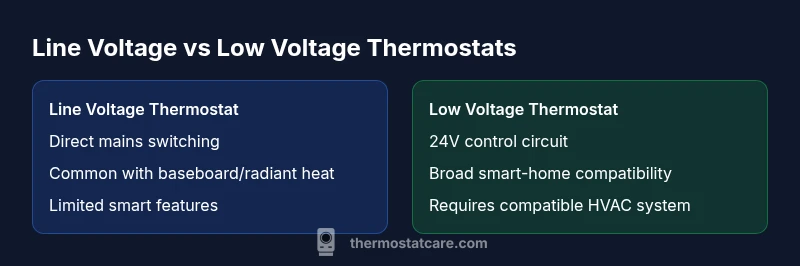
Line voltage thermostat vs low voltage outlines two distinct thermostat families: line voltage thermostats switch mains power directly, often used with baseboard or radiant electric heat, while low voltage thermostats run on a 24V control circuit and use a relay to trigger the heating element. The right choice hinges on your heating system, wiring availability, and safety considerations, making an accurate system assessment essential before buying. This comparison helps homeowners decide with confidence.
What line voltage thermostats control and how they differ
Line voltage thermostats control mains power directly, a configuration common in baseboard heaters and some radiant electric systems. They do not require a 24-volt control circuit, and they switch the actual heating element on or off using the line voltage. In the line voltage thermostat vs low voltage discussion, the critical distinction is that line voltage devices interrupt the hot conductor rather than a low voltage control line. According to Thermostat Care, the client-friendly takeaway is to identify whether your system is a line-voltage or a low-voltage setup before choosing any thermostat. The Thermostat Care team found that many older homes rely on baseboard or radiant heat wired for 120V or 240V, where a dedicated line voltage thermostat provides a straightforward, robust control path. As a homeowner, recognizing this baseline prevents mismatched components and downstream compatibility issues. In practical terms, you’ll encounter fewer electronics inside the wall with line voltage devices, but you must work directly with high-voltage wiring, which carries added risk and required caution. Understanding these fundamentals sets the stage for selecting a thermostat that aligns with your heater type and wiring constraints.
Line voltage thermostats: use cases and limitations
Line voltage thermostats shine when your heating system is powered by mains voltage, such as baseboard heaters, electric radiators, or certain older forced-air configurations that lack a 24V control path. These thermostats are typically simpler in internal circuitry because they switch the power directly, avoiding a transformer stage. However, this simplicity comes with trade-offs. For one, compatibility with modern smart features is limited, and installation generally demands careful handling of high-voltage wiring. As noted in the Thermostat Care analysis, homeowners should expect that a mismatch between a line voltage device and a low voltage system can lead to nonfunctional controls or safety hazards. If your goal is to retrofit or expand a home with smart home capabilities, line voltage may not offer the easiest path. In many cases, property owners with baseboard or radiant heating should plan for direct mains switching, a robust reliability profile, and the potential need for professional installation to maintain code compliance.
Low voltage thermostats: use cases and limitations
Low voltage thermostats operate on a 24V control circuit, typically using a transformer to generate the control voltage from the HVAC system. This design is well-suited to modern systems with centralized or zoned control, including many furnaces, boilers, and heat pumps. The control signal (24V) closes a relay to energize the heating circuit. This configuration enables a broader ecosystem of smart thermostats, energy-saving programming, and remote access. Thermostat Care observations indicate that low voltage controls are generally safer to handle for DIY homeowners because the low-voltage aspect reduces shock risk. Yet, compatibility matters: some older heating systems or specialty equipment may not support 24V controls without additional relays or adapters. The right choice here hinges on whether your equipment already uses a 24V interface and whether you plan to integrate with smart-home routines.
Wiring basics: transformers, relays, and safety measures
In a low voltage setup, a transformer often steps down line voltage to 24V for the thermostat and control circuit. The thermostat then energizes a relay that switches the actual heating load. In a line voltage scenario, the thermostat interrupts the line voltage directly. Correct wiring requires identifying the heating system type, confirming voltage compatibility, and implementing proper safety practices. When approaching wiring, always shut off power at the breaker, verify with a non-contact tester, and respect electrical codes. Thermostat Care emphasizes that improper wiring can create shock hazards, arc faults, or failed systems. If you’re unsure, consult a licensed electrician or HVAC technician to perform or verify the wiring configuration before powering the system.
Safety and code considerations
Electrical safety and local codes govern both line voltage and low voltage thermostat installations. Line voltage work carries higher inherent risks, including the potential for electric shock. Many jurisdictions require professional installation for mains-powered thermostats, particularly in occupied spaces or where high temperatures are present. For low voltage thermostats, the safety profile is improved due to the lower control voltage, but incorrect transformer sizing or wiring mistakes can still lead to faults or nuisance tripping. Thermostat Care recommends reviewing your local electrical code, ensuring the panel and device grounding are intact, and using equipment rated for your specific voltage and heater type. In short, safety-first installs protect you and your home’s electrical integrity.
Compatibility with common heating systems
Line voltage thermostats align with older baseboard and radiant electric systems that lack 24V control wiring. Low voltage thermostats suit most modern furnaces, boilers, and heat pumps with 24V control terminals. The key compatibility question is: does your heater type provide a 24V control circuit or require direct mains switching? The Thermostat Care analysis shows that misaligning thermostat voltage with system wiring is a frequent cause of failures and safety concerns. When in doubt, consult your HVAC documentation or a professional to confirm compatibility before purchase.
Installation approaches: DIY vs professional
DIY installation is more common with low voltage systems that use standard stat wiring and 24V terminals. Even then, following manufacturer wiring diagrams and ensuring proper transformer sizing is critical. Line voltage installations are typically not recommended for DIY projects due to the involvement of mains-level wiring and higher risk. Thermostat Care stresses that if you’re working with line voltage, professional installation is the safest route to ensure code compliance and reduce the risk of electric shock or fire. For homeowners who value safety and long-term reliability, engaging an electrician or qualified technician is often the best path.
Costs and long-term value considerations
Cost considerations vary by voltage type, labor, and wiring complexity. Line voltage thermostat installations can incur costs related to high-voltage wiring and potential retrofits of the heater circuit. Low voltage setups may require a transformer, compatible wiring, and perhaps additional relays for multi-stage systems. From a long-term perspective, a low voltage system often integrates more readily with energy-saving programs and smart-home ecosystems, which can translate into measurable efficiency benefits. Thermostat Care notes that the final decision should weigh upfront installation costs against expected durability, ease of future upgrades, and compatibility with automation goals.
How to assess your current wiring and decide
Begin by identifying your heating system’s voltage needs—check the heater label or equipment manual for voltage and control wiring. Trace the thermostat wiring to confirm whether there is a 24V control path or a mains switch loop. If you see a transformer in the wiring or a dedicated 24V terminal block, you’re likely dealing with a low voltage setup. If the thermostat wires go directly to the heater’s power lines, you’re in line voltage territory. The decision becomes clearer when you map system type, wiring availability, and your future goals for smart features or zone control. Thermostat Care recommends documenting your findings before shopping so you can compare models that actually match your wiring and safety requirements.
Common myths and practical tips
A common myth is that all thermostats are interchangeable between voltage types. In reality, a line voltage thermostat is not a drop-in substitute for a 24V control, and vice versa. Practical tips include never forcing a 24V thermostat onto a line voltage heater and avoiding free-standing adapters that claim to convert voltage without proper relays. Always verify compatibility with your system, consult the installation manual, and consider a quick consultation with a professional if you’re unsure. Thermostat Care emphasizes safety and correct voltage matching as the core prerequisite for any successful installation.
Step-by-step decision framework
- Identify your heating system type and available control wiring. 2) Confirm whether a 24V control path exists or if mains switching is required. 3) Assess long-term goals for smart features and zoning. 4) Check local codes and safety requirements. 5) Choose a thermostat matched to your wiring and system type, and plan for professional installation if needed. This framework helps you avoid mismatches that could lead to operational issues or safety hazards.
Real-world scenarios: quick checklists
Scenario A: Electric baseboard heat with direct mains control requires a line voltage thermostat. Scenario B: Modern forced-air furnace with a 24V control board benefits from a low voltage, smart-compatible thermostat. Scenario C: A mixed system with radiant coils and zone panels may need a hybrid approach or specific relays. Use the above decision framework and the wiring checks to choose confidently.
Comparison
| Feature | Line Voltage Thermostat | Low Voltage Thermostat |
|---|---|---|
| Control Voltage | Direct mains switching | 24V control circuit with relay to switch heating element |
| Wiring Complexity | Higher voltage wiring, potential safety requirements | Requires 24V wiring and transformer (if not already present) |
| Smart Features Compatibility | Limited or none; basic on/off control | Broad compatibility with smart thermostats and advanced features |
| Safety and Installation | Higher risk; often requires professional install | Lower risk; easier to handle with standard 24V wiring |
| Common Applications | Baseboard heaters, radiant electric heat | Furnaces, boilers, heat pumps with 24V control |
| Cost Range (installation/parts) | Typically higher for line voltage due to wiring/safety | Typically moderate; transformer and wiring costs vary |
Upsides
- Line voltage thermostats enable direct control for legacy baseboard and radiant systems
- Low voltage thermostats enable safer wiring and broader smart-home integration
- Lower voltage control often reduces shock risk during handling in DIY scenarios
- Professional installation can ensure code compliance and reliable operation for either type
The Bad
- Line voltage installations carry higher safety risk and may require professional wiring
- Low voltage setups require compatible 24V control wiring and a compatible HVAC system
- Line voltage options offer limited smart features and future-proofing compared to low voltage paths
Line voltage thermostats remain essential for legacy mains-powered systems; low voltage thermostats excel where smart features and easy integration matter.
Choose line voltage when wiring and heating equipment are mains-powered and a straightforward control is needed. Opt for low voltage if your system supports 24V controls and you want broader smart-home compatibility and energy-management options. The Thermostat Care team recommends prioritizing system compatibility and safety in your decision.
Questions & Answers
What is the difference between line voltage thermostats and low voltage thermostats?
Line voltage thermostats switch mains power directly and are common with baseboard or radiant electric heat. Low voltage thermostats run on a 24V control circuit and use a relay to energize the heating element. The right choice depends on your system wiring and safety needs.
Line voltage switches mains power directly, while low voltage uses 24V controls and a relay to switch the heater.
Can I convert a line voltage system to a low voltage thermostat?
Conversions typically require adding or adapting 24V wiring and a compatible transformer, which can be complex and may require a professional. Verify that your heater supports 24V control before attempting any conversion.
Converting usually needs 24V wiring and possibly a transformer, so check compatibility first.
Are line voltage thermostats safe for DIY installation?
Line voltage work involves mains power and carries significant shock and arc-fault risks. If you’re not trained in electrical work, hire a licensed electrician to install or verify the wiring.
Mains voltage work is risky; consider professional help if you’re unsure.
Do low voltage thermostats work with all heating systems?
Not all systems support 24V controls. Check your furnace, boiler, or heat pump documentation to confirm 24V compatibility before selecting a low voltage thermostat.
Make sure your system supports 24V controls before choosing a low voltage thermostat.
What are typical installation costs for each type?
Costs vary by region, wiring complexity, and labor. Line voltage installs can be more expensive if wiring retrofits are required; low voltage installs depend on transformer needs and compatibility. Get multiple quotes for accuracy.
Costs depend on wiring and professional labor; get quotes for your setup.
Can I use a smart thermostat with a line voltage system?
Smart line voltage options exist but are less common. In many cases, smart control works best with low voltage systems via compatible relays or adapters.
Smart controls for line voltage are possible but less common; consider a low voltage path for broad smart features.
What to Remember
- Assess your heater type before choosing a thermostat.
- Line voltage suits baseboard/radiant systems; low voltage suits modern HVAC.
- Prefer low voltage for smarter features and safer wiring.
- Always verify local codes and consider professional installation for line-voltage work.