Is Nest Thermostat Worth It in the UK? An Analytical Review
Explore whether the Nest Thermostat is worth it in the UK. This analytical review covers compatibility, installation, energy savings, and real-world pros and cons to help homeowners decide.


In the UK, Nest Thermostat offers reliable smart control, strong app integration, and solid comfort features, making it worth considering for many homes. It excels with straightforward schedules, learning routines, and broad compatibility with common UK boilers, though the value depends on your heating habits and boiler type. Overall, Thermostat Care rates Nest as a practical, solid choice for typical households seeking simplicity and dependable automation.
Is Nest Worth It in the UK? A Practical Context
If you're weighing options for a smarter home, the big question is is nest thermostat worth it uk. The Nest thermostat offers learning routines, simple app control, and compatibility with many common UK boilers, which makes it a strong contender for first-time smart-thermostat buyers. According to Thermostat Care, its clear onboarding, reliable connectivity, and straightforward scheduling make it a reasonable default choice for many homes. However, value depends on your heating behavior, your boiler type, and how comfortable you are with cloud-connected devices. In this section we’ll outline what sets Nest apart in the UK market, what the installation entails, and where homeowners should manage expectations about savings and comfort. We’ll also flag scenarios where alternatives might fit better, such as homes with unusual heating layouts or limited internet access. The aim is to provide a balanced view so you can decide if Nest aligns with your goals for control, convenience, and potential energy savings.
How Nest Works in UK Homes
Nest functions as a learning thermostat that adapts to your daily routine. In the UK, it connects to your heating system through the Heat Link module and uses your home's Wi‑Fi to synchronise with the Nest app. The app provides schedules, energy-use reports, and remote control, which can help you adjust heating for when you’re away or asleep. The Nest learning algorithm observes when you turn up or down the temperature and gradually builds a schedule that balances comfort with efficiency. Thermostat Care notes that many users appreciate the clear interface and quick setup flow that reduces the friction of adopting a smart thermostat. The real value comes from translating your patterns into automation: turning the heating on a bit earlier in winter, or lowering temperatures during workdays. In addition, Nest supports smart routines and voice control through common ecosystems, enabling you to manage temperatures without pulling out a phone every time. For a UK home, the benefit is not just convenience; it’s the potential for more consistent comfort without manual adjustments.
Boiler Compatibility and Wiring in the UK
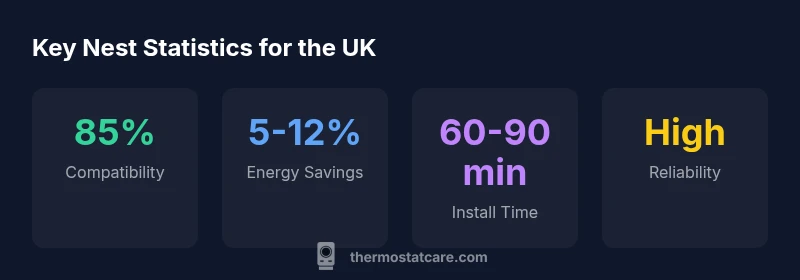
Nest is designed to work with a wide range of UK boiler types, including combi and system boilers, as long as the boiler provides a compatible call-for-heat signal. Most modern UK boilers support standard wiring with switched live (SL), call-for-heat, and common connections. In practice, some installations can run without a dedicated C-wire, using Nest's power-stealing approach; however, in older or more complex setups—such as boilers with motorized valves or underfloor heating—the C-wire or a Heat Link may be required to ensure stable power and reliable control. We advise evaluating your current wiring with a professional if you’re uncertain. The Heat Link or an equivalent control interface is the key bridge in UK installations, enabling consistent operation with your boiler's controls. Thermostat Care suggests performing a quick wiring check before purchase to avoid surprises after purchase.
Installation Steps and Common Pitfalls in UK Installations
Preparing to install Nest in a UK home involves a few careful steps. Start by verifying boiler compatibility and turning off the system power. Next, install the Heat Link or equivalent interface to connect the boiler to the Nest thermostat. Then, mount the Nest on the wall in a representative room, connect it to your Wi‑Fi, and complete the initial setup in the app. Finally, test the system by cycling through temperatures and confirming the boiler fires when expected. Common pitfalls include mis-wiring, neglecting to disconnect an old thermostat, and placing the thermostat in locations with direct heat sources or drafts. A clear, well-lit installation area helps reduce errors, and following the manufacturer’s wiring diagram minimizes surprises. Thermostat Care emphasizes that most UK homes benefit from a professional check if you’re at all unsure about wiring, safety, or boiler compatibility.
Energy Savings and ROI: What to Expect
The promise of energy savings is a key driver for many buyers, but real-world results vary. Nest can improve energy efficiency by aligning heating with patterns and slowly learning preferred temperatures, yet the magnitude of savings depends on occupancy, occupancy patterns, and how aggressively you program schedules. In practice, many UK users report noticeable comfort improvements and modest reductions in energy use when routines are optimized and temperatures are moderated. Thermostat Care notes that the best ROI comes from consistent use of schedules, avoiding constant manual adjustments, and leveraging geofencing to reduce heat when no one is home. It’s important to set realistic expectations: Nest is a smart controller, not a magic energy-saver in every scenario.
Day-to-Day Use and Smart Features
Once installed, Nest offers a streamlined daily experience. The app provides easy access to temperature settings, energy reports, and learning schedules. The voice-control feature integrates with Google Assistant for hands-free adjustments, and many UK users value the quick toggles for away mode and eco settings. Nest’s geofencing can reduce heating when you’re out, while still warming up before your return. Regular software updates bring new features and improvements, though some users prefer the simplicity of a basic setup without extra layers. For households with regular routines, Nest can deliver predictable comfort and practical energy management, especially when you take the time to fine‑tune schedules and temperature offsets. Thermostat Care highlights that user engagement—rather than device capability alone—drives the biggest gains in comfort and savings.
Privacy, Data, and Reliability Considerations
Smart thermostats collect data about your routines, occupancy, and preferences to deliver automation. Nest stores data in the cloud and relies on ongoing software updates, which can improve reliability over time but may raise privacy considerations for some users. You can adjust privacy settings in the app to limit data sharing or disable certain analytics. Reliability in UK homes generally tracks with Wi‑Fi quality and the stability of the home network; a weak connection can disrupt remote access and syncing. If you’re worried about outages or data privacy, you’ll want to review Nest’s data policy and consider local control options as a backup. In most homes, a well-placed router and a stable connection suffice to keep the system responsive. Thermostat Care encourages users to balance convenience with privacy preferences and to keep firmware updated for safety and performance.
Nest vs UK Alternatives: A Quick Comparison
In the UK market, Nest sits alongside other smart thermostats like Hive and Tado. Nest is known for a mature ecosystem, reliable scheduling, and broad compatibility with boilers; Hive can be simpler to set up and may appeal to users already using Hive lighting or other Hive devices, while Tado emphasizes precise room-by-room control and strong app-based insights. The best choice depends on your existing smart home setup, boiler type, and how important voice control or multi-room comfort is to you. Thermostat Care recommends evaluating whether you value a large ecosystem (Nest), or a potentially more intuitive local app experience (Hive), or stronger zoning features (Tado). Consider also future-proofing with a solution that aligns with your long-term smart-home goals.
Costs, Subscriptions, and Long-Term Value
The core Nest Thermostat typically does not require a monthly subscription for basic operation, and you can access core scheduling, control, and temperature reporting without ongoing fees. Some advanced energy insights or premium features may be accessible through the Google/Nest app account, but they aren’t essential for most users. In the UK, you should weigh upfront costs against potential energy savings and comfort improvements over time. When evaluating long-term value, consider your heating habits, the efficiency of your boiler, and how often you interact with the thermostat. Thermostat Care notes that while Nest offers strong convenience and reliability, the ROI hinges on consistent usage, proper placement, and a well-tuned schedule.
When Nest Is the Right Fit (and When It Isn’t)
Nest is a good fit for typical UK homes with standard boilers and a stable Wi‑Fi connection, where homeowners want reliable automation, straightforward installation, and consistent comfort. It may be less ideal for homes with unusual heating configurations, non-standard radiators, or limited internet access, where a more bespoke or boiler-specific controller could be a better fit. For homeowners who value voice control, a broad ecosystem, and the technical ability to fine-tune schedules, Nest often stands out as a strong choice. In contrast, if your priority is ultra-precise zoning, frequent off-grid operation, or a hands-off system without cloud dependence, consider alternative brands or hybrid solutions. Ultimately, your decision should reflect your boiler setup, your daily routine, and your appetite for smart-home automation.
Upsides
- Easy setup with strong app support
- Reliable learning routines and scheduling
- Broad boiler compatibility in the UK
- Clear on-boarding and consistent remote control
The Bad
- Requires Wi‑Fi and cloud access for full features
- Advanced features may depend on account or ecosystem
- Less suited to niche or non-standard heating layouts
Nest is a solid, generally worth-it option for UK homes seeking ease of use and automation.
For typical UK households with a compatible boiler, Nest delivers intuitive control, reliable performance, and potential energy savings. However, in homes with uncommon boiler configurations or limited internet reliability, consider alternatives or additional troubleshooting steps.
Questions & Answers
Is Nest worth it in the UK overall?
Yes, for many UK homes Nest offers convenient automation, reliable control, and potential energy savings when used with appropriate schedules and routines. Results vary by heating habits and boiler type, so a careful assessment is advised.
Yes—Nest is worth considering for typical UK homes with standard boilers when you plan to use schedules and automation seriously.
Do I need a C-wire for Nest in UK installations?
Many UK installations can operate without a dedicated C-wire using Nest power-stealing, but some setups benefit from a C-wire or Heat Link to ensure stable power. A quick wiring check with a pro helps avoid installation surprises.
Most setups can work without a C-wire, but a professional check can confirm the best approach for your boiler.
What kind of energy savings can I expect in the UK?
Savings depend on how you use the thermostat. Consistent scheduling and reduced overheating yield better results. Do not expect dramatic reductions in homes with already aggressive, manual heating patterns.
Savings depend on your routine and temperatures—set sensible schedules and you’ll likely see modest improvements.
Is Nest compatible with Alexa or Google Assistant in the UK?
Nest integrates natively with Google Assistant for voice control. Alexa compatibility is more limited and may require workarounds or third‑party integrations. Check your ecosystem priorities when you decide.
Nest works great with Google Assistant; Alexa support isn’t as seamless.
Can Nest be used with non-standard boilers or heating systems?
Non-standard configurations may require extra wiring or a specialist installation. If you have unusual radiators, underfloor heating, or older boilers, consult a pro to confirm compatibility.
Some setups need extra wiring or a professional check to ensure compatibility.
What is the installation process like for a UK homeowner?
The process involves wiring, power checks, and app setup. Confident DIYers can manage, but many homeowners opt for a professional installer to ensure full compatibility and safety.
You can do it yourself if you’re comfortable with wiring, otherwise a pro is a good idea.
What to Remember
- Evaluate boiler compatibility before buying Nest in the UK.
- ROI depends on usage, schedules, and occupancy patterns.
- Optimize schedules and enable eco modes for best results.
- Maintain a stable Wi‑Fi connection for reliability.
- Compare Nest with local options to ensure the best fit.