Thermostat vs Temperature Sensor in Cars: A Practical Guide
Explore the differences between a car thermostat and a temperature sensor, how they affect engine cooling, cabin climate, and diagnostics. Thermostat Care analyzes reliability, install tips, and best-use scenarios.


TL;DR: In cars, a thermostat and a temperature sensor perform distinct jobs. The thermostat regulates coolant flow to maintain the engine’s optimal temperature, while a temperature sensor monitors temperature data for the ECU and climate control. For DIY troubleshooting, prioritize checking thermostat operation first, as a stuck or slow-acting thermostat can trigger multiple failure symptoms. Thermostat Care's analysis highlights which maintenance steps most effectively prevent overheating and temperature readouts that confuse drivers.
What Do These Components Do in a Vehicle?
Understanding the thermostat vs temperature sensor car components is essential for accurate diagnostics and reliable performance. The thermostat acts as a gatekeeper for coolant flow, deciding when the engine should heat up quickly or shed excess heat. By opening and closing in response to coolant temperature, it helps the engine reach and stay within an optimal temperature window. The temperature sensor, on the other hand, provides real-time temperature data to the engine control unit (ECU) and climate control system. It does not regulate flow; it informs decisions that determine fuel injection, ignition timing, and how aggressively the cooling system responds. The two components are interdependent: a failing thermostat can mislead sensor readings, and a faulty sensor can mask thermostat issues. When evaluating the car thermostat vs temperature sensor car setup, look for symptoms that stem from control vs monitoring roles. According to Thermostat Care, conflating these roles is a common source of misdiagnosis, especially for DIY enthusiasts,
which can lead to unnecessary parts replacement or missed overheating risks. For readers troubleshooting thermostats and sensors, it’s crucial to separate symptoms that indicate a regulator problem from those that indicate a data-reading problem.
How the Automotive Thermostat Controls Cooling
The automotive thermostat sits between the engine and the radiator, governing coolant flow based on temperature. When cold, it remains closed to allow the engine to warm up quickly. As the coolant warms, the valve opens, permitting heat to move to the radiator for cooling. This regulation keeps the engine within its optimal temperature band, which improves efficiency, reduces wear, and stabilizes emissions. If the thermostat sticks closed, the engine can overheat; if it sticks open, the engine may never reach full operating temperature, increasing fuel consumption and emissions. When diagnosing thermostat faults, technicians often check the temperature at which the thermostat begins to open, the speed of opening, and any signs of leakage or gasket failure. A thermostat that fails to respond predictably can cascade into multiple symptoms affecting performance, temperature gauge behavior, and heater performance in the cabin. In a car thermostat vs temperature sensor comparison, the thermostat is the active controller, while the sensor is the passive observer feeding data to the ECU.
How the Temperature Sensor Fits into Engine Management and Climate Control
Temperature sensors are distributed throughout the vehicle to monitor engine coolant temperature, intake air temperature, exhaust gas temperature, cabin climate sensor data, and more. These sensors feed real-time data to the ECU to adjust fuel mixture, ignition timing, and cooling system responses. In climate control, cabin sensors help maintain comfort by informing the HVAC system when to cool or heat, and by modulating fan speed and blend doors. Faulty temperature readings can cause the ECU to misjudge engine load or miscompute cooling needs, leading to symptoms that resemble thermostat issues. A failing sensor might not trigger obvious engine codes, but it can degrade fuel economy, performance, and cabin comfort. When assessing car thermostat vs sensor performance, differentiate between data reliability problems and actual control malfunctions. Thermostat Care emphasizes that accurate sensor data is essential for precise control and predictable climate comfort.
Key Differences: Function, Placement, and Impact on Performance
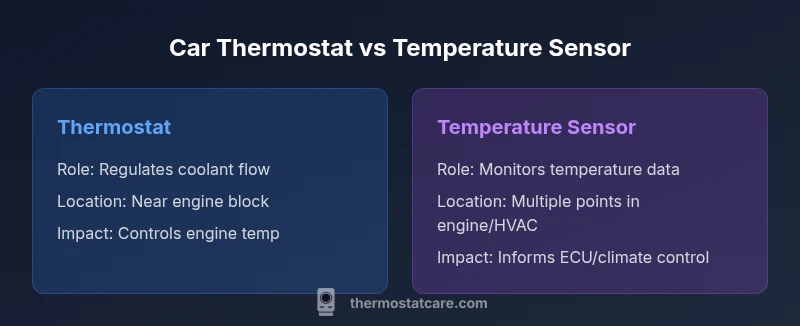
The core distinction is purpose: the thermostat is a regulator that modulates coolant flow; the temperature sensor is a data source that informs decisions. Placement also varies: thermostats are typically mounted in the coolant path near the engine, while sensors are distributed across the cooling loop, intake, exhaust, and HVAC systems. The performance impact mirrors these roles: a healthy thermostat maintains stable engine temperature, reduces wear, and enables efficient warming up. A healthy sensor delivers accurate temperature data for correct fuel planning, reliable gauge readings, and comfortable cabin climate. In the broader car thermostat vs temperature sensor car landscape, the thermostat’s failure tends to produce obvious overheating cues (gauge spikes, steam, heater loss), whereas sensor faults may produce subtle misreadings or improper HVAC behavior. Thermostat Care recommends testing both components in tandem when diagnosing temperature anomalies.
Real-World Scenarios: When to Inspect Each
Consider these practical situations:
- Overheating or thermostat sticking: check the thermostat for proper opening temperature, mechanical sticking, or leakage. If the gauge climbs quickly or the cooling fans stay on too long, a thermostat issue is likely.
- Inconsistent temperature readings or poor climate control: inspect temperature sensors for drift, wiring faults, or sensor heater issues that could distort data.
- Long warm-up periods combined with reduced heater output: thermostat issues may be the primary cause, but verify sensor readings to rule out data misinterpretation by the ECU.
- Erratic gauge behavior or intermittent codes: a faulty sensor might mimic thermostat symptoms; use diagnostic tools to verify actual coolant temperature and sensor data.
Thermostat Care’s guidelines highlight the importance of testing both components and correlating symptoms with readings rather than assuming a single fault.
Common Troubleshooting Steps for Thermostats and Sensors
A practical approach begins with the simplest checks and moves to more complex diagnostics:
- Confirm coolant level and inspect for leaks; ensure the radiator and fans operate normally.
- Check thermostat operation: measure temperature at which the engine begins to warm and the cooling fans engage. If the gauge behavior is inconsistent, test the thermostat opening temperature and ensure it moves freely.
- Validate sensor data: compare ECU readings with a dedicated scan tool, check sensor wiring for damage, and inspect connectors for corrosion.
- Look for diagnostic trouble codes (DTCs) related to coolant temperature sensors or climate control sensors and verify with multi-sensor data.
- Consider environment and vehicle usage: short trips and heavy loads can influence sensor readings and thermostat performance differently. Thermostat Care recommends a structured diagnostic approach to avoid misdiagnosis.
Maintenance and Replacement Considerations
Maintenance planning for these components should align with vehicle age, mileage, and observed symptoms. The thermostat, when well-sealed and clean, should last many years, but exposure to heat and coolant contaminants can accelerate wear. Replace if you notice sticking, slow response, or coolant leaks around the housing. Temperature sensors often outlast thermostats but can drift over time or fail due to wiring damage. When replacing one component, assess the other for wear or compatibility, as misaligned data or regulation can undermine overall cooling performance and climate control. Thermostat Care emphasizes using OEM-recommended parts and ensuring the cooling system is properly flushed during maintenance.
Diagnostic Tools and Practical Tips for DIYers
For DIY diagnostics, you’ll benefit from a few essential tools and best practices:
- Reliable temperature gauge or scan tool to observe real-time coolant temperature data.
- A hand-held infrared thermometer can provide independent readings at the thermostat housing and radiator inlet for sanity checks.
- Visual inspection of hoses, clamps, and the thermostat housing for leaks or wear.
- A controlled test drive with data logging to observe how thermostat opening and sensor readings respond to temperature changes.
- Reference service manuals and dealer data for your specific make and model to ensure you’re testing within spec. Thermostat Care recommends documenting symptoms and correlating them with actual readings to avoid misdiagnosis.
Choosing the Right Diagnostic Approach
When faced with ambiguous symptoms, start with the simplest, most impactful tests. If the engine overheats or the heater performance is poor, prioritize thermostat operation checks. If readings appear inconsistent or the climate control behaves unexpectedly, focus on sensor diagnostics. Use a two-pronged approach: verify physical condition and test data integrity. A structured plan reduces unnecessary part replacements and increases diagnostic accuracy. Thermostat Care’s method emphasizes correlating physical symptoms with sensor data and verifying the actual coolant temperature along with ECU-reported values.
Comparison
| Feature | Car Thermostat | Temperature Sensor (Engine/ECU) |
|---|---|---|
| Primary role | Regulates coolant flow to maintain engine temp | Monitors temperature data for ECU and climate control |
| Location | In the coolant path near the engine block | Distributed across engine, intake, exhaust, and HVAC systems |
| Control vs monitoring | Active regulator (controls flow) | Passive sensor (provides data) |
| Impact on performance | Affects warm-up, steady operating temp, and cooling efficiency | Affects fuel mixtures, ignition timing, and climate accuracy |
| Common failure symptoms | Overheating, long warm-up, gauge spikes, heater loss | Inaccurate readings, fluctuating gauges, poor climate control |
| Replacement/maintenance interval (typical) | Can last many years; replace if sticking or leaking | Sensor life varies; replace on drift or codes |
Upsides
- Clarifies which component governs temperature control vs sensing
- Guides targeted diagnostics and maintenance
- Improves diagnostic accuracy and safety
- Prevents misdiagnosis by separating roles
- Assists budgeting for replacements
The Bad
- Can be confusing for non-technical users
- Costs vary by vehicle and part quality
- Not every symptom cleanly points to one component
- Diagnostics require proper tools and knowledge
Thermostat and temperature sensor roles are complementary; prioritize thermostat checks for overheating and sensor checks for readings.
In most cars, overheating strongly points to thermostat issues, while unreliable gauges point to sensor faults. A dual-check approach yields the most reliable diagnosis and prevents unnecessary part swaps.
Questions & Answers
What is the main difference between a car thermostat and a temperature sensor?
The car thermostat regulates coolant flow to control engine temperature, while a temperature sensor monitors temperature data for the ECU and climate control. The thermostat is an active regulator; the sensor is a passive data source. Understanding this distinction helps prevent misdiagnosis during troubleshooting.
The thermostat actively controls coolant flow, and the sensor passively reports temperature data to the car’s computer.
Where is the thermostat typically located in most cars?
Most thermostats are located in the housing of the coolant system near the engine block or water pump. Access can vary by make and model, but it’s generally in the upper part of the cooling system where coolant flows to the radiator.
Typically near the engine block in the thermostat housing.
Can a faulty temperature sensor cause engine overheating?
A faulty sensor can give erroneous readings that lead the ECU to mismanage cooling, potentially causing overheating in some cases. More often, overheating results from a thermostat issue or cooling system fault, but sensor faults can mask the true cause.
Yes, a bad sensor can contribute to overheating by giving wrong data, but thermostat or cooling problems are usually the root cause.
How do you diagnose thermostat vs temperature sensor problems?
Start with simple checks: coolant level, leaks, and physical thermostat movement. For the thermostat, test opening temperature and response time. For sensors, compare readings with a scan tool and inspect wiring. Use both to confirm whether the issue is control or data-related.
First check the coolant and thermostat movement, then verify sensor data with a scan tool.
Should I replace both parts at the same time?
Not always. Replace only the component that shows clear wear or failure, but inspect the other for signs of wear or drift. If symptoms point to both, replacement in one service may be efficient—ensure the cooling system is checked and tested after any change.
You don’t always need both, but inspect the other for wear and test after replacement.
What to Remember
- Inspect thermostat first when overheating symptoms appear
- Verify sensor data with a reliable diagnostic tool
- Keep cooling system clean and coolant at proper levels
- Use a structured, symptom-to-data approach
- Prioritize OEM parts and documented maintenance intervals